
George Will


http://www.jewishworldreview.com --
LIKE THE PUDDING that Winston Churchill famously rejected with the words "it has no theme," the presidential campaign, until recently, was not about anything. But a spate of recent polls indicates that the theme of the campaign is the electorate's remarkably broad resistance to Al Gore's attempted courtship.
A Los Angeles Times poll shows George Bush with an eight-point lead (51-43). He leads by 21 points among married voters. The "gender gap," meaning Republican weakness with women, has disappeared: Bush is supported by 48 percent of women, Gore 46. Bush leads by 14 points among married women (two-thirds of the female electorate), has a 16-point lead (55-39) among men and has the support of one-fifth of Democratic men. Among self-described independents, his lead is 16 points. He leads Gore in every age cohort except voters 65 or older, and in every income group except those earning $20,000 to $40,000. Gore's lead in those two groups is small.
A New York Times poll shows Bush leading among men and women, Catholics and northeasterners. All this in spite of the fact that on a range of issues many people favored Gore's positions.
A veteran Democratic consultant, speaking on condition of anonymity, says the public gives Gore no credit for the economy's performance. He is not regarded as an important maker of Clinton administration economic policy. (Neither is Clinton considered the architect of the Greenspan Boom.) The public does not think the boom is primarily a product of government policy. The long boom seems almost a force of nature, and it seems durable, which undercuts Gore's attempts to frighten voters into thinking that the things they value (prosperity, peace, the welfare state, the family puppy) are so fragile that Bush might destroy them, inadvertently (with "risky schemes") if not malevolently.
Also, Gore hurt himself with what was perceived as an opportunistic split with the administration regarding Elian Gonzalez. This confirmed many voters' suspicions that Gore's hunger for office is unseemly. In "A Man for All Seasons," an exasperated Thomas More runs his hands up and down his friend Norfolk and exclaims, "Is there no single sinew in the midst of this that serves no appetite of Norfolk's but is, just, Norfolk?" Gore's behavior regarding Elian made Gore seem to be appetite, straight through.
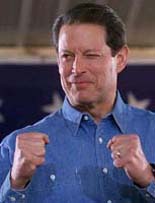 |
| Al(pha) Gore |
This year may resemble 1980. For Bush today, as for Ronald Reagan then, the key to winning is just reaching a threshold of presidential plausibility. In May 1980, with Soviet forces in Afghanistan, with the humiliation of the hostage crisis in Iran compounded by the fecklessness of invading Iran with eight helicopters, with stagflation giving rise to a "misery index" (the sum of the inflation and unemployment rates, which peaked at 19.6 in 1980), perhaps four-fifths of the electorate did not want to reelect President Carter.
Nowhere near that many voters had decided by May 1980, or would eventually decide, to vote against Carter. But there was scant enthusiasm for reelecting him. So Reagan's principal task was to seem acceptable. As late as the single debate on Oct. 28, polls showed the race in a virtual dead heat. In the debate, Reagan's performance, particularly his amiable "There you go again" response to Carter's charge that he was a threat to Medicare (this was a Carter version of Gore's by now almost comic mantra about Bush's having a "risky scheme" about this and that), convinced enough voters that he was a safe alternative to Carter.
In 1980 disagreeable conditions made change seem imperative. Today pleasant conditions make change seem safe. This defines Bush's task and Gore's problem. Bush must project presidential stature and select a running mate who augments the perception that he is a safe choice. The breadth of Gore's current weakness, in spite of the fact that voters seem to prefer his positions to Bush's on many issues, suggests that he himself--his persona--is not attractive beyond, or even throughout, the Democratic

Comment on JWR contributor George Will's column by clicking here.

05/15/00: Majestic Avenue
05/11/00: Just How Irrational Is the Exuberance?
05/08/00: Home-Run Glut
05/04/00: A Lesson Plan for Gore
05/01/00: The Hijacking of the Primaries
04/28/00: The Raid in Little Havana
04/24/00: Tinkering Again
04/17/00: A Judgment Against Hate
04/13/00: Tech- Stock Joy Ride
04/10/00: What the bobos are buying
04/06/00: A must-read horror book
04/03/00: 'Improving' the Bill of Rights
03/30/00: Sleaze, The Sequel
03/27/00: How new 'rights' will destroy freedom
03/23/00: Death and the Liveliest Writing
03/20/00: Powell is Dubyah's best bet
03/16/00: Free to Be Politically Intense
03/13/00: Runnin', Gunnin' and Gambling
03/09/00: And Now Back to Republican Business
03/06/00: As the Clock Runs Out on Bradley
03/02/00: Island of Equal Protection
02/28/00: . . . The Right Response
02/24/00: Federal Swelling
02/22/00: Greenspan Tweaks
02/17/00: Crucial Carolina (and Montana and . . .)
02/10/00: McCain's Distortions
02/10/00: The Disciplining of Austria
02/07/00: Free to Speak, Free to Give
02/02/00: Conservatives in a Changing Market
01/31/00: America's true unity day
01/27/00: For the Voter Who Can't Be Bothered
01/25/00: The FBI and the golden age of child pornography
01/20/00: Scruples and Science
01/18/00: Bradley: Better for What Ails Us
01/13/00: O'Brian Rules the Waves
01/10/00: Patron of the boom
01/06/00: In Cactus Jack's Footsteps
01/03/00: The long year
12/31/99: A Stark Perspective On a Radical Century
12/20/99: Soldiers' Snapshots of the Hell They Created
12/16/99: Star-Crossed Banner
12/13/99: Hubert Humphrey Wannabe
12/09/99: Stupidity in Seattle
12/06/99: Bradley's most important vote
12/03/99: Boys will be boys --- or you can always drug 'em
12/01/99: Confidence in the Gore Camp
11/29/99: Busing's End
11/22/99: When We Enjoyed Politics
11/18/99: Ever the Global Gloomster
11/15/99: The Politics of Sanctimony
11/10/99: Risks of Restraining
11/08/99: Willie Brown Besieged
11/04/99: One-House Town
11/01/99: Crack and Cant
10/28/99: Tax Break for the Yachting Class
10/25/99: Ready for The Big Leagues?
10/21/99: Where honor and responsibility still exist
10/18/99: Is Free Speech Only for the Media?
10/14/99: A Beguiling Amateur
10/11/99: Money in Politics: Where's the Problem?
10/08/99: Soft Thinking On Soft Money