
Don Feder

always a lost cause
http://www.jewishworldreview.com -- IN "THE PATRIOT," the Mel Gibson movie that opened last weekend, there's one particularly poignant scene. A young Continental soldier -- Gibson's son in the story -- is in camp after another crushing American defeat. Among the effects of a fallen comrade he finds a tattered flag. As he reverently examines it, a grizzled veteran tells him, "It's a lost cause."
The American fight for independence, in fact, ,was the mother of all lost causes. England had a trained, highly disciplined professional army, led by competent if unimaginative generals.
American forces rarely numbered more than 20,000. Most were militia, a contentious, undisciplined crowd with elected officers.
Prior to Yorktown, there were notable American victories -- Trenton, Princeton, Saratoga and Cowpens. But the mightiest empire on earth could absorb those defeats and more.
Our losses put us constantly on the brink of extinction -- the fall of Ft. Washington (3,000 Americans taken prisoner), Brandywine Creek, the bloody snows of Valley Forge, the defection of our ablest battlefield commander (Benedict Arnold), army mutinies in 1780 and 1781, Camden and the capture of New York, Philadelphia and Charleston.
Arguably, but for the formidable leadership of George Washington, a French fleet and those tenacious freeholders the British dismissed as peasants, the Crown would still be taxing our tea and the Fourth of July would be a footnote in history.
At some point in "The Patriot" it struck me: For most of our history, America has been a lost cause. If we won the revolution by the skin of our teeth, we clung to independence by our fingernails in the War of 1812. The British burned our capital. The only American victory anyone remembers, which kept England from seizing the mouth of the Mississippi, was won by an army of frontiersmen, freedmen, Indians and pirates, led by a general best known for fighting duels.
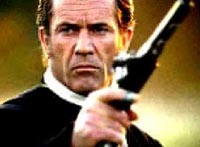 |
| Gibson in "The Patriot" |
The Civil War was another nearly lost cause. The Confederacy had hands down the better generals and soldiers. The early battles saw rank upon rank of blue coats led to the slaughter. The Union was saved by a president with less than a year of formal education and a general with a fondness for the bottle who graduated near the bottom of his class at West Point.
Between 1918 and 1940, American preparedness declined to the point where, when we entered World War II (with another famous defeat), Hitler considered the American military a joke. Eisenhower laughed all the way from Normandy to the Elbe.
In the late 1970s, it looked like we were losing the Cold War, with America still reeling from Vietnam and Watergate, the Soviets advancing from Afghanistan to Nicaragua and a peanut farmer in the White House. A decade later, the Berlin Wall fell and the Kremlin went into receivership.
Today, once again, the American cause seems doomed -- the retreat of English as our common tongue, the multiculturalist assault on all we hold dear, American trade dollars arming communist China, the U.S. armed forces turned into a laboratory for bizarre social experiments and a draft-dodger as commander in chief -- from the man who reputedly could not tell a lie to the man who could be disbarred for lying under oath.
In a recent survey of seniors at 55 of our most prestigious colleges, only 23 percent were able to correctly identify James Madison as the principal framer of the Constitution. Nearly 80 percent earned a D or F on a high-school level American history test.
Is the cause lost at last? Not when there are still millions of us who remember what America once was. Not when there's an upsurge in patriotism in times of crisis, like the Gulf War. Not when the public response to books like "The Greatest Generation" and movies like "Saving Private Ryan" (and the applause I heard at the end of "The Patriot") shows the flame still burns.
It's time to take up the ragged banner, patch it and carry it once more into battle. The odds may be overwhelmingly against us. But destiny, it seems, is on our side.
If, in the coming engagement, you're a flag short, there's one on the
mantle of the fireplace in our living room, folded in a triangular shape. It
was presented to me at the funeral of my father, another

JWR contributing columnist Don Feder's latest book is Who's Afraid of the Religious Right. Comment on his column by clicking here.

