
Mona Charen

http://www.jewishworldreview.com --
JAN KARSKI, the first person to alert the West about the Holocaust of
Europe's Jews taking place behind German lines, died last week. He was 86. A
Polish patriot who had repeatedly escaped death at the hands of both the
Nazis and communists, Karski settled in the United States after Poland was
sold out to the Soviets at Yalta. He taught international relations at
Georgetown University -- a prosaic second act to a life whose first chapters
were marked by such courage and heroism that it takes your breath away.
The New York Times, along with newspapers from Warsaw to London to Jerusalem, have paid tribute to this hero with lengthy obituaries. He is among those lauded by Israel as one of the "righteous gentiles."
Karski was born to a Catholic family in the city of Lodz in 1914. A brilliant student, he was snatched up by the Polish diplomatic service. But as war approached, Karski enlisted in the army. He was serving as a cavalry officer in 1939 when Poland was invaded by the Germans and the Soviets (part of the Hitler/Stalin Pact). Karski was captured by the Russians. Somehow, he managed to convince his captors that he was a private instead of an officer -- a lucky or shrewd disguise since nearly all of the other officers imprisoned with Karski were massacred by the Soviets at Katyn Wood. Karski escaped.
He next became an agent of the Polish underground and, in 1940, was captured and horribly tortured by the Gestapo. Rather than risk telling what he knew, Karski slit his wrists. The Nazis put him in a hospital where he was promptly rescued by an underground commando team.
In 1942, Karski was contacted by Jews of the Warsaw Ghetto and asked if he would like to witness what the Nazis were doing to the Jews. Karski consented. Wearing a disguise of old rags and a blue Star of David armband, Karski climbed through a freshly-dug tunnel into the Jewish ghetto. He saw emaciated children, dead bodies lying in the streets and starving people with expressionless eyes. He personally watched two overweight boys in Hitler Youth costumes shooting the starving Jews for sport and laughing when their bullets found a target. "Remember this, remember this," his guide, a Jewish lawyer, kept murmuring as they surveyed the hellish scenes.
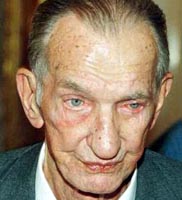 |
| Karski |
Some of those trains went to Treblinka, where nearly all who survived the journey would be gassed. But as The New York Times explained, some cars were simply abandoned on sidings until the people inside died of starvation or suffocated.
To get word to London and Washington, Karski had to travel through occupied Europe disguised as a German. Because he was certain that his Polish accent would give him away, he first had three teeth pulled. The swelling would serve as an excuse for being unable to talk. After an arduous trip with countless close calls, Karski reached the free world.
He was able to meet with Anthony Eden in London and hand over the microfilm he had smuggled in the hollowed out base of a key. But the foreign minister was unmoved, saying Britain had done enough by accepting 100,000 Jewish refugees. In the United States, Karski met with Felix Frankfurter. "I am unable to believe you," the only Jewish Supreme Court Justice said.
Karski also met privately with Roosevelt and came away doubting that he had influenced the president. But others say the meeting convinced Roosevelt to form the War Refugee Board.
Rare enough are men and women willing to risk their lives for those they
know and love. What made Karski such a jewel was his willingness to do so
for strangers -- merely for the sake of simple decency. "And flights of
angels sing thee to thy

Comment on JWR contributor Mona Charen's column by clicking here.

