
Mona Charen



http://www.jewishworldreview.com --
SO YOU THINK things are bad today? Wade into David Frum's fascinating
evocation of the 1970s, "How We Got Here: The '70s, The Decade That Brought
You Modern Life -- For Better or Worse" and count your blessings.
The '60s tend to get all the ink, Frum argues, but it was in the '70s that things really began to fall apart. It was a decade roiled by exploding crime rates, public and private corruption of every kind, declining product quality, frightening inflation, the meltdown of traditional family values, and the triumph of judicial usurpation. The decade was the high water mark for Soviet expansion and featured a series of American humiliations abroad that began with Vietnam and ended with the hostages in Tehran.
Demoralization was the order of the day, in both senses of the word. "In 1964, Frum writes, "according to the University of Michigan's annual poll, fewer than one-third of Americans endorsed the complaint that 'the government is pretty much run by a few big interests looking out for themselves.' Sixty-four percent took the sunny view that government is run 'for the benefit of all.' Fourteen years later, the proportions were almost exactly reversed. Sixty-seven percent glumly espoused the 'few big interests' answer; only 27 percent endorsed the 'benefit of all' alternative."
In the 1970s, Americans embraced mountebanks and con men of every variety -- from Werner Erhard (ne Jack Rosenberg) of EST fame, to Uri Geller, (master of bending spoons), to the bogus cosmology of Erich von Daniken. The nation's baloney detector was cast into the attic for most of the decade, giving fantasy and nonsense a long run.
"How We Got Here" zooms from close-up to panorama like a swiftly moving camera. In the chapter titled "The Courage to Divorce," Frum finds those nuggets of popular wisdom that explain so much. The best friend in the hit film "Kramer vs. Kramer" speaks for her time when she says of Mrs. Kramer, who walked out on her husband and very young son, "You may not want to hear this, but it took a lot of courage for her to walk out of here."
Women changed dramatically and, it seems, permanently in the 1970s. They tossed aside premarital chastity like yesterday's newspaper. Men underwent correspondingly huge reversals. For generations, men had gone to any lengths to defend and uphold the honor of their women, even fighting duels to the death. But in the 1970s, men suddenly and amazingly easily accepted the idea that "their" women had had many lovers before them (and might take a few after).
Americans once admired strong but silent types like Gary Cooper and John Wayne. But the '70s saw "a vast shift in the emotional climate, a kind of global moistening. The president wipes away tears when he tours hurricane disasters; coaches' voices catch at their teams' annual banquets; fathers snuffle at their daughters' weddings. In 1972, the front-runner for the Democratic nomination ... Sen. Edmund Muskie, destroyed his hopes by appearing to break down and weep during a reply to an editorial attack upon his wife by a New Hampshire newspaper. Today, those tears would float Sen. Muskie into the White House."
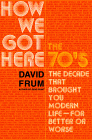 |
| Purchasing this book -- linked in first paragraph -- helps fund JWR |
There is much more: a lucid explanation of the inflation that ravaged the nation; a lengthy reminder of the busing disaster; and a primer on food (the one area in which things improved during the 1970s).
With enormous detail and yet broad perspective, "How We Got Here" is
essential reading for those who want to better understand, well, just about

JWR contributor Mona Charen reads all of her mail. Let her know what you think by clicking here. Please bear in mind, though, that while all letters are read, due to the heavy amount of traffic, not all letters can be answered.

