
Cathy Young


http://www.jewishworldreview.com --
IS 1999 GOING TO BE "the Year of Ayn Rand"? So says the press
release for My Years with Ayn Rand, the new edition of the memoir by
Nathaniel Branden, former disciple and lover of the novelist/philosopher
who championed individualism, reason, and capitalism. The made-for-cable
film The Passion of Ayn Rand, mainly a story of the Rand-Branden affair,
premiered last month. There's a new postage stamp honoring Rand. The
Chronicle of Higher Education reports that her work is becoming a
respectable subject of scholarship, such as the recently published Feminist Interpretations of Ayn Rand
edited by Chris Matthew Sciabarra
and Mimi Reisel Gladstein.
The popular appeal of Rand's novels Atlas Shrugged and The Fountainhead endures half a century after publication. Her books sell over 300,000 copies every year, and are cited by many as a major influence on their lives. She continues to generate strong feelings, positive and negative. On one Internet book forum, the section devoted to Rand is titled, "Ayn Rand: Love Her or Hate Her?"
But is there anything in between?
In my early twenties, I had my own Ayn Rand phase, though even then I was put off by her dogmatic streak. In a college paper, I noted that "sometimes you get the impression that 'being rational' means 'agreeing with Ayn Rand.'" And back then, I didn't even know that in dealings with friends and followers, this defender of the free mind brooked no dissent.
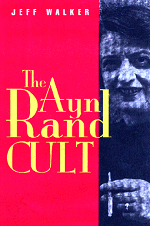
This was just one paradox in the life of a woman whose vision of a rational universe allowed no possibility of paradox. (An account of the dark side of Rand can be found in the bitter and tendentious but interesting new book The Ayn Rand Cult by Jeff Walker.) She held up respect for reality as the highest virtue yet displayed an exceptional capacity for evading reality -- such as pretending that her meek, passive husband was akin to her towering literary heroes. She asserted that she could account rationally for all her emotions; yet her conduct in the affair with Branden progressed from irrationality to near-insanity.
 |
Still, Rand's work has much to offer. The Fountainhead is an electrifying paean to independence, creativity, and artistic integrity; its themes of the contrast between the creator and the parasite, and between true self-sufficiency and the self-defeating quest for power, are brilliantly developed. Rand's defense of the free market as the foundation for human freedom was clearly ahead of its time. And while often extreme in her caricatures of other philosophers, she was prophetic about the modern intellectuals' flight from reason and knowledge.
Rand's vision of pride, joy and achievement as man's estate captures a vital aspect of reality to which religion, philosophy and literature have often given short shrift. But it is only one aspect of reality. It is true in some sense that the human mind is sovereign; it is also true that it is severely limited. It is true that human beings can be masters of their fate, and that they are often in the grip of forces beyond their control. Joy and tragedy, reason and paradox are both parts of the universe.
Rand, no doubt, would rather have seen her vision rejected outright than accepted as one of several competing truths. But ultimately, such acceptance is the best, most enduring future her work can have.
And that's
just another paradox of the legacy of Ayn

JWR contributor Cathy Young is co-founder and vice-president of the Women’s Freedom Network and author of Ceasefire! Why Women and Men Must Join Forces to Achieve True Equality Send your comments to her by clicking here.

06/04/99: Clash of the PC titans
05/28/99: Majoring in porn?
05/25/99:Solving the 'NEA-problem'
05/14/99: Feminists lost the war of ideas when they dismissed Friedan
05/07/99: Littleton lesson: Even in tragedy there's 'gender politics'
04/29/99: Question 'reality'
04/21/99: ‘If you get caught in NYC ...
04/16/99: ‘This is the way we shoot down
Americans!’
04/12/99: Who drives away drop-out dads?
03/31/99: Time for a battle for ‘men’s reproductive rights?’
03/26/99: Left refuses to let bygones be bygones
03/18/99: Do both sides in the ‘mommy-wars’ misuse science?
03/12/99: EXTRA! EXTRA! Va. court rules violence is an equal-opportunity offender
03/04/99: Do even known-liars
deserve the presumption of innocence?