
Cathy Young


(JWR) ---- (http://www.jewishworldreview.com)
AN UNSPEAKABLE HORROR is, by definition, beyond words. Yet there has been no shortage of
words said on the tragedy in Littleton, Colo., where two high school students shot 36 of their
classmates, killing 13.
Not surprisingly, everyone wants to tie the shooting to his or her pet cause: religion, family, violent entertainment and video games, school discipline, the “masculinist culture.” And, of course, gun control.
Some of the arguments are shaky. Did the decline of religious faith contribute to the shooting? Littleton appears to be a highly religious community where evangelical Christianity is a strong influence.
What about family breakdown? Eric Harris and Dylan Klebold came from stable two-parent families. It seems inconceivable that the parents would not have known that their boys were worshiping Adolph Hitler and building bombs in the garage; but teen-agers can be good at hiding things from parents.
One might blame the “progressive” attitude that parents must respect their children’s privacy and not monitor their Internet activity, but we don’t know if the Harrises and the Klebolds embraced these notions.
There’s also the issue of community responsibility. At Columbine High School, the boys openly wore swastikas and armbands proclaiming “I hate people,” gave the “Heil Hitler” salute and made a video for class in which they walked through the school halls shooting students in an eerie preview of the massacre.
Have the schools become too tolerant of nonconformism, or too big and impersonal?
When conservatives and libertarians note that all the recent mass school shootings have
happened in public schools and extol private schooling, this can be seen as another attempt to
convert a tragedy into political capital. 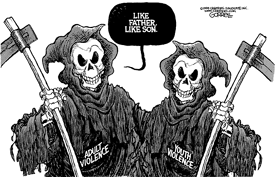 Still, it’s true that private schools are far less shy about
enforcing norms of civilized behavior, and that in a school with 2,000 students it’s hard to pay
individual attention to kids, even with caring teachers. Accounts of life at Columbine High also
portray a climate of extreme cliquishness and rampant bullying by school athletes — which
does not justify but may partly explain the killings.
Still, it’s true that private schools are far less shy about
enforcing norms of civilized behavior, and that in a school with 2,000 students it’s hard to pay
individual attention to kids, even with caring teachers. Accounts of life at Columbine High also
portray a climate of extreme cliquishness and rampant bullying by school athletes — which
does not justify but may partly explain the killings.
And the “toxic culture”? Unquestionably, movies, TV, music and video games today expose kids to far more graphic, macabre violence than earlier generations. But sometimes the logic gets confused: Are teen-agers desensitized by fantasy killings that are deceptively “clean” or too explicitly gruesome? While Harris and Klebold often played a violent video game called Doom (which, however, has monsters and not people as targets), there’s no evidence that other recent school shooters were addicted to such games.
Likewise, it may intuitively make sense that the death-obsessed “Goth” subculture and the cult of Satanism-dabbling rocker Marilyn Manson can only lead to trouble; but there have been no other sensational crimes linked to these trends.
Gun control seems like an obvious solution. Yet guns were common in this country, especially in the West and the South, 50 or 60 years ago — but teen-agers did not walk into schools and start firing at their classmates. At the same time, America has always been a more violent society than Europe. In 1990, the non-firearm-related murder rate in the United States was at least three times higher than the total murder rates in Japan, Sweden or Switzerland (where guns are legal). And gun control laws won’t stop teens bent on destruction from building deadly bombs.
In part, it’s the qualities that many of us cherish about America — the respect for
individualism, the relative weakness of social controls, the expectation that each person must
find his or her own path in life — that make our social order more precarious. We can seek a
better balance between individualism and community, freedom and social norms. We can try
to prevent tragedies like Littleton. But we must be humble enough to remember that our best
efforts may not be

JWR contributor Cathy Young is co-founder and vice-president of the Women’s Freedom Network and author of Ceasefire! Why Women and Men Must Join Forces to Achieve True Equality Send your comments to her by clicking here.

04/21/99:‘If you get caught in NYC ...
04/16/99:‘This is the way we shoot down
Americans!’
04/12/99: Who drives away drop-out dads?
03/31/99: Time for a battle for ‘men’s reproductive rights?’
03/26/99: Left refuses to let bygones be bygones
03/18/99: Do both sides in the ‘mommy-wars’ misuse science?
03/12/99: EXTRA! EXTRA! Va. court rules violence is an equal-opportunity offender
03/04/99: Do even known-liars
deserve the presumption of innocence?