
Cathy Young


(JWR) ---- (http://www.jewishworldreview.com)
THE RENAISSANCE OF NEW YORK CITY in the five years of Rudolph
Giuliani's tenure as mayor -- the decline in unemployment and welfare
dependency, the cleaner streets and subways, and above all the sharp drop
in crime -- has been reported and celebrated nationwide. But not by
everyone: most of the city's left-leaning intellectuals have reacted to
these developments with undisguised dismay.
In an exchange earlier this month in the online magazine Slate, two such literati, authors and academics Ellen Willis and Stanley Aronowitz, earnestly discussed whether Giuliani's rule was similar to Slobodan Milosevic's policies of ethnic cleansing in Yugoslavia (a little too extreme after all, they decided) or merely to the régime in Singapore which keeps the streets clean and safe while suppressing civil liberties. Of course, last time I checked, no newspapers critical of the Mayor were being banned in New York, but maybe that's a minor detail.
This is not to deny Rudy's dictatorial streak. Even some who appreciate his achievements note that the Mayor, a former prosecutor, still has a prosecutorial rather than a mayoral temperament. He once went to court trying to suppress a magazine ad that made innocuous fun of him. He is notoriously impatient with critics.
His crusade against X-rated establishments has undoubtedly helped
make many once-seedy neighborhoods more livable, but it has also had
overtones of self-righteous moralism -- which turned both ridiculous and
slightly Orwellian when the Mayor suggested that good citizens should snap
pictures of their less virtuous brethren coming out of sex shops. 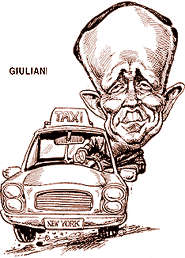 And, as
historian and policy expert Fred Siegel notes in The New Republic, after
achieving spectacular success in cracking down on crime during his first
term, Giuliani unwisely channeled his single-minded zeal into efforts to
curb jaywalking and banish law-abiding street vendors from busy streets.
And, as
historian and policy expert Fred Siegel notes in The New Republic, after
achieving spectacular success in cracking down on crime during his first
term, Giuliani unwisely channeled his single-minded zeal into efforts to
curb jaywalking and banish law-abiding street vendors from busy streets.
Yet the success of the anti-crime crusade remains a great achievement. Has it come at the cost of civil liberties? The recent tragic death of Amadou Diallo, the African immigrant who was mistaken for a suspect and shot 41 times by policemen from the special Street Crimes Unit, has prompted Giuliani's detractors -- such as Willis and Aronowitz -- to depict his rule as a reign of police terror.
Others, however, observe that the overall incidence of the use of deadly force by the police has been cut by 50 percent under the Giuliani administration.
Siegel makes the interesting argument that as crime drops and people feel less terrorized by thugs, they become more likely to resent minor unpleasant brushes with the cops. Yet it is still true that traditionally, the main gripe residents in poor minority communities have voiced against the police is not brutality but neglect -- failure to protect to enforce the law and to protect the law-abiding citizens from the criminals.
To the left-wing intelligentsia, Giuliani's victories in the war on crime are fundamentally illegitimate because they have been achieved by law-and-order tactics that hold criminals responsible for crimes, not by efforts to address the "root causes" of crime such as poverty, racism, and social injustice. But the fact is that it is predominantly poor people, and minorities in particular, who suffer from crime, and not just in the sense that they are its primary victims.
There is a good argument to be made that if poverty leads to crime, crime also perpetuates poverty. The costs of doing business in crime-ridden neighborhoods are too prohibitive. So businesses shut down, or move, or fail to open in the first place, leaving residents with fewer services and fewer jobs. Under Giuliani, both Harlem and the South Bronx are enjoying an economic revival.
Giuliani's arrogant and inflexible personal style may have contributed to the level of racial and political tensions in New York (exploited by demagogues like the Rev. Al Sharpton). But make no mistake: it's not the "oppressed" who believe that the presence of hookers, junkies and derelicts adds spice and vibrancy to urban life, or who are more bothered by Disney theaters than by open-air drug markets.
It's the
literati who still haven't outgrown radical

JWR contributor Cathy Young is co-founder and vice-president of the Women’s Freedom Network and author of Ceasefire! Why Women and Men Must Join Forces to Achieve True Equality Send your comments to her by clicking here.

04/16/99:‘This is the way we shoot down
Americans!’
04/12/99: Who drives away drop-out dads?
03/31/99: Time for a battle for ‘men’s reproductive rights?’
03/26/99: Left refuses to let bygones be bygones
03/18/99: Do both sides in the ‘mommy-wars’ misuse science?
03/12/99: EXTRA! EXTRA! Va. court rules violence is an equal-opportunity offender
03/04/99: Do even known-liars
deserve the presumption of innocence?