
Cathy Young

drop-out dads?
(JWR) ---- (http://www.jewishworldreview.com)
THE U.S. DEPARTMENT OF HEALTH AND HUMAN SERVICES has started a
public service ad campaign directed at fathers who don't live with their
children, with the slogan, "They're your kids. Be their dad."
Commendably, the campaign stresses that children need a father's love as well as his money. But is it the right answer to fatherlessness?
Like much of today's rhetoric, the initiative assumes absent fathers are absent by choice. As HHS Secretary Donna Shalala put it, "While many noncustodial fathers eagerly support their children, too many choose not to be a part of their child's life financially or emotionally."
But to start with, most divorced fathers did not choose the divorce. Two-thirds of divorces involving children are initiated by mothers, usually not because of the husband's desertion or abuse but because of general discontent with the marriage.
Nor do most divorced fathers choose to be noncustodial parents.
 In
a Stanford University study in the late 1980s, 70 percent said they wanted
sole or at least joint physical custody. While most dads do not seek
custody, it's not always for lack of interest. Many feel they have no
chance of prevailing, or wish to spare themselves and the children a
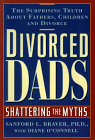
custody battle. In his 1998 book Divorced Dads: Shattering the Myths,
Arizona State University psychologist Sanford Braver reports that just one
in six divorced fathers (compared to two-thirds of mothers) get the
custodial arrangements they wanted.
In
a Stanford University study in the late 1980s, 70 percent said they wanted
sole or at least joint physical custody. While most dads do not seek
custody, it's not always for lack of interest. Many feel they have no
chance of prevailing, or wish to spare themselves and the children a
custody battle. In his 1998 book Divorced Dads: Shattering the Myths,
Arizona State University psychologist Sanford Braver reports that just one
in six divorced fathers (compared to two-thirds of mothers) get the
custodial arrangements they wanted.
What's more, relatively few noncustodial fathers actually abandon their children. The majority see them regularly and rarely default on child support if they are steadily employed.
(On average, noncustodial parents claim to pay 90 percent of the amount owed and custodial parents claim to receive 70 percent.)
Over half of "deadbeat parents," according to a recent Wisconsin study, earn less than $6,000 a year.
Fathers who do disengage from their children are often driven away.
They feel that they are denied any real say in their children's upbringing and that their ex-spouses disrupt their relationship with the children. In her study of divorced fathers, Virginia Polytechnic Institute professor Joyce Arditti found that nearly 20 percent felt said the mother's interference with visitation was a serious problem. Indeed, mothers confirm this: 25 to 40 percent admit at least sometimes denying visits to the father to punish him for something.
"Driven-away dads," as Braver calls them, are much more likely to default on their financial obligations -- and not always because they refuse to pay as a form of protest. The fights over visitation may leave them so traumatized as to impair their earning ability, or cause them to run up huge legal bills and "support their attorneys instead of their children," in the words of one activist. Some make the agonizing decision to give up.
Our society deplores father absence, but does little to protect father presence. In many states, it's all but impossible for a father to even get joint legal custody -- which gives him equal say in decisions about children's education, medical care, etc. -- unless the mother agrees.
He can rarely stop his child from being relocated thousands of miles away.
(Any proposals to limit a mother's freedom to move have been decried as sexist, but a father's freedom of movement is restricted just as much if he wants to be near his kids.)
Even custodial mothers who violate court orders by denying the father access to the children rarely suffer legal consequences, despite recently passed laws against visitation interference.
Neither liberals nor conservatives have shown much interest in the problems of disenfranchised fathers. Liberals -- and feminist in particular -- tend to see fathers' demands as a threat to women's rights. Most conservatives cling to the stereotype of divorced fathers as irresponsible males who walk out to sow their wild oats.
But maybe the HHS
should launch a new ad campaign directed at the courts and at some
custodial mothers, with the slogan, "They're his kids. Let him be their

JWR contributor Cathy Young is co-founder and vice-president of the Women’s Freedom Network and author of Ceasefire! Why Women and Men Must Join Forces to Achieve True Equality Send your comments to her by clicking here.

03/31/99: Time for a battle for ‘men’s reproductive rights?’
03/26/99: Left refuses to let bygones be bygones
03/18/99: Do both sides in the ‘mommy-wars’ misuse science?
03/12/99: EXTRA! EXTRA! Va. court rules violence is an equal-opportunity offender
03/04/99: Do even known-liars
deserve the presumption of innocence?