
Cathy Young



http://www.jewishworldreview.com --
MAYBE THERE'S FINALLY a way in which the Russians are luckier than we
are: their presidential elections are already over.
Of course, if our presidential race leaves much to be desired, that goes triply, at least, for Russia's Election 2000. First, the outcome wasn't really in doubt: the only question was whether Vladimir Putin, Boris Yeltsin's handpicked successor, would get more than 50% of the vote and avoid a runoff (he did). What's more, while international observers dismissed claims of voter fraud, they noted that the elections couldn't properly be called "fair." Many of the print and broadcast media remain state-owned, and they unsubtly favored Acting President Putin.
Extraordinarily, too, Putin has refused to say much about what he intends to do, except in generalities about strong government, protecting the elderly, better education, and so forth. Most of the people who voted for him seem to be most impressed by his image as a man of action -- action that includes a brutal war against the rebellious Chechnya.
While Putin remains enigmatic, some things in his past and recent record are troubling for anyone who wants Russia to be a free, civilized society. He is a veteran of the Soviet KGB who reinvented himself as a reformer -- but who, to this day, openly takes pride in his service in the bloody secret police force and defends its role in Russia's history.
The fact that Russians voted for a strong leader and a strong government doesn't necessarily indicate a turning away from freedom. Law and order, after all, is a popular theme with American voters. Without a government that can enforce the laws and protect citizens' rights, no market economy or free society can exist. But what is Putin's vision of the government's role and its relationship to society?
Russia's new leader proclaims his respect for a free press, yet his short stewardship has seen one of the most disturbing episodes in post-Soviet Russian journalism: the detention of Andrei Babitsky, a reporter perceived as overly sympathetic to the Chechen rebels, and the secrecy that surrounded his fate for weeks. Putin has also expanded the authority of government agencies to classify documents as secret.
An orderly society à la Putin may also be is a militarized society. In a New York Times column, Russian-born journalist Masha Gessen reports that he has re-established military training in high schools (abolished in 1989) and mandatory training exercises for reservists.
Is there a bright side?
Well, there is the fact that Russia had an election in which the people had a choice, however imperfect.
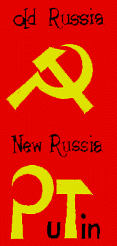 |
| Gado, Daily Nation, Kenya |
It is a sign of better times, too, that Putin has repudiated a sordid attack on his liberal rival Grigory Yavlinsky on a state-run TV channel -- a report that baldly appealed to prejudice by linking Yavlinsky to homosexuals and Jews. (Under the old regime, no one was embarrassed about anti-Semitism, let alone gay-baiting.) And while the coverage of Yavlinsky on state TV in the last days of the campaign was vicious, he received mostly positive treatment on the private Independent TV network and on a channel financed by the Moscow city government. There is no longer a monopoly on opinion and information, even if the deck is stacked.
Still, in the end, a political system must have more to say for itself than "we're not a totalitarian dictatorship anymore." Russia remains caught in a painful transition; if it doesn't move forward, it will backslide, not toward the old regime but toward less freedom, less openness, more hostility to the West. So far, Putin seems to be taking steps in that direction.
It
remains to be seen if he takes any steps forward, toward the orderly but free
society to which he pays lip service in his

JWR contributor Cathy Young is co-founder and vice-president of the Women’s Freedom Network and author of Ceasefire! Why Women and Men Must Join Forces to Achieve True Equality Send your comments to her by clicking here.
