 |
|
|
Jewish World Review April 4, 2000 / 28 Adar II, 5760
http://www.jewishworldreview.com --
The Central Conference of American Rabbis' decision last week to support
Reform rabbis who choose to officiate at same-sex commitment ceremonies is
causing a good deal of grumbling in some Reform lay circles, as well it
should.
For Orthodox Jews, who regard the revelation at Sinai as no less an
historical fact than any other mass-witnessed, recorded and entrusted event,
the shock of Reform rabbis sanctioning acts the Torah considers deeply
sinful was somewhat mitigated. After all, the Reform movement was built on
rejection of the Torah's divine origin and the binding nature of its laws.
This latest move was but a new manifestation of that old repudiation.
For many other Jews, though, who had never given the historicity of Sinai
much thought but had come to feel most comfortable in Reform temples, the
recent move has brought about a crisis of conscience.
They are right. For while all the Torah's laws are binding on all Jews, its
directives regarding the deepest and most holy realm of human relationship,
the sexual, are in a category of their own. They cannot be labeled rituals,
observances or even simple prohibitions; they comprise the essence of a
deeply Jewish concept English-speakers call morality --- a concept long
embraced by much of the non-Jewish world, which, according to Jewish
tradition, is likewise charged with its adoption.
To be sure, and contrary to popular assumption, no sexual orientation itself
is condemned by the Torah. Axiomatic to Jewish law is that only acts and
willful attitudes (like nurturing desires that are wrong) can be prohibited,
not initial proclivities. Among the acts, however, that the Torah clearly
regards as immoral -- regardless of the actors' sexual inclinations or
self-definition -- is sexual congress between men (and, to a lesser degree,
between women).
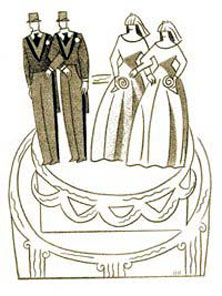 DEFINING MORALITY DOWN
By Rabbi Avi Shafran
 It is widely known
that the Reform leadership's cautious endorsement last May of certain
traditional Jewish practices was largely laity-fueled. Reform Jews who are
not afraid of returning to their Jewish roots are certainly chagrined at the
violence their leaders visited last week on a deeply Jewish value. Even,
however, for many Reform Jews who may never have been greatly troubled by
their movement's jettisoning of the kosher laws or the Sabbath, this
most recent decision was somehow... different.
It is widely known
that the Reform leadership's cautious endorsement last May of certain
traditional Jewish practices was largely laity-fueled. Reform Jews who are
not afraid of returning to their Jewish roots are certainly chagrined at the
violence their leaders visited last week on a deeply Jewish value. Even,
however, for many Reform Jews who may never have been greatly troubled by
their movement's jettisoning of the kosher laws or the Sabbath, this
most recent decision was somehow... different.

But aren't homosexuals fixed in their orientation, unable to sexually relate to the opposite gender? Interestingly, though much of the modern psychiatric community would answer that question in the affirmative, there is an abundance of sociological and ethnological evidence, both ancient and contemporary, that weighs in with a powerful no. History is replete with accounts of societies, like that of ancient Greece, where men were expected to live as homosexuals for a number of years and then marry and raise families.
Or, for an example closer to historical home, take the sixties countercultural icon Lou Reed, who lived and openly self-identified for many years as sexually unconventional but who has since settled into a heterosexual life. There may be a predisposition to homosexuality, as there may be to other behaviors deemed immoral by the Torah, but none of them are beyond human control.
Isn't love, though, all that really counts? Most certainly not. Even in the most libertarian contemporary minds, acts of adultery, incest or bestiality are rejected as immoral and unsanctioned, although the case for love might well be made in each of those examples. Many will no doubt bristle at the comparison of those practices to homosexual unions and protest that no one is currently promoting "open", brother-sister or man-pet "marriages".
 The bristlers, though, might take a moment to consider how the
average person -- or, for that matter, the average Reform rabbi -- a century
ago would have reacted to the sanctioning of the sexual union of
two men or two women that the Reform movement has now endorsed. The fact is
inescapable: Once morality is gravely injured, it bleeds profusely.
The bristlers, though, might take a moment to consider how the
average person -- or, for that matter, the average Reform rabbi -- a century
ago would have reacted to the sanctioning of the sexual union of
two men or two women that the Reform movement has now endorsed. The fact is
inescapable: Once morality is gravely injured, it bleeds profusely.
And equally inescapable is another fact, an uncomfortable, but trenchant one: The engine that is empowering acceptance of homosexual acts both in larger society as well as, now, among Reform leaders, is nothing other and nothing more than the contemporary credo of self-centeredness, the conviction that (with apologies to Alexander Pope) "whatever one feels like doing is right" - the polar opposite of the very essence of 3000 years of Jewish tradition, of the profound Jewish idea that only what G-d has instructed us to do is right..
It would be tragic enough were any religious group to abandon the very concept of morality. That a Jewish group has now chosen to do so (and amid much hoopla and self-congratulation) should be a source of deep shame to all Jews.
But especially to the many thoughtful Reform laymen and laywomen who hearts are closer to the Torah than those of their religious leaders.
May they
have the courage of their
convictions.



01/12/00: Friendly words from a surprising place
12/03/99: The original spin on Chanukah
11/09/99: Heart and soul
10/26/99: Recidivist parents
07/17/99: Wake Up Call?
06/14/99: A Remarkable Reform Manifesto
03/26/99: Message In A Bottle
03/09/99: The Times and The Timeless
01/20/99: Black Hats, Bad Guys
12/10/98:
Bringing Wall Street
Wisdom To the Quest for
'Jewish-Continuity'
7/06/98: Jaded
7/01/98: Full disclosure