 |
|
|
Jewish World Review Dec. 10, 1998 / 21 Kislev, 5758
Rabbi Avi Shafran
AN AMBITIOUS PROGRAM to send any willing Jew in the world
between the ages of 15 and 26 to Israel for ten days was recently
put before the public eye. The "Birthright Israel" plan,
intended to help fuel Jewish identity and continuity, is
impressive, to be sure. And expensive; it is expected to cost
$300 million over five years, a sum that will be initially
financed by the Israeli government, a group of North American
Jewish philanthropists and the Council of Jewish Federations.
Only a truly hardened cynic could dismiss so
well-intentioned an effort out of hand, yet the gnawing sound you
hear is the suspicion that free tours of Israel may prove less
effective than expected, or even, G-d forbid, counterproductive.
Many are the tales, to be sure, of confused or uncommitted
Jews who came to discover their roots and their lives' direction
in the Holy Land, whose very atmosphere, the Talmud teaches us
after all, is a catalyst to wisdom. But there is also much in
Israel, especially these days, that could conceivably have a less
than salubrious effect on unguided Jewish souls.
The plan, after all, will be offering, according to The New
York Times, "kibbutz trips, archeological trips, hiking treks,
ecological journeys and historical trips" -- fare that could just
as easily disillusion young visitors as inspire them. The
kibbutz movement has hardly been a successful engine of Jewish
(or even kibbutz) continuity; hiking trails in Israel may not
always compete favorably with the Appalachian Trail -- and what
is an "ecological trip" anyway? Historical tours might indeed
raise some consciousnesses, but that would largely depend on what
elements of Jewish history would be presented, and from what
perspective.
THE JEWISH STATE AS THE JEWISH FAITH
Leaving entirely aside the question of why anyone would deem
the Jewish religious heritage in need of a substitute, there can
be little doubt that, for better or worse, the Jewish State is
clearly less inspiring today to many Jews than it was during the
heady days of the 1960s.
Those, for instance, who found it relatively easy to discern
forces of good and of evil when a host of Arab nations ruthlessly
threatened Israel more than three decades ago are less likely to
perceive the persistence of that threat today. Things like
Yassir Arafat's astonishing ability to preach coexistence and
peace to some audiences (even as he preaches entirely diametric
ideals to others) and the press's incessant portrayal of Israel
as intransigent, and worse, make it even harder to see things as
they once were so clearly perceived by so many, like the younger
Mr. Steinhardt.
Even many of those who may once have reveled in the romantic
"my might and the strength of my hand" notion of temporal Jewish
assertion of power and right to the Jewish land have become
disillusioned of late with the rude intrusion of geopolitical
realities on the Zionist dream. Israel's leaders, once
effectively worshipped in this camp, are often perceived as the
Jewish enemy. These days, to recast a famous expression, it is
hard to be a secular Zionist.
LOW ASPIRATIONS
The comparison bears reflection. In popular American
culture, the bar mitzvah celebration has sadly but undeniably
come to be associated not with the commencement of commitment but
with its smothering. What once heralded (and for some still
heralds) a life of intense Jewish identity has devolved, in so
much of the Jewish community, into a celebration of
teen-agerhood, a vehicle for parental excess, a showcase for
disk-jockeys and movie themes. It would be superfluous (not to
mention depressing) to detail here the "state of the contemporary
American bar mitzvah," but the picture, most of us know, is not a
pretty one.
Thus, ironically, should the "Birthright Israel" plan live
up to the hope for it Mr. Steinhardt expressed (though did not
likely intend), it will not only fail to solidify Jewish
continuity but become just another means for Jews to embrace
materialism and what passes for popular culture in modern times.
BELABORING THE OBVIOUS
Might there even, though, be shorter and surer roads, even
in the Diaspora, to the goal of connecting Jews to other Jews and
to Judaism? Like, for instance, the road Jews traveled for the
nearly 2000 years during which visiting or settling in Eretz
Yisroel was hardly an option. The very same road, as it happens,
that still remains the most effective means of ensuring Jewish
identity, praxis and life: a true, traditional Jewish education
for every precious Jewish child.
Every study of Jewish continuity, after all, has identified
Jewish education as the most potent predictor of future Jewish
identity and Jewish living; the more years of Jewish education --
and the more traditional the curriculum -- the stronger the
resultant bond with the Jewish people and faith.
So many Jewish day schools and yeshivos are suffering
economically, and so many Jewish parents are unable to afford
them. For lack of nothing more than dollars, priceless Jewish
souls -- from a wide assortment of Jewish backgrounds -- are
being denied the opportunity to learn to read Hebrew, to study
Torah, to hear what Shabbes is like.
There can be little doubt that scholarships to help present
Jewish children with their spiritual heritage could deeply,
relatively quickly and radically change the demographic landscape
of the Jewish world.
Does it not seem self-evident that, if the will is there to
empower Jewish continuity, the way -- or, at very least, a major
way -- is the Jewish school?
PUTTING GOALS ABOVE POLITICS
But all truly open-minded Jews, whatever their
denominational affiliations, realize that a traditional Jewish
education -- one that regards Judaism as it has been regarded for
three millennia -- is, simply stated, the most potent ensurer of
Jewish continuity. If Jewish knowledge and observance are good,
it must be admitted that more of each is surely better.
And the undeniable, happy reality is that, for decades, day
schools have been resolutely, sensitively and successfully
servicing children from a variety of Jewish backgrounds.
Some of those children may have since come to identify
themselves as Orthodox, others not. But all were equipped with
the opportunity and knowledge to make Jewish choices -- and all
graduated more likely to remain conscious and dedicated parts of
the Jewish people (not to mention more likely to visit or live in
Israel).
ADMITTED CHUTZPAH
Their very success in their fields, though, might well
afford us hope that, when re-evaluating their plan, the dedicated
philanthropists will be keenly aware of the fact that here, as in
every important endeavor, the wisest investments are those placed
in proven stocks.
 Bringing Wall Street Wisdom
To the Quest for 'Jewish-Continuity'
Bringing Wall Street Wisdom
To the Quest for 'Jewish-Continuity'
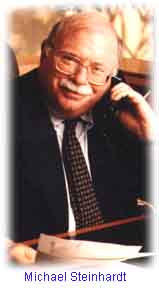 Michael H. Steinhardt, the successful Wall Street money
manager who, along with Seagram Company chairman Charles R.
Bronfman, is initiating the program, feels that association with
Israel is the ultimate goal. "Israel has frankly... for much of
my life," he told The Times, "been a substitute for [Jewish]
theology."
Michael H. Steinhardt, the successful Wall Street money
manager who, along with Seagram Company chairman Charles R.
Bronfman, is initiating the program, feels that association with
Israel is the ultimate goal. "Israel has frankly... for much of
my life," he told The Times, "been a substitute for [Jewish]
theology."
An unintentionally depressing comparison, as it happens, was
employed by Mr. Steinhardt himself, in an interview with a
reporter for The Forward. He expressed his hope, the weekly
reported, that the program will achieve success and establish a
tradition even "perhaps analogous to [the] bar mitzvah."
"Birthright Israel" is a good, if imperfect, idea, and its
originators deserve credit for putting forth any plan -- not to
mention the considerable funds they have pledged -- to intensify
Jewish identity and commitment. Were the program amended,
though, to maximize the Jewish impact of the gift it offers
Diaspora Jews -- were it, say to provide them ten days (or even
two of the ten) in an Israeli yeshiva catering to those from
overseas or in an adult beginner's program sponsored by an
outreach institute -- it might well be a truly giant step in the
right direction. Surely no objective observer would deny that
Torah-study is an integral part of the contemporary Israeli
scene.
Some, of course, might wax cynical at the thought of
concentrating communal Jewish efforts on institutions that, all
said and done, are overwhelmingly Orthodox. Coming from Orthodox
quarters, to be sure, the notion would certainly seem
self-serving at best.
Still, it is probably audacious for members of the Orthodox
community to suggest to people like Mr. Steinhardt and Mr.
Bronfman how best to maximize investments of funds; they are,
after all, proven successes in the worlds of high finance and
business.

Rabbi Avi Shafran is Director of Public Affairs for Agudath Israel of America,
the largest grass-roots Orthodox Jewish group in America.


7/06/98: Jaded
7/01/98: Full disclosure