 |
|
|
Jewish World Review Oct. 13, 2000 / 14 Tishrei, 5761
http://www.jewishworldreview.com --
'LAST NIGHT he was hated by G-d, disgusting, distant, abominable [in His
eyes]. . . . Today he is beloved, a delight, close, a dear friend.''
So does Maimonides describe the great power of teshuva (repentance) to transform a
person and his relationship with G-d.
Yom Kippur is the most joyous day on the Jewish calendar. Reflecting on
our actions of the past year, we find ourselves amazed at how alien they
seem to us, how little they comport with our vision of ourselves as
essentially good people. That
sense of alienation from our own actions paradoxically makes us aware of
something higher within us --- a G-dly essence that is belied by our deeds.
Our horror at the disparity between deeds and essence fills us with a
determination to live our lives in closer conformity with our true essence
and a feeling of confidence that we have the power to do so. That
determination leaves us feeling uplifted and
once again worthy of sustaining a relationship with G-d.
Five days later, on Sukkos, we give concrete expression to that newfound
feeling of closeness to G-d by leaving our permanent dwellings to sleep
under the stars. The makeshift sukkah inspires a feeling of intimacy with G-d
by reminding us of
His protection and of the Clouds of Glory that sheltered our ancestors
during 40 years of wandering in an inhospitable desert.
All the festivals entail rejoicing, but only Sukkos is called "zman
simhaseinu" -- the season of our rejoicing. No other holiday creates the
same feeling of intimate connection with G-d.
When the Temple stood, the height of the celebrations during Sukkos was
the pouring of the water libation on the altar every morning. Today Jews
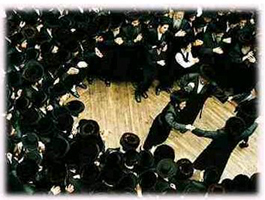
still join together during Chol Hamoed, the festival's intermediate days, to dance together until the early
morning, in memory of the Simhas Beis Hashoeva, the festivities connected to
the drawing of the water for
the libation.
The water libation also expressed this idea of connection. When G-d
separated the upper and lower waters during the six days of creation, the
Midrash says, lower waters rebelled and threatened to destroy the world in
their efforts to be rejoined to
the upper waters. Only when they were promised that they would be poured on
the altar in the Temple as part of the Divine service, were they placated.
The Midrash teaches us the necessity of connecting the lower, physical
world to the higher world of spirit. The world of spirit is unitary,
reflecting the unity of its source. Only through an awareness of the
essential unity underlying all of existence is any real connection
possible -whether it be to our fellow man or G-d. To the extent that we
perceive ourselves as purely physical beings, we become conscious of our own
boundaries and separation from others.
Interestingly, every event that Jews colloquially refer to as a simha marks
the joining of an individual to something outside of him- or herself. Bris
mila (circumcision) celebrates the entry of the infant boy into a covenant extending back
over 4,000 years to our
forefather Avraham. At the age of mitzvas, we rejoice that another young Jew
has become a full-fledged member of the Jewish community, with all the
mutual responsibilities that entails. And at weddings we join in the
happiness of two formerly discrete individuals who become bound to one
another in a union that allows for
the fullest realization of their potential.
THE world was created in such a way that people experience some degree of
mutual dependency and are forced to interact with one another. But the
nature of that interaction is not determined.
It can be grudging, something forced upon us by external necessity. At best,
relationships thus created are narrowly legalistic, contractual, based on an
ongoing assessment of the quid pro quo for everything we do for someone
else.
At worst, other human beings are seen primarily as competitors for limited
pieces of the pie. Temporary bonds of mutual advantage may be formed, but
exploitation of others for the attainment of personal pleasures is more
often the rule.
Judaism, however, offers another model --- one which recognizes our essential
connectedness to others. It is a model based on being a giver and not a
taker.
A taker experiences life as hunger, and convinces himself that his hunger
can be sated by the acquisition of more and more material goods and
pleasures. He seeks to expand his personal space, but he can never lose
consciousness of his boundaries
and all that divides him from others.
The giver, by contrast, is someone transcends his boundaries. By giving
to others, he comes to love them and view them as an extension of himself.
One wise woman noted ironically: 'Nothing I acquired endured; everything
I gave away lasted forever.'' What we attain is consumed and gone; even the
pleasure of consumption is quickly forgotten. But what we give to another,
even a smile on the
street, endures, for it forms a bond between us.
That sense of relationship, of transcends the narrow confines of oneself, is
the essence of Jewish happiness. Not by accident do our sages designate a
large measure - -a heaping tablespoon, for instance -- as a 'laughing''
measure.
'The soul that blesses grows fat,' reads the verse (Proverbs 11:25). The
Vilna Gaon explains: One who brings joy to others and shares in their
success, without jealousy, swells with joy, whereas 'envy causes the bones
to rot'' (Proverbs 14:30).
On Yom Kippur, we achieve a heightened awareness of the divine spark
within us, even as we are shamed by the recognition of all that we have done
to dim the light and betray the gift bestowed upon us. Once we recognize
that spark within us, we are prepared to see it in our fellow human beings
as well, and to connect with them and G-d over Sukkos --- zman
True Jewish rejoicing
By Jonathan Rosenblum


JWR contributor Jonathan Rosenblum is a columnist for the Jerusalem Post and Israeli director of Am Echad. He can be reached by clicking here.


09/28/00: Making Rosh Hashana work
08/31/00: We won't ever learn, will we?
07/26/00: The light still burns bright
06/29/00: Convenient scapegoating of 'fanatics'
06/19/00: American judicial activism pales when compared to Israel's
06/05/00: When nobody else would, religious Jews were willing to save their brethren; they should be
honored, not charged
05/05/00: Love your fellow Israeli --- except if he is religious
04/24/00: Of matzas and mitzvas
04/10/00: Israel's post-democracy
04/03/00: Welcome to 'democratic' Israel, where speaking your mind can land you in jail --- especially if you are religious
03/27/00: The ADL's latest imaginary enemy: Religious Jews
01/25/00: Of ostriches and cavemen
01/14/00: Reason and madness
12/27/99: Love sweeter than wine
11/23/99: When lives are at stake, where's Israel?
11/17/99: The Mortara Affair Revisited
11/08/99: Do religious Jews make lousy parents?
10/28/99: Heed the heart
10/14/99: Tell me you love me --- please!
09/27/99: True Jewish rejoicing
08/09/99: Many Ways to be a Jew
07/15/99: Abolish the Three Weeks?
07/08/99: Memories of Entebbe
05/17/99: The Leadership We Deserve
05/10/99: Still a Hero
03/18/99: Israel’s "Little Rock Central High"?
02/19/99: Why Israel's fervently-Orthodox are mad-as-....
02/04/99:Those ornery Orthodox: Myth and Reality
02/01/99: Keep the money