 |
|
|
Jewish World Review April 24, 2000 / 19 Nissan, 5760
"HASTE IS SATAN'S most trusted companion," Hafez Assad
is reported to have told President Clinton during their
recent tete-a-tete in Geneva.
Clinton, whose days in office are ticking away, was no
doubt disappointed to hear such sentiments from the
Syrian leader, whose days are rumored to be even more
dramatically numbered, He would have preferred the
attitude of Prime Minister Barak, who has bought into the
timetable for Clinton's Nobel Peace Prize bid and rushed
headlong to offer Assad the entire Golan.
Assad could have quoted Jewish sources as easily as
Syrian folk sayings. "Be deliberate in judgment," is the
very first piece of advice that has come down to us from
the Men of the Great Assembly (Ethics of the Fathers
1:l). That advice encompasses everything we do, for the
essence of our lives is the exercise of judgment.
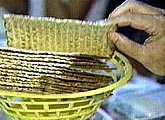
The requirement that the matza must be placed in the
oven within 18 minutes of the flour and water first being
mixed together is derived from the verse, "And you shall
guard the matzot." And the same is said to be true of
mitzvas: One cannot tarry in their performance.
From our sages' comparison of the performance of
mitzvas to the baking of matzot, Rabbi Yitzhak Hutner
pointed out, we gain a major insight.
A matza that does not make it into the oven in time is no
matza, and eating it on Passover is a very serious
transgression. Similarly a mitzva done lackadaisically is
not just missing an added beautification; the very form of
the mitzva is absent.
To understand why that should be so, we have to first
realize that the eagerness to perform a mitzva is not like
the eagerness to marry a millionaire or for fame and
adulation - both of which can engender extraordinary
efforts.
The difference lies not just in the object of desire.
Rather the eagerness to do a mitzva is a function of the
relationship of our souls to the material, created world.
Our sages compare the soul in this world to a princess
married to a country bumpkin. The princess, raised on the
delicacies of the royal palace, will never be satisfied with
anything her husband brings her. She yearns to return to
her father's house.
So it is with the soul. The soul yearns to escape the
bounds of the world of space and time. (Time, too, is an
aspect of the created world. The blessing "He who
created bereishis" -- the "beginning" -- refers to the creation
of time, writes the Vilna Gaon.) The soul seeks to be
reunited with its divine source. In this world, that desire to
unite with G-d finds its expression in the eagerness to
perform mitzvas.
The Jewish people exist outside the confines of space and
time. The normal rules of historical causality do not apply
to us. For that reason every material explanation of
history has foundered on the continued existence of the
Jewish people, raising the ire of all those, from Marx to
Toynbee, who sought to encompass all of human history
in their formulas.
Abraham was told that the fate of his descendants would
be a function of divine providence not historical necessity.
The Jewish people came into existence with the exodus
from Egypt. Precisely at the moment of our formation as a
people, G-d again removed us from the bounds of time
and gathered us together in an instant. The matza we eat
every year at the Seder is a reminder of the haste with
which we left Egypt --- a haste that left no time for
leavening.
G-d took us out of Egypt in order to give us the Torah.
The mitzvas of the Torah are our unique possession, the
reason for our special destiny. Those mitzvas should
reflect our national existence, which is above time and
space.
They must be driven by a soul seeking to cleave to G-d.
mitzvas lacking that urgency, writes the Maharal of
Prague, fall under the dominion of time. At the deepest
level, they resemble chametz on Passover.
Matza is called "poor bread." The poverty, however, is
not in the bread but in ourselves. The matza itself is
spiritual bread, composed only of its essential elements. It
symbolizes the world of spirit, which is one of simplicity
and unity.
As we eat the matza, we are reminded of how far we are
from the world of spirit. Most of us can barely digest a
week's worth of matza. Our physical selves are not at the
level to eat spiritual bread more than one week of the
year. The matza forces upon us the recognition of our
limitations: "We seek to do Your will," we cry out to
G-d, "but the leavening within, our physicality, holds us
back and slows us down." As we eat the matza this year,
may we all merit to experience the independence of a soul
removed, if only for an instant, from the limitations of time
and
Of matzas and mitzvas
By Jonathan Rosenblum
 In one area, however, we are commanded to move with
alacrity. "When a mitzva comes into your hand, don't let it
ferment (literally, become chametz.)," our sages instruct us.
They learn the requirement of hurrying to do a mitzva
from the identical Hebrew orthography of the words
mitzvas (commandments) and matzot.
In one area, however, we are commanded to move with
alacrity. "When a mitzva comes into your hand, don't let it
ferment (literally, become chametz.)," our sages instruct us.
They learn the requirement of hurrying to do a mitzva
from the identical Hebrew orthography of the words
mitzvas (commandments) and matzot.
 Prior to the Covenant of the Pieces, at which G-d
informed our forefather Abraham of the destiny of his
progeny, including their sojourn in a land not their own,
G-d first lifted Abraham above the world of the
constellations.
Prior to the Covenant of the Pieces, at which G-d
informed our forefather Abraham of the destiny of his
progeny, including their sojourn in a land not their own,
G-d first lifted Abraham above the world of the
constellations.

JWR contributor Jonathan Rosenblum is a columnist for the Jerusalem Post. He can be reached by clicking here.


04/10/00: Israel's post-democracy
04/03/00: Welcome to 'democratic' Israel, where speaking your mind can land you in jail --- especially if you are religious
03/27/00: The ADL's latest imaginary enemy: Religious Jews
01/25/00: Of ostriches and cavemen
01/14/00: Reason and madness
12/27/99: Love sweeter than wine
11/23/99: When lives are at stake, where's Israel?
11/17/99: The Mortara Affair Revisited
11/08/99: Do religious Jews make lousy parents?
10/28/99: Heed the heart
10/14/99: Tell me you love me --- please!
09/27/99: True Jewish rejoicing
08/09/99: Many Ways to be a Jew
07/15/99: Abolish the Three Weeks?
07/08/99: Memories of Entebbe
05/17/99: The Leadership We Deserve
05/10/99: Still a Hero
03/18/99: Israel’s "Little Rock Central High"?
02/19/99: Why Israel's fervently-Orthodox are mad-as-....
02/04/99:Those ornery Orthodox: Myth and Reality
02/01/99: Keep the money