
|
|
|
Jewish World Review June 19, 2000 / 16 Sivan, 5760
http://www.jewishworldreview.com --
ONE OF THE GREATEST CHALLENGES confronting
judges in any properly functioning democracy is that of
separating their personal views from their role as
interpreters of the law.
That distinction between one's private opinions and one's
duties as a judge, however, escapes our current Supreme
Court justices, who often seem to be guided by little other
than their own ideology. The court veers wildly between
cases of judicial hyperactivity in which it substitutes its
views for those of other governmental branches to cases
in which it shows the greatest deference of the other
branches.
Yet a bright thread runs through the court's selective
judicial activism: Whether it is being active or passive, the
court ultimately reaches the result supported by Meretz.
Immediately prior to the last elections, for instance, the
Supreme Court enjoined the government from closing
Orient House for violations of the Oslo Accords, even
though the closure decision was an exercise of the
executive branch's authority over foreign policy. In a
dangerous precedent, Justice Dalia Dorner speculated
(probably correctly) on the government's political
motivations.
Imagine an American court ordering a halt to American
bombing of Iraq on the grounds that the president was
motivated by a desire to distract attention from the
Monica Lewinsky scandal.
In a democracy, the price for such shenanigans is exacted
by voters at the polls, not by the courts acting as their
guardians.
By contrast, when archaeologists petitioned the court in
January to order the government to halt the destruction of
precious archaeological sites on the Temple Mount by the
Moslem Wakf, the court deferred to the government.
Justice Yitzhak Zamir admitted that the Wakf had
violated Israel's planning and antiquities laws, but found
that because of the political sensitivity of the Temple
Mount, extra-legal factors had to be taken into account
and the matter should be left to the government.
Thus, when Binyamin Netanyahu was replaced by Prime
Minister Ehud Barak, the court switched from activist to
passive mode. This past week, Zamir summarily rejected
a petition seeking the courtmartial of a soldier who
proudly told the national media how, out of ideological
opposition to the army's presence in Lebanon, he had
delayed entering a battle in which three of his officers
were killed. Zamir lashed out at the petitioner's attorney
for seeking the intervention of the court in a "military
matter" and for running to "the court for every single
thing."
The court, however, showed no such deference for
internal army procedures in the Galili case, where the
court blocked the promotion of a general who had
already been punished by the army for an improper
sexual relationship with a female soldier. Justice Tova
Strassburg-Cohen felt no compunction about second
guessing two chiefs of staffs and two defense ministers,
and offering her own view that no officer could be that
important to the army's fighting ability.
When the petitioner is a wronged young woman, the
court turns activist and substitutes its judgment for that of
the army, but when the petitioner is an army officer living
in the West Bank, he is sent home after a tongue-lashing
for trying to involve the court in matters beyond its
competence. The pattern that emerges from a comparison
of these cases reveals an underlying ideological tilt to the
court. No wonder the court's opinions so often read like
op-eds devoid of traditional legal analysis.
Justice Ya'acov Kedmi's opinion, creating a right for
teenage homosexuals to have their lifestyle celebrated on
Educational TV was devoid of any legal citation. And
Justice Dorit Beinisch's opinion in the recent "spanking
decision" could have been entitled, "my philosophy of
modern child-rearing."
Even where the court cites traditional legal materials, the
legal reasoning is a mere patina covering the ideological
agenda. Thus in overruling the parole board's decision to
parole Yoram Skolnik, the Supreme Court made a
retroactive end-run around the pardon power of the
president, who had twice commuted parts of Skolnik's
sentence. To do so, Justice Aharon Barak concocted an
argument that Skolnik remains an ongoing danger to
society based on nothing more than Skolnik's continued
adherence to a nationalist-religious ideology. The court
brushed aside the General Security Service's finding that
the danger of Skolnik's release would be "nearly zero."
The court thus gave macabre confirmation to Skolnik's
pre-hearing quip that his only chance would be to remove
his kippa and join Peace Now.
The court wore an even flimsier legal fig leaf when it
ordered the government to allow women's prayer
services at the Western Wall involving the wearing of
tallitot and the public reading of the Torah. With
Orwellian flourish, the court unblushingly declared such
services "traditional" within the meaning of the governing
administrative regulations. According to the court's
reading of "traditional," egalitarian minyanim and Jews for
Hare Krishna will also inevitably find their place at the
Kotel. And all in the name of tradition.
A constitutional court on the model of many European
countries would be infinitely preferable to the current
situation in which justices, largely selected by the court
president, and representing a very tiny slice of society,
impose their values on the society. Justices of
constitutional courts are typically selected through the
political process and represent a broad cross-section of
society. In many European countries, the justices of
constitutional courts need not even be lawyers, since, as
in Israel, so little of what they do involves interpretation of
traditional legal texts. If courts are going to willy-nilly
substitute their policy judgments for those of the executive
branch, far better that the justices be drawn from many
disciplines and represent a broad cross-section of
society.
In addition, a broadly representative constitutional court
would be much more suited to ruling on such issues as the
status of the Wall. No longer would the form of worship
at the Wall be determined by justices who empathize
more easily with the feelings of Moslem worshipers on the
Temple Mount (whom they protect from the Temple
Mount Faithful) than with those of the vast majority of
Jewish worshipers at the Wall.
Never having prayed at the Wall or even knowing many
people who do so regularly, they cannot grasp the
sensitivities of Jewish worshipers. A constitutional court's
great advantage is that it is overtly political, and would at
least allow us to call a spade a spade without
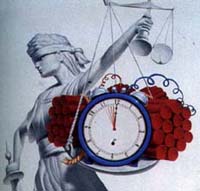
American judicial activism pales
when compared to Israel's
By Jonathan Rosenblum


JWR contributor Jonathan Rosenblum is a columnist for the Jerusalem Post. He can be reached by clicking here.


06/05/00: When nobody else would, religious Jews were willing to save their brethren; they should be
honored, not charged
05/05/00: Love your fellow Israeli --- except if he is religious
04/24/00: Of matzas and mitzvas
04/10/00: Israel's post-democracy
04/03/00: Welcome to 'democratic' Israel, where speaking your mind can land you in jail --- especially if you are religious
03/27/00: The ADL's latest imaginary enemy: Religious Jews
01/25/00: Of ostriches and cavemen
01/14/00: Reason and madness
12/27/99: Love sweeter than wine
11/23/99: When lives are at stake, where's Israel?
11/17/99: The Mortara Affair Revisited
11/08/99: Do religious Jews make lousy parents?
10/28/99: Heed the heart
10/14/99: Tell me you love me --- please!
09/27/99: True Jewish rejoicing
08/09/99: Many Ways to be a Jew
07/15/99: Abolish the Three Weeks?
07/08/99: Memories of Entebbe
05/17/99: The Leadership We Deserve
05/10/99: Still a Hero
03/18/99: Israel’s "Little Rock Central High"?
02/19/99: Why Israel's fervently-Orthodox are mad-as-....
02/04/99:Those ornery Orthodox: Myth and Reality
02/01/99: Keep the money