 |
|
|
Jewish World Review Nov. 29, 2000/ 2 Kislev, 5761
Elliot B. Gertel
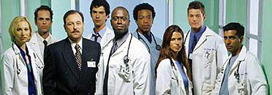
Andre Braugher (so memorable for his fine work on Homicide: Life on the Street) brings intensity and charisma to his role as Dr. Ben Gideon, who directs experimental medicine at a Boston hospital. This is television’s most positive African American characterization to date, and the series offers another fine opportunity for a black actor, a student doctor played by Russell Hornsby.
The series has made some well-taken points about African American fathers being good parents and about black physicians being treated with some prejudice. Though sensitive to the black experience, however, this series, after the first three episodes at least, seems to obsess a bit much on Jewish references. Why, I’m not sure.
From its very first episode, written by Paul Attanasio, Dr. Gideon takes on the wife of a blue blood undergoing experimental treatments. Shocked that this woman has not summoned her children to her husband’s bedside in view of the uncertainty of the treatment, he asks: "Is this some way to express latent hostility to your children?" She responds, "I’m sure that Freud works perfectly well for the Freuds, but we’re not like that." The viewer is left wondering whether the remark is a jab at Jews. Dr. Gideon reinforces that impression with the comment: "Honor thy father is like bagel. It’s no longer considered Jewish." The wealthy matron seems to convey further prejudice when she tells Gideon: "Don’t presume on this sudden friendship with my husband," as if to say that he is not of their social class (and race) and should therefore keep out of their family matters.
Yet it would seem that on "Gideon’s Crossing," not everything is as it seems. It turns out that the wife has tried desperately to get her children to see the negligent dad who has alienated them, but to no avail. She may not be racist or anti-Semitic after all, just frustrated, hurt and tired, and caught between her husband’s disease and his pattern of withdrawal from his own family. This is a series, I should add, which even bends over backwards to give the benefit of a doubt to its arch-villains -- HMO doctors! So are the references to Jews gratuitous here or devices to coax more perspective and non-bigoted thinking about all minorities?
The second episode, also written by Attanasio, would seem to indicate a commitment by the series to dismantling prejudices in creative and unexpected ways. A young female doctor is treating a man who claims that he has become ill due to toxins in the highrise to which his workplace has been moved. The doctor confronts the building’s developer, a Mr. Stein or Steinem (the elocution was not clear even to the closed caption transcribers). She greets him with the accusation that he "has been described… as being a cigar-chomping sleazy real estate developer." He tells her quite matter-of-factly that he put up a thirty million dollar building in a minority neighborhood and denies that his building is making people sick. He also insists that he does not consort with politicians in order to win favors so he can cut corners. Just when we are ready to regard him as the familiar Jewish slumlord stereotype, albeit younger and soft- spoken, he comes out with a question that seems to be a bigot’s self-indictment: Were any of the men who complained about getting sick in the building "anything but white or middle aged" -- and thus unwilling to commute to a black neighborhood? As it turns out, the man complaining of "non-specific ailments" does turn out to be unwilling to drive to the Roxbury neighborhood where his company has moved its office space.
In one fell swoop, it would seem, the writer has tricked his audience into stereotyping a Jewish man and then realizing that the problem rests in the prejudices of a third party. It’s quite a twist of plot and a lesson in revising prejudiced thinking. The point is made all the more effectively because in this episode neither the writers nor their Dr. Gideon give the benefit of the doubt to that week’s villain: the non-Western healer. When the platitude-spouting quack says of his cancer patient, "She’s so much more than her illness," Dr. Gideon, in confronting this man, retorts: "Not if it kills her she isn’t."
I wondered whether this intriguing pattern of bursting prejudices and presumptions with psychological insights would persist from episode to episode, especially insofar as the "Jewish" angle is concerned. Having seen the third episode, I’m not so sure what to expect of future offerings. For in Episode Three, penned by Eric Overmyer, we are introduced to two Jewish doctors who are given troubling dialogue, to say the least. A Dr. Fleck starts with the word, "Oy," and then proceeds to be rather untroubled about a young Asian woman’s mysterious and deteriorating ear problem. The woman is a prodigy violinist, and her father is worried that she will go deaf. Dr. Fleck jokes with a younger Jewish colleague that Beethoven’s music improved with deafness. Is Dr. Fleck supposed to represent burnt-out middle-aged physicians who make light of debilitating illness and happen to be Jewish? He refers to his younger Jewish colleague, Dr. Charry, as "Dr. Landsman," -- Yiddish for someone of similar geographical background. The more energetic and idealistic and younger Jewish doctor, Charry, asks if he can take over the case, and Dr. Fleck turns over his patient without a blink (or a wiggle of the ears).
Dr. Charry and staff are amused that the young Asian woman has a boyfriend who sneaks into her hospital room to have sex with her. They learn that she cannot tell her father about her boyfriend because he is Chinese and they are Korean. Shades of Romeo and Juliet. Yet all of a sudden the plot sounds more l.ike "Abie’s Irish Rose" in that the young Jewish doctor suddenly delivers a monologue about his parents’ threatening to disown him if he ever married a Gentile girl and of his being unhappy each day as a result. One would have hoped that a series that purported to offer multicultural perspectives would be fairer to Jewish concerns about intermarriage and less likely to make comparisons between these religious concerns and ethnic or racial biases of other communities. But no such finesse here, unfortunately, at least not yet. So far, I prefer Attanasio’s handling of Jewish themes to Overmyer’s.
Someone once observed , "When most of us are thinking, we’re not thinking. We’re just rearranging our
11/09/00: "Meet the Parents" ... but dishonor religion
Is Gideon’s Crossing purposely reinforcing prejudices?


Contributing writer Elliot B. Gertel, JWR's resident media
maven, is a Conservative rabbi based in Chicago.

07/06/00: Sacred synagogues? Not when Hollywood comes calling
06/21/00: Defunct 'Early Edition' is no loss to people of faith
03/20/00: When Black Archie Bunkers 'diss' the 'Jewish doctors'
03/07/00: Jack and Jill: Turning the table on stereotypes?
07/27/99: Popular Providence sends troubling messages about religion and science
06/14/99: May 'The Nanny,' R.I.P. --- not!
06/07/99: Suddenly Susan's Death of a Rabbi
05/13/99: During the "sweeps," religion suffers
