 |
|
|
Jewish World Review June 21, 2000/ 18 Sivan, 5760
Elliot B. Gertel
For the
past few seasons, audiences could follow good-natured Chicago pub owner Gary Hobson (Kyle
Chandler) as he dashed to save lives based upon receiving a daily heavenly "heads-up" from a "special edition" of the next morning's Chicago Sun-Times, mysteriously deposited on his doorstep along with a spiritual cat.
Chandler and his cohorts made for a most amiable cast. There was one exception: Gary's Jewish
friend, Chuck (Fisher Stevens). Each week he was more conniving, obnoxious, and disloyal than the previous. Always in constant search of a fast buck, viewers, and during one episode, even a woman rabbi he was dating, were expected to believe Chuck was basically a good guy.
Talk about a fantasy TV series.
By the series' second to last episode, and with Chuck no longer a recurring character, a far more salubrious characterization of Jews and of Jewish values finally emerged.
In it, Gary must pursue and help an amateur bounty-hunter named Mel Schwartz, even as his own sanity is already being scrutinized by a clueless court system.
Mel's recklessness as an accountant moonlighting as bounty-hunter is extremely dangerous to both Schwartz and Gary, not to mention Mel's pregnant and almost full-term wife.
Mel rebuffs Gary's help, telling him, "You're not my father, you're not my rabbi, you're not my shrink."
Still, the much younger and more centered and, after all, newspaper-prophetic Gary does not let Mel fall
into disaster.
Alarmed by Mel's unexplained absences, beset by fears and suspicions, his pregnant wife traces him to a
motel --- and arrives there in time to find that, with Gary's help, he has captured a brawny, desperate
criminal who almost killed him before Gary's arrival.
The wife is more shocked by Mel's confession of being a bounty hunter than by the possibility of an extramarital affair. "I go to bed with an accountant," she cries; "I wake up with a bounty hunter."
At this point, Mel explains his obsession with bounty hunting. "I'm an accountant and a bounty-hunter,"
he pronounces. "I'm a hyphenate." Mel says he could not stand walking into a dinner party and getting
polite and bored nods when he was queried about his accounting work. Lately, he sighs, "I've been boring
myself." So he decided to send for an audio cassette on bounty hunting and to let it guide him while he
pursues criminals as field training.
The upshot of this pleasant episode, written by Alex Taub (who did not do as well in the episode about
Chuck dating a woman rabbi) is a defense of responsible fatherhood, and, for that matter, of the ideals of
Jewish fatherhood, from Mel's wife and even from the hardened criminal. The latter opens up about his
two sons who don't care what an exciting life their father lives, but rejoice whenever he is home for
dinner and around for show-and-tell.
Mel's wife declares lovingly, "I'm proud of you. I've always been proud of you. You're smart. You're
responsible. You're loyal." When Mel protests that these are just "code words for boring," his wife
counters, "No. Never boring. This baby --- he's going to be lucky to have a dad like you."
So, not long
before Father's Day, the TV audience gets some justified praise for a "loyal" Jewish father. Noticably missing, however, is any mention if Schwartz's wife is Jewish, though she is depicted with some minor traces of the type of "neurosis" usually attributed by TV writers to Jewish women. At least no comments are made about mixed marriage --- a rare boon for TV and even for this series.
Without doubt, Early Edition , a gentle and benign effort, will enjoy popularity, particularly with younger
viewers, in perpetual syndication over "family" channels. It will be interesting to see whether the series is
embraced by Christian television. After all, the last episode, written by Carla Kettner, suggested that the
"prophecy" in the newspaper is akin to a chain letter among arbitrarily -- or, perhaps, psychically -- chosen
children whom the current designee encounters and saves at a moment of disaster. The call to assist those
in trouble is therefore a kind of cosmic "payback" for having been saved. The chosen ones are given the
opportunity to appoint their successors with the help of the ghosts of the predecessors who knighted
them.
The Jewish themes, like all the topics and characters treated on this show, are therefore to be always
bound with half-baked notions of karma, spiritism and synchronicity. As Gary says at the end of the
episode, "I think maybe sometimes we've got to say it's G-d's plan."
That is about as "theological" as the series ever got. I'm afraid that its "contribution" to American pop
religion is the message that G-d has turned over the Divine Plan to New Age notions and that Jews are, at
best, well-meaning thrill seekers who cannot appreciate their own values and teachings without
reinforcement by New Age concepts and
03/20/00: When Black Archie Bunkers 'diss' the 'Jewish doctors'
Defunct Early Edition is no loss to people of faith
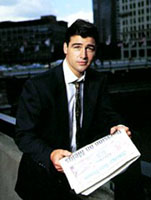
Gary Hobson (Kyle
Chandler)
and his "special" paper

Contributing writer Elliot B. Gertel is JWR's resident media
maven.

03/07/00: Jack and Jill: Turning the table on stereotypes?
07/27/99: Popular Providence sends troubling messages about religion and science
06/14/99: May 'The Nanny,' R.I.P. --- not!
06/07/99: Suddenly Susan's Death of a Rabbi
05/13/99: During the "sweeps," religion suffers
