
|
 |
|
|
|
Jewish World Review Nov. 9, 2000/ 11 Mar-Cheshvan, 5761
Elliot B. Gertel
But like much Hollywood fare these days, religion is used for farcical fodder.
For Jews, especially, "Meet the Parents" should be regarded as nothing short of offensive, making, as it does, a big point of suggesting that the most affectionate outsiders in upper class society -- those who desire to please and yet, at once, march to their own drumbeat -- are a cat and a Jew.
Audiences are expected to accept the premise that a Jew (in this case, from Detroit via Chicago) is totally out of his element on Long Island, as if there were no Jews on Long Island, and the typical Oyster Bay home belongs to a retired CIA agent.
True, the Stiller character is uncomfortable in high society, but for "comedic" purposes is rendered such a pathetic outsider that one thinks we've returned to the era of the Marx Brothers. In "Meet the Parents," the Jew who grew up in Detroit is a virtual stranger to suburban life --- and to the very concept of a family dinner.
It's not if Stiller’s character merely has a Jewish sounding last name, either. From the beginning, the movie's writers and producers want to make sure his religious affiliation is known. In an early scene, for instance, our Jewish klutz is asked to "say grace" at the first supper together with his fiancee’s family. True, the father does expect his daughter’s suitor to be able to come up with something ("You telling me that Jews don’t pray?"). And the Jewish visitor does come up with a prayer that (quite innocently?) equates prayer with servile flattery ("Kind and gentle and accommodating G-d, sweet L-rd of Hosts"). The scene suggests a Jewish discomfort with prayer (which may be true to life for many non-observant Jews, though not for Judaism) and an honest skepticism about "prayers of praise."
Given the overall context of the film, however, I would conclude that the scene is an attempt to elicit easy laughs out of a discomfort with prayer itself.
As the flick progresses, Stiller’s character eventually meets his girlfriend’s preppy, successful and multi-talented ex-fiance, whose avocation is carpentry and who is most gifted at it. The ex-fiance says that he took up carpentry in order to better follow the Christian messiah --- yet he is constantly referring to his ex's sexual charms. The bipolarity here between piety and lust comes off for a moment as an assault on the superficially "born again," but then quickly falls into place as just another easy laugh at the expense of religious vocabulary. The references here are too shallow to be a parody on religious concepts or beliefs. The audiences are willing to laugh at the chance reference. But even the religious vocabulary is not treated with any concern for accuracy.
The ex-fiance shows our Jewish guest a wooden altar that he has made for the wedding of the girlfriend’s sister, explaining: "You might call it a chuppah." A chuppah is, of course, no altar, but why get literal about such things among friends?
By the end of the film, Stiller’s character has almost burned his hosts’ house down, nearly destroyed the wedding and come close to maiming the bride due to his inability to control his impulses and his overriding concern with self-preservation and successfully lying to his girlfriend’s dad. The film is, in fact, a kind of moral comedy about truth, but with far more comedy than morality --- and not great comedy at that.
The "moral" is that lying is o.k. when you’re in love and when you haven’t really hurt anybody anyway, even if you almost have. The Jewish klutz represents a world where self-serving people find salvation to the point that they become accepted even after they are exposed for trying to cover their tracks. Since there is no more grace or gentility or honor, even, or especially, among WASP families, being a Jewish klutz who knows when he is being sneaky and selfish, is a moral edge --- at least according to this film.
"Meet the Parents," to be sure, is merely a comedy. But why should we embrace such premises, even in our entertainment? Why would we want to? And why was the crew responsible for this diversion so hellbent on knighting their Jewish lad as the nobleman of a world where honor and truth are beside the
07/06/00: Sacred synagogues? Not when Hollywood comes calling
"Meet the Parents" ... 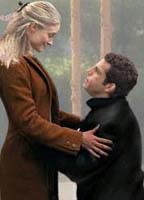
but dishonor religion


Contributing writer Elliot B. Gertel, JWR's resident media
maven, is a Conservative rabbi based in Chicago.

06/21/00: Defunct 'Early Edition' is no loss to people of faith
03/20/00: When Black Archie Bunkers 'diss' the 'Jewish doctors'
03/07/00: Jack and Jill: Turning the table on stereotypes?
07/27/99: Popular Providence sends troubling messages about religion and science
06/14/99: May 'The Nanny,' R.I.P. --- not!
06/07/99: Suddenly Susan's Death of a Rabbi
05/13/99: During the "sweeps," religion suffers
