
Cathy Young

http://www.jewishworldreview.com --
A FEW WEEKS AGO, I attended a symposium at the Cato Institute in
Washington, D.C. titled "The Rule of Law in the Wake of Clinton." Besides
the familiar themes of corruption and contempt for the law, many speakers
voiced alarm over the Clinton Administration's record on civil liberties ---
especially its efforts to expand the state's powers of surveillance over
electronic communications.
The criticism doesn't just come from the right. Left-of-center civil libertarians such as American Civil Liberties Union president Nadine Strossen and JWR columnist Nat Hentoff have castigated the current administration as one of the most hostile to civil liberties.
The Clintonian attitude toward the law is an inviting target, given that we have a President who may be disbarred for acts committed while in office. But in this instance, I wonder if the Clinton Administration is getting a bit of a bum rap.
This administration is hardly responsible for the fact that a gigantic communications revolution happened on its watch (unless Al Gore did invent the Internet). When Bill Clinton moved into the White House, the information superhighway was still a two-lane country road. Earlier administrations never had to make decisions on how law enforcement should respond to new technologies that can be used for criminal purposes. Lyndon B. Johnson and Richard Nixon hardly deserve credit for not spying on people's e-mail.
The latest government venture that many see as an assault on our freedoms is "Carnivore," a software program the FBI has used to capture e-mail going to or from a particular person. In response to the concerns of civil liberties groups and Internet service providers, the House Judiciary Committee held hearings on the subject last month. Attorney General Janet Reno will have the program examined by experts who will report to an independent panel. However, she has refused to suspend use of Carnivore pending review, as 28 mostly Republican legislators urged.
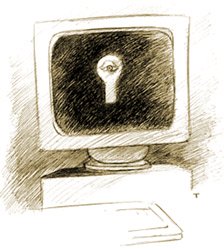 |
Privacy advocates are up in arms because, in looking for its target, Carnivore scans the e-mail of people who are not under surveillance. But, while your innocent e-mail may be scanned by a computer, it won't be seen by human eyes. The FBI says the controversial program (whose silly name is tailor-made to arouse apprehension) offers far greater specificity than other means of online surveillance, since it can rapidly collect just the "to" and "from" information in electronic messages and zero in on the target. They claim this is essentially no different from telephone wiretapping, which law enforcement agents have long been able to do with proper safeguards.
It's the safeguards that should be the focus. Some privacy advocates say that under current law, federal agents could wiretap someone's e-mail without having to show probable cause, as they must when wiretapping a phone. But one "Netizen" who defends Carnivore and dismisses the alarm as paranoid -- Jay Whitehead, co-founder of Upside Magazine and CEO of EmployeeService.com -- writes that "just like a police search of your home or a wiretap of your phone, the FBI can use its Carnivore system only with a judge's permission."
Let's face it, there are people whose electronic communications we do want the government to be able to monitor: the ones who steal the credit card numbers of Net shoppers, send out destructive computer viruses, or plot to blow up the World Trade Center. Even libertarians generally agree that the proper role of government includes protecting individuals from force and fraud. The tension between this function and the protection of individual rights from the state is something we'll always have to grapple with.
If the FBI conducts Internet sting operations that lure people into
crimes that might never have been committed otherwise -- such as buying child
pornography -- it's no better or worse than off-line entrapment. If it
wiretaps a suspect's e-mail, we need to ensure that the same judicial
oversight that protects individual rights when it comes to other types of
surveillance still applies. (In particular, we need to ensure that records
are kept of all of the FBI's online activities.) What matters is not the
medium but the

JWR contributor Cathy Young is co-founder and vice-president of the Women’s Freedom Network and author of Ceasefire! Why Women and Men Must Join Forces to Achieve True Equality Send your comments to her by clicking here.
