



 Contact The Editor
 Articles By This Author
The president's comments in a phone interview with Fox News highlight the ongoing distrust between the White House and some law enforcement officials in the wake of a nearly two-year investigation by special counsel Robert Mueller III into Russia's 2016 election interference and the Trump campaign.
"It's disappointing," Trump said when asked about Christopher Wray's role in ongoing reviews of the FBI's handling of the Russia investigation. "Let's see what happens with him. Look, the jury's still out."
Trump faulted the FBI director for "skirting" the debate surrounding the Russia investigation, although the agency and the Justice Department have insisted it has cooperated fully with those reviewing the case. He said more developments could come in the next two weeks but declined to elaborate.
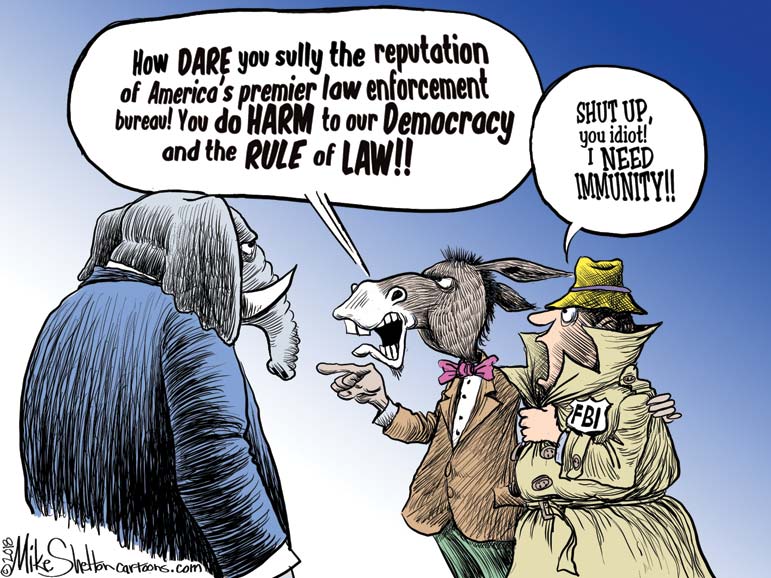
While the president continued to criticize the FBI's conduct, multiple federal law enforcement officials interviewed Friday expressed varying degrees of anger, resignation and alarm over the decision by Attorney General William Barr to abandon the prosecution of Flynn for lying to the FBI about his conversations with Russia's ambassador to the U.S. before Trump took office.
"The attorney general is supposed to be above reproach and apolitical in terms of how the department operates and how he or she as an individual operates, and he's just completely lost that," said one veteran Justice Department lawyer who, like others, spoke on the condition of anonymity for fear of retaliation. "He's Trump's attorney. He's not the country's attorney."
A day after the Flynn reversal, more than a half dozen Justice Department employees expressed similar displeasure with the move, saying they did not agree with Barr's legal rationale and that they worried about what it might portend for the agency going forward. A smaller number of law enforcement officials contacted Friday said they were basically pleased with the outcome, and were critical of decisions made by former FBI director James Comey, who launched the Flynn investigation.
Several current lawyers in the department said they were disturbed by Barr's personal intervention in cases involving Trump's friends, and a few said they or their colleagues were updating their resumes and considering leaving.
Some described being torn between wanting to leave because they feel the institution's reputation is being ruined, and wanting to stay to stem the spread of what they see as political corruption. Most cases, the employees noted, do not attract the attorney general's attention, though they still require competent management.
"It's exhausting," said one department lawyer. "You feel like it's a constant battle of you against the leadership of your country, and that's a horrible feeling."
A spokeswoman for Barr said any talk of people contemplating leaving in the wake of the Flynn decision "is not what we are hearing. In fact, we have received significant positive feedback from Department lawyers who are applauding the recommendation of U.S. Attorney Jeff Jensen."
Jensen, the U.S. attorney from St. Louis, was brought in by Barr to review the Flynn case, which had been turned over to the District of Columbia U.S. Attorney's Office after Mueller closed the special counsel's office last year. Jensen concluded Flynn's guilty plea to lying to the FBI should be dismissed because agents did not have a valid reason to be investigating him. Barr agreed.
Within the FBI, there was growing concern among employees that Wray's long-term tenure may be in jeopardy, given the president's comments.
Brian O'Hare, president of the FBI Agents Association, defended Wray in a statement Friday.
Wray "continues to lead through unprecedented challenges with a steady hand," said O'Hare, who credited the FBI director for making "the changes needed to ensure that the FBI is best positioned to deal with threats to the American people."
Barr, in an interview with CBS News on Thursday, also defended the FBI director, saying Wray "has always supported and been very helpful in various investigations we've been running." He called Wray "a great partner to me in our effort to restore the American people's confidence in both the Department of Justice and the FBI."
People close to the president, however, said Trump has complained privately that Wray has not spoken out forcefully against former officials like Comey, but they added that the president does not seem to be inclined to act on that dissatisfaction, at least not now.
"Wray is not going to be fired because there is a sense of realism, because we are in a pandemic, and it's in an election year," predicted one official, who added that Trump has little love for Wray but is not preparing to fire him.
A spokesman for Wray declined to comment on the president's remarks.
After firing Comey in May 2017, Trump nominated Wray to serve a 10-year term as FBI director, but on Friday, sought to shift the responsibility for his appointment to former deputy attorney general Rod Rosenstein, a frequent target of Trump's ire.
A former colleague of Wray's complimented Trump's decision to put him in charge of the bureau.
"I think the president made a very wise choice when he chose Chris Wray to be the next FBI director, and in my view, the director's been - since he came aboard - he's been earnestly focused on fixing and helping the department work through some very tough situations that were not of his making," said John Richter, a former U.S. Attorney who worked with Wray in the Justice Department. "So far as I can tell, he's acutely focused to getting the right outcomes, but getting them in the right way, and I expect to see more."
In a statement earlier this week, the FBI went further than it has in the past to criticize previous officials' conduct, saying Wray "remains firmly committed to addressing the failures under prior FBI leadership while maintaining the foundational principles of rigor, objectivity, accountability, and ownership in fulfilling the Bureau's mission to protect the American people and defend the Constitution."
The president's comments Friday suggest the FBI's statement did not assuage his concerns. But he heaped praise on Barr for reversing course on Flynn's case.
"These are dirty politicians and dirty cops and some horrible people, and hopefully they're going to pay a price some day in the not too distant future," Trump told Fox News.
Trump said Americans "owe a lot to Attorney General Barr," and praised his top law enforcement official as "a man of unbelievable credibility and courage." Had Barr been attorney general when the special counsel investigation began, Trump said, "he would have stopped it immediately."
"He's going to go down in the history books," Trump said.
Trump suggested he and Barr had discussed the Flynn matter at some point - though the president said he took a hands-off approach.
"I told Bill Barr, 'you handle it,' " Trump said. "I would be absolutely entitled, in theory, the chief law enforcement officer, in theory, but I said you know what, I want Bill Barr to handle it."
Trump suggested he would be vindicated further in the coming days.
"A lot of things are going to be told over the next couple of weeks," the president said, again without elaborating. Jensen's review of cases in the District's U.S. attorney's office is ongoing, and Connecticut U.S. Attorney John Durham is conducting a broad review of the Russia investigation - though there are no indications of imminent major developments in their probes.
On Thursday, Timothy Shea, a former adviser to Barr who in January was named U.S. Attorney for the District of Columbia, filed court papers seeking to dismiss the case against Flynn. Shea wrote that Flynn's interview by the FBI in January 2017 was "untethered to, and unjustified by, the FBI's counterintelligence investigation into Mr. Flynn," and that it was "conducted without any legitimate investigative basis."
The Justice Department cannot unilaterally dismiss the Flynn case. Its filing seeks U.S. District Court Judge Emmet G. Sullivan's approval to do so, and it remains to be seen how the judge will respond. In 2009, when faced with allegations of FBI wrongdoing in an investigation of the late senator Ted Stevens, R-Alaska, Sullivan appointed an outside lawyer to investigate the matter. The legal and factual basis for that move was different than in the Flynn case, but Sullivan could press Justice Department lawyers to further explain their decisions.
Trump forced out Flynn in February 2017, and when he pleaded guilty, the president tweeted: "I had to fire General Flynn because he lied to the Vice President and the FBI. He has pleaded guilty to those lies. It is a shame because his actions during the transition were lawful. There was nothing to hide!"
It is highly unusual for the Justice Department to seek to undo a guilty plea, and comes just months after Barr pressed prosecutors in another of Mueller's cases to soften their sentencing recommendation for the president's friend and former political adviser Roger Stone.
Shortly before the Justice Department abandoned Flynn's prosecution, the line prosecutor on the case, Brandon Van Grack, formally withdrew - just as the Stone prosecutors had. Only Shea, a political appointee, signed the filing.
Flynn, 61, was a senior Trump campaign foreign policy aide who went on to serve 24 days as national security adviser, the shortest tenure on record. The retired three-star Army general was forced to resign from the White House in 2017 for misstating the nature of his contacts with then-Russian Ambassador Sergey Kislyak to Vice President Mike Pence, senior White House aides, federal investigators and the news media.
In his plea, Flynn admitted he was in touch with senior Trump transition officials before and after his communications with Kislyak. The pre-inauguration communications with Kislyak involved efforts to blunt Obama administration policy decisions on sanctions on Russia and a United Nations resolution on Israel, according to his plea. He also admitted misstating his lobbying work for the government of Turkey.
Sign up for the daily JWR update. It's free. Just click here.
(COMMENT, BELOW)