
Andy Rooney
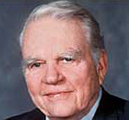
http://www.NewsAndOpinion.com | Writers try to make concessions to what interests readers but inevitably they end up writing about what interests them. I spend so much time writing that punctuation looms large in my life. However, I recognize that a lot of people couldn't care less about it-or "could care less," as the expression has become even though it doesn't make sense.
There are nine punctuation marks in that first paragraph of mine and they all serve a purpose. The period or dot used as an unequivocal stop to a flow of words, is one of the great inventions of all time. It's simple and there's no doubt about what it means. It's interesting that it has recently acquired a whole new use in computer language as ".com" When you speak it, you say, "dot com," not "period com."
I especially like dashes in a sentence, like the one in my first paragraph, although I don't think they were even an acceptable punctuation mark when I started taking English classes in the fourth or fifth grade. A dash is somewhat similar to but different from three dots in a sentence…if you know what I mean.
Commas are useful in making the meaning of a written sentence clearer to a reader but newspaper copy editors have turned against them and I don't understand why. There are many fewer commas in newspaper stories than there were 20 years ago. (I'm not sure, of course, whether it's the editors or the writers who are using fewer of them, but I often have to reread a sentence to understand it because of a missing comma.) I like using parentheses like that occasionally, too. It indicates the thought is sort of a side remark being made to the reader. If you use brackets, they convey a different meaning. Parentheses are rounded marks to set off a group of words. Brackets are a different shape, usually with right angles at top and bottom. I think of them as strong parentheses and hardly ever use them even though there are keys for them on every keyboard.
No one writes as he speaks and no one speaks as he writes, but when you put words down on paper, you ought to be able to hear yourself saying them. If you cannot, the chances are that what you have written is stilted, stiff and too formal. You can't write exactly as you speak, though, because it would be repetitive and rambling.
The advantage the written word has over the spoken word is that you can think a moment about what you want to say and how you want to say it instead of blurting it out. When we speak like that, we usually recognize that we haven't said what we meant accurately so we rephrase it and say it again. On paper, you have the opportunity to say it right the first time.
There is one punctuation mark I don't understand so I never use it. That is the semicolon. The colon is a practical divider of ideas and I often use one, but I never use a semicolon because I don't know what it does. I don't even know why it's spelled all one word instead of being hyphenated as "semi-colon."
The semicolon is a period over a comma. If you use a period, a comma, a colon, question mark, quotation mark, hyphen, dash or bracket, you know what you're doing, but what does a semicolon do? Is it sort of a colon? It is used to separate ideas in a sentence that are more different than when you use a comma but not so different as when you use a period. This bears no likeness to the use of a colon and I hereby call for a worldwide English language boycott of the semicolon!

Comment on JWR contributor Andy Rooney's column by clicking here.
03/11/02: War on a full stomach
03/06/02: Uninformed and misinformed
03/01/02: Some thoughts on aging
02/27/02: Saving is a cheap hobby