 |
|
|
Jewish World Review Dec. 22, 2000 / 25 Kislev, 5761
Antiochus and the Maccabees are long gone, but Rabbi Moshe Sherer reminds us that the spiritual struggle between Hasmoneans and Hellenists has not ended.
http://www.jewishworldreview.com --
IN THE HAFTORAH of Shabbes Chanukah, recited this year on Dec. 23 in synagogues the world over, the Prophet describes his vision:
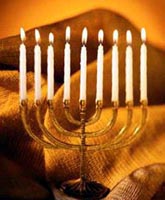
"And behold, there was a golden menorah with a bowl (gulah) on its top. (Zechariah 4:2)
Our sages declare in the Midrash that this menorah is
symbolic of Klal Yisroel, the Jewish people; and then, in a beautiful
word play, point out the word geulah, the golden bowl topping the
menorah, implies golah, dispersion, and geulah, redemption.
The menorah symbol, therefore, contains a paradox. How one
interprets this symbol in his approach to life determines whether he
takes the road to golah, and disaster, or to geulah, to victory and eternity. The events of Chanukah help us to understand how this one symbol can branch off into two such diverse ends.
The Jewish camp in the days of Antiochus was split. The Hellenists
(Misyavnim) stressed the outer forms of Judaism, the ceremonial. All
they saw in the menorah was the pure glittering gold, which pleased their
aesthetic sense. The Chashmonaim (Hasmoneans), in contrast, looked
deeper and saw pure oil, the inner warmth emanating from a light kindled
in holiness. Concern solely with the externals of religion leads ultimately
to golah, a loss of Jewish cohesiveness. The road to geulah
demands penetration to the substance, commitment to the core -- to
content.
THE MIRACLE of the one-day supply of oil that burned for eight days is central to the Chanukah theme. Many commentators have given differing
explanations as to why Chanukah celebrates an eight-day miracle,
which the author of Judaism's constitution, Rabbi Yosef Karo, points out
was actually only a seven-day miracle, since there was sufficient
oil to burn for the first day. Our sages wisely observed that the miracle of
the first day was manifest in how the Chashmonaim found the courage to light of the menorah, when logic dictated that the neir tamid (Eternal Light) would quickly dissipate.
To achieve geulah one must have this capacity to reach out for the
unattainable. Were the Jew to have been deterred by his inadequacies
and inhibited by his limitations, he would have long ago been swallowed
up in golah.
The events of Chanukah yield another significant insight. The Greeks
contaminated the oils of the Bais Hamikdash (Holy Temple). The
question arises: if the Greeks aimed to black out the menorah forever,
would it not have been suited their purpose to destroy
the oils completely instead of only contaminating them?
However, their method exposes their sinister intentions. The Greeks
reasoned: let the menorah lights burn brightly -- but let the flames
arise from contaminated oil; let them shed a false light. The Greeks
understood that the subversion of Torah would better be
achieved if they could cause the Jewish people to illuminate the world
with impure oils.
THE LIGHT THAT PENETRATES
Like the Hellenists, our generation has enthroned the externals of the
menorah, and extended this philosophy into all aspects of Jewish living.
We have taken a leaf from the lessons of the legendary marketing genius,
Elmer Wheeler, who instructed restauranteurs: "Don't sell the steak,
sell the sizzle!" By selling the sizzle of mitzvos, instead of the life-giving substance of Yiddishkeit, the spiritual hucksters have sent our generation down the golah road, instead of the road to
geulah.
Furthermore, our generation has, to a large degree, lost its belief in
miracles and has placed its faith in studies, surveys and resolutions.
They have exchanged the spiritual daring of our fathers for a cold,
pragmatic approach to Judaism. Proper goals for genuine Judaism are
often diluted because they do not seem practical. The lessons of the
one-day supply of oil of the Chashmonaim seems to have passed by our generation, as we plod along with our chilling "realism."
What is most remarkable in this analogy is that the strategy of today's Hellenist forces is so strikingly similar to the tactics of
the Greeks of old. Only the scenery has changed. Movements in Jewish life have kindled lights that they themselves have
contaminated, trampling on basic Jewish concepts. All of these
menorahs, lit by the forces that work from within to
overthrow Torah authority and classical Judaism, have contributed to the
chaos and confusion that characterize Jewish life today.
In America, for example, Jewish life can best be characterized as
glittering and dazzling on the outside, but eroded and cold on the
inside. Here, too, the modern-day Hellenists are building a Judaism
based on slogans instead of sincerity, on theatrics instead of theology.
The endless varieties of Judaism competing for the attention of the
American Jew make a pretense of saving our youth with cliches and
ceremonials. Today, they bear sad witness to the appalling results
of the policy of serving our youth adulterated spiritual lollipops
instead of inspiring them with the broad majestic sweep of our Torah.
THE CONTINUING STRUGGLE
A great rabbi once offered this explanation: The battle of the
Chashmonaim never really ended. It continues to this very day.
It was essentially a struggle against forces that set out to make the Torah a museum piece and to assimilate the Jewish masses by subterfuge and subversion. This battle to confuse and betray true Judaism still rages in our times, and thus, still engulfed in the smoke of the battle, we do not pause to rejoice. In such a continuing crisis, one must concentrate with greater vigor toward the goal of geulah. Total Torah commitment must replace tokenism. Complete concentration must replace crippling
Exploiting the Menorah ---
and the Miracle
In recent years, Madison Avenue has developed a booming Chanukah
industry in an effort to exploit the Menorah, as they did,
lehavidil, with the Christmas tree. During this season, newspaper
advertisements offer Chanukah greeting cards, Chanukah candies, Chanukah
wrapping paper. With all the hoopla, the meaning of Chanukah has had little
impact on the under-educated Jew. Contrast this with the experience of
our grandparents; many of them lit their lights in crude utensils, but
the candles they kindled penetrated every nook of their homes.

In contrast to all other of the Jewish festivals, where there is a
specific mitzvah of simcha, a commandment of rejoicing, we find no such obligation regarding Chanukah. Why? Should not the victories and miracles of Chanukah also be marked with the same degree of joy as all
other holidays?

The late Rabbi Moshe Sherer, who headed the World Agudath Israel Organization, contributed this essay to JWR's inagural issue. Send your comments by clicking here.

