
|

|
|
|
|
Jewish World Review Dec. 29, 2000 / 3 Teves, 5761
BALTIMORE DIARIST
A rabbi's smile and
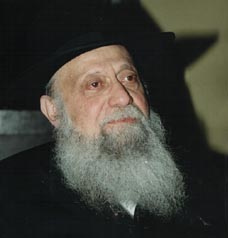
Today is the 30th day, or shloshim, since the passing of Rabbi Yaakov Moshe Kulefsky of Baltimore. We offer a personal glimpse at greatness and an insider's view into a world that most of us will never visit --- or even know exists
http://www.jewishworldreview.com --
THOSE GATHERED here know him by a variety of titles ---
his wife as "Yaakov Moshe," his five children as "Daddy,"
his forty grandchildren and twelve great-grandchildren
as "Zayde". But to us, his thousands of disciples
flooding the main study hall inside the Ner Israel Rabbinical College's
central building, or standing and shivering on the
lawn outside, listening over the speakers, Rabbi Kulefsky is
simply the Rosh Yeshiva.
The Hebrew title, literally means "head
of the yeshiva," and connotes his role as its
spiritual leader.
But in the case of Rabbi Kulefsky, it meant much more.
I remember my first encounter with the Rosh Yeshiva.
One Shabbos evening, after prayers, I approached
Rabbi Kulefsky to ask him about a point he had made during a lecture
the previous afternoon. Gently, he clasped my hand in
his right palm, and folded his left, wrinkled hand on
top of mine. Already in his seventies, and suffering
from, amongst other maladies, near blindness, he could
not see me.
But he did not recognize my voice, either.
He asked me my name and spoke with me for a
minute or so, holding my hand throughout. As I
prepared to depart, he flashed me his smile. "Oh,
what a smile he had," a rabbi would later remark in
his eulogy. That disarming smile has remained with me
for over a year. I imagine it will endure for years
to come.
No one is smiling on this bitterly cold December
morning. Rabbi Kulefsky’s death was so sudden, and so
swift. "Sure, he’s been in and out of the hospital all
year. But who imagined the end would come so soon?"
says one rabbinical student. "Only Wednesday he gave his
weekly lecture right there next to the lectern,"
he continues, pointing to a spot to the right of the
podium where the Rosh Yeshiva -- too weak to stand --
delivered his public address. Now, inches from that
spot, the rabbi lies in a fragile wooden coffin.
By eight this morning hundreds of mourners from around
Jewish Baltimore are gathering at the campus -- which sits on a lush,
ninety-acre campus in Pikesville, Maryland, and
comprises 250 high school, 350 undergraduate and 200
married fellowship students -- along with rabbinical
and communal leaders from around the country. The
sight is an awesome commentary on the man that
all have come to mourn. In forty-seven years as a
Talmud teacher in the yeshiva, and in these last
fifteen months as its Rosh Yeshiva, Rabbi Kulefsky
touched thousands of lives and imparted his teachings
to three generations of followers.
Great rabbis from around the country -- pious men
graced with flowing white beards and adorned in long,
majestic black frock coats -- mingle with young
mourners seventy years their juniors; prominent and
wealthy community leaders take their seats beside
uncelebrated laymen. Here, death has equalized not
only the dead, but the living as well. Here, our
master gone, we all are equally bereft, equally alone.
I take my place, squeezed in to a small corner of the
room where thousands have now gathered, waiting for
the officiating rabbi to begin. No one speaks, though
I do hear an undercurrent of sound, a somber chorus of
weeping. And the eulogies have not even begun.
Finally they do begin. Rabbi Sheftl Neuberger,
Assistant Dean, assumes the podium and offers words of
introduction. We sit, frozen, listening to the man who
usually leads our beautiful, lyrical prayers as
cantor, deliver measured, mournful words. No one knows
what to think; the wound is too fresh, our spirits
still numb. Thousands share the shock, the confusion,
the despair. It is not a comforting unity, but a
solemn, lonely one.
Rabbi Neuberger introduces the speakers, one at a
time. Ten leading rabbis, both from within and without
the yeshiva, extol the virtues of an incredible
teacher and person. We cannot feign the rabbi’s
brilliance, they tell us, but we can emulate Rabbi
Kulefsky’s warmth, his dedication, maybe even his smile.
Sorrowful family members share vignettes, some which
almost inspire a smile, about the Rosh Yeshiva’s life.
His brother-in-law, Leon Sutton, relates that, at
eleven years old, little Yaakov Moshe preferred to
stay inside all day and study religious texts rather
than play outside. His mother, concerned for his
health, once forced him from the house, warning him
not to return for ninety minutes. But the persistent
young child found the house’s one open window, leading
to the coal room. When Yaakov Moshe’s mother
eventually came down, she noticed a peculiar sight:
her son, covered in soot, smiling innocently, Talmud
in hand.
Others recall how near-blindness did not deter the
Rosh Yeshiva from continuing to teach and study, years
after most would have thrown in the towel, and the
Talmud.
Wearing thick glasses, the rabbi would place
every word of the already specially-enlarged text he
was reading under a massive magnifying machine,
hunching over to decipher the Hebrew or Aramaic word.
Or else, he would press the page up to his face, his
magnifying glass close to his eye, struggling to
comprehend as if his last breath depended on it. To a
man for whom teaching others was life’s sole purpose,
it probably did.
Rabbi Berel Weisbord, the yeshiva’s mashgiach, or
Spiritual Guide, cries in his eulogy, "The shock, the
tzar [grief]. The yeshiva was spoiled. We had such a
gem… Whenever we wanted…[we could] take a look at a
living example of Torah. He didn’t just say the words
– he felt them in his heart."
The eulogies end. The procession begins. The casket
that holds the Rosh Yeshiva is constructed of wood,
and, in keeping with Jewish custom, is deliberately
simple in design. Four pairs of men clutch hands to
support the casket and carry it from the building.
Their every movement is mirrored by a sea of black –
thousands dressed in the traditional garb of dark
suits and hats – following behind.
We exit the building, down the yeshiva’s front path,
surrounded on all sides by hundreds who have been
waiting there. The pallbearers -- mostly
family members -- place the body in the hearse. For
those carrying the casket, this must feel like a
burial in its own right, leaving behind the box, and
the body inside it.
Rabbi Neuberger instructs the driver, "Drive slowly
until the top of Mount Wilson. All of us will follow
you. Stop at the top of the hill and wait for everyone
to catch up. Then, pedestrians will return to campus
and the vehicle caravan will begin." To fulfill the
mitzvah, or duty, of accompanying the dead, one
must follow the deceased for several yards. Here, in
added reverence, the entire yeshiva, and community,
proceeds up the hill against the forty-degree,
blustering winds, to fulfill the mitzvah and bring
honor to the Torah.
I was not especially close with
the Rosh Yeshiva; if positioning near the hearse, now
creeping slowly up Mount Wilson Lane, was determined
by relationship, I would have been near the tail of
the pack. But today, just as during his life, any one
of us can be close to the Rosh Yeshiva if only we make
the effort. Now, I regret not making the effort
sooner.
Perhaps that contrition drives me, as if possessed, to
run up Mount Wilson Lane, never falling out of arm’s
reach of the hearse. My face turns beet red, and my
breathing becomes heavy as adrenaline takes over. I
feel impassioned, like an athlete who sees nothing but
the finish line or the basket, and rises above his
physical self to accomplish his task. I want to say
goodbye, and I need to feel close to the man I
remember so vividly, who meant so much to all of us,
even if we knew him only from afar.
Young men, boys, the only ones capable of keeping step
with the hearse, are crying all around me. I want to
cry, too, but the sweeping winds have dried my tears.
I reflect on the meaning of greatness, on how in one
short lifetime, one can become the type of person for
whom thousands feel it necessary to mourn and follow
right up to the graveside. I realize what it means to
be near such a person, and feel guilty for having
taken him for granted. I recall Rabbi Weisbord’s
words: "We had such a gem. The yeshiva was spoiled." I
begin to wonder why we wait to speak about our great
leaders until they are already gone; wouldn’t it make
sense to declare their greatness when they are still
here for us to appreciate?
Ten, perhaps twenty, minutes have passed, and the
hearse comes to a halt at the top of the Mount Wilson
hill. The rabbi relays more instructions. The
pedestrian crowd begins to disperse, and those going
to the cemetery in Rosedale, twenty minutes away, line
their cars, one behind the other, in a caravan
half-a-mile long and hundreds of cars strong.
I stand for another few moments atop the hill. I will
not be driving to the cemetery; it is nearly noon, and
I have work to do and errands to run before the
Sabbath begins. I will attend the nightly eulogies
that the yeshiva will offer throughout the week of
shiva, the intense mourning period for immediate
family, and the community-wide event on its final
evening; I will be present at the shloshim, the end of
the somewhat less-intense thirty day mourning period
traditionally commemorated with longer, prepared
eulogies, unlike the impromptu ones delivered at the
funeral on short notice. I will continue to reflect on
the Rosh Yeshiva’s life and its numerous messages. In
the meantime, privately, I have already said my
goodbye, running alongside the hearse.
I return to the beis medrash (study hall), now empty of people but
still full of chairs and wires and equipment. It looks
like a stampede has come through the room, but I
suspect that, hurrying to attend the Rosh Yeshiva’s
final voyage, no one was too concerned with the room’s
appearance.
The lights in the yeshiva’s central
gathering spot have been dimmed, as our lives have
been with this loss.
I close my eyes, walk away, and
picture the Rosh Yeshiva’s luminous
Ari Koretzky is a Baltimore-based writer. Send your comments by clicking here.
a disciple's tear
By Ari Koretzky