 |
|
|
"Challah": More than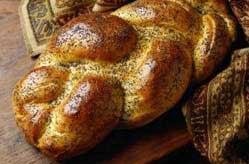
a mundane mouthful
By Rabbi Berel Wein
http://www.jewishworldreview.com |
The Torah entrusted the spiritual and emotional health of a home
and family to the woman of the house. Part of the mechanism that aided the
Jewish woman in the accomplishment of this awesome task was the special
mitzvos -- commandments of the Torah -- that were part of her sphere. The
most famous of these mitzvos is undoubtedly the lighting of the Sabbath
candles every Friday evening. In a sense, the entire spiritual center of
the household is reflected in the glow of the flames of the Sabbath candles.
But in the Torah reading of this week we are told of another
central mitzvah that is part of the family's inner structure and sense of
spirituality and serenity.
During Temple times, that commandment, known as
"challah" -- is the requirement to separate a piece of dough and offer it as a
gift to the Kohen, priest. Burning that piece of dough is so ingrained within the
people of Israel that the special bread that graces our Sabbath tables is
itself called "challah," after the name of the mitzvah associated with the
baking of that bread.
The Torah teaches us that "man does not live by bread
alone." Thus bread -- to truly have meaning beyond its essential physical,
hunger-satisfying quality -- must somehow be associated with the spiritual.
The mitzvah of "challah" also reminds us of the role of charity and
compassion, especially as it applies to food sharing and distribution. The
prophet Isaiah, in his great message of Godly challenge that is read in the
synagogue on Yom Kippur, states that we are commanded to "spread our own
bread before the hungry."
In our blessed country of the United States, true
and widespread hunger or famine as it is known in other parts of the world,
is rare and thus perceived as an aberration. Thus, the sharing of our bread
with the hungry has less of a dramatic impact upon us. But the Torah
imperative to see the want of others in the very fullness of the bread of
our meals still is applicable to us. Hospitality, goodness, charity,
compassion and concern for others, are all encompassed in the mitzvos of
food --- all such an integral part of Jewish tradition.
The reminder of "challah" is the reality check of Jewish tradition
and of its moral influence upon all areas of human existence and
relationships, even with our daily bread.
"Challah" also carried with it the requirement that it be eaten by
the Kohen while he was in a state of tahara -- ritual purity. Food that was
shared from someone else's table is entitled to appreciation and
recognition. Thus, a Kohen could eat his own food without always being in a
state of tahara. But whenever he ate of the matanos kehuna - the special
gifts of food that were given to him by the Jewish people, he was always
obliged to eat those gifts in a state of ritual purity.
The recognition that what was given to one by others, certainly by the Creator of us all, is to be treated in an exalted and pure fashion is also part of the matrix of
Jewish life. One is never allowed to demean or squander even one's own
assets, but one is certainly bidden to use what is given to him by others in
a wise, holy and productive fashion.
The obligation of the Kohen to eat his matanos kehuna in a spiritual and reverent fashion is practical reinforcement to the idea of appreciation and productivity. Therefore, the next time we are about to place a piece of "challah" bread in our mouth, we
should remember the exalted spiritual and moral idea that lies behind this
seemingly mundane mouthful.
JWR contributor Rabbi Berel Wein is one of Jewry's foremost historians and
founder of the Destiny Foundation.
He has authored over 650 tapes, books and videos which you can purchase at RabbiWein.com.
Comment by clicking here or calling 1-800-499-WEIN (9346).



03/08/02: The Havdala ceremony
01/04/02: Meditation and isolation
12/12/01: What celebrating Chanukah says about the state of Jewry
11/29/01: Requisite for a great scholar: Acknowledging -- and admitting -- one's limits
09/28/01: On forgiveness
09/07/01: Comfort and consolation
08/17/01: As the Jewish year draws to a close
07/13/01: The Three Weeks
07/06/01: Seventeenth of Tammuz
06/20/01: Worthy word books
06/01/01: The best (spiritual) summer reading
05/23/01: Shavous: Cheesecake, blintzes and flowers
04/03/01: Pre-Passover cleaning: A man's perspective
03/23/01:The Bible as fiction
03/08/01: A Purim fable
02/22/01: Why history
12/01/00: Those stubborn Jews
09/29/00: Of gifts and judgements
08/25/00: Diversity and unity
08/18/00: On Wagner and Chacham Ovadia
07/12/00: The return of a Torah scroll and confronting painful memories
06/27/00: Single issue fanatics
05/22/00: Strength and Weakness
04/04/00: The message of spring
04/25/00: Ritual's role
03/09/00: The hubris trap
02/28/00: Denial
02/17/00: The individual and the state
02/04/00: Going it alone
01/27/00: Hang together or hang alone
01/11/00: Hope and good sense: A Jewish recipe for survival
12/06/99: Trendy vs. tenacious
11/15/99: Legacies and remembrances
11/08/99: The joy -- and responsibility -- of being a grandparent
10/28/99: Imperfect solutions
10/21/99: 'Holy loafers'
10/07/99: Earthquakes --- 'natural' and otherwise
09/28/99: Beauty
09/17/99: Blessing the children
09/10/99: A good year