
|
|
|
Jewish World Review Feb. 3, 2000/ 30 Shevat, 5760
“Well, you have to know how to fly”, one four year old told me.
“And you have to have muscles—big ones”, added a five year old.
“It helps to have a gun—or some kind of weapon…But I guess you don’t have to have one all the time”, a six and a half year old offered.
One might think these youngsters were giving descriptions of a superforce needed to repel an imminent invasion of aliens. Instead, this was how a group of young children responded to my question, “What does it take to be a hero?”
More and more, young children’s ideas of heroism are derived from television shows and movies, where even the good guys
Or so it seems.
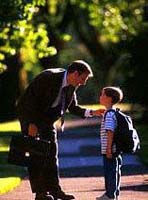
Happily, the good news is that such role models can be found closer to home than most parents realize. Much closer. For the research shows that the most important and influential role models of all for young children are often their own mothers and fathers. It is children’s parents—despite what goes on in the world around them—who play the biggest role in modeling children’s behavior and instilling basic values. But how did they get that way?
Those people whose parents consistently showed kindness and sensitivity towards others, and gave their children the message—through their actions—that it was important to care about others, were much more likely to become rescuers than people whose parents did not set such an example.
The fact is, parents often underestimate the power they possess to influence their children. Several years ago,
 Down to Earth Heroes
By Dr. Janice Cohn
 (particularly the good guys) automatically use violence to solve their problems and conquer evil. Add to this to the fact that many of today’s public figures who would ordinarily be looked upon as role models, (from sports stars to the President of the United States), end up having feet of clay. We then find we are looking at a serious void regarding positive, inspiring role models for kids.
 This premise is vividly illustrated in an important book, The Altruistic Personality, by Sam and Pearl Oliner. The Oliners, who are professors at Humboldt University, conducted a comprehensive research study which sought to answer this question: What determined which people, during the second world war, became rescuers of Jews in Nazi Europe. On the surface, these people seemed no different from their neighbors and friends. But while others did nothing to try to stop the slaughter, or began to emulate the Nazi invaders, rescuers risked their lives—and often the lives of their families—to try to save people who were often total strangers to them. Many of us would consider these people to have shown extraordinary courage.
  I conducted a small research study involving several private schools in New York City. The study focused on identifying young people’s role models. Several hundred students responded to the questionnaires and it was gratifying to discover that the majority of the young people did not choose rock stars, financial moguls or other celebrities as their heroes and role models. They chose, instead, their own parents. Even more gratifying were the reasons they gave for their choices. Though many of these young people came from privileged backgrounds and had parents who had acquired considerable wealth, power or fame, this is not what students wrote about. They had some very different things in mind. Here are some typical examples:
These young people’s responses movingly illustrate the power of simple examples of goodness and decency. The key here is that children were influenced and inspired by their parent’s actions, not parental lectures. Keep this in mind when you are tempted, even momentarily, to tell your children to heed what you say, rather than what you

JWR contributor Dr. Janice Cohn, a psychotherapist, is Chief of Consultation and Education at the Department of Psychiatry, Newark Beth Israel Medical Center. The author of Raising Compassionate, Courageous Children in a Violent World , she is also in private practice in New York City and Montclair, New Jersey. Send your comments by clicking here.


01/27/00: Parental discipline affects child's compassion