 |
|
|
Shelley F. List
http://www.jewishworldreview.com --
RECENTLY, my three-year-old shut himself in the family van. We had put up a frantic search, and finally spotted him trying in vain to open the heavy sliding door. Only much later did I remember that Ari knew exactly how to get out of the van. Though he wasn’t strong enough to budge that sliding door, he often made a big deal of opening the driver’s door and hopping proudly into the driveway. All by himself.
It was his own panic that kept Ari from remembering that he knew how to save himself. And so it is for the rest of us: sometimes we all need to be reminded of the salvations we have already mastered, in order to take advantage of them.
That’s exactly what Rabbi Abraham J. Twerski, MD would tell us. A practicing psychiatrist and founder of Pittsburgh’s Gateway Rehabilitation Center, Rabbi Twerski’s pocket-sized It's Not as Tough as You Think promises to “Smooth out Life’s Bumps.” Most of the lessons in these 102 Lilliputian chapters reveal concepts we probably already knew --- but, well, forgot.
This is easier said than done. Marriage counselors are kept busy trying to restore communication between spouses. I was fortunate to hear some words of wisdom, which, if given due consideration, may avert some of the more common problems in marriage.
"My wife and I used to argue," this man said, "and I would be defensive and do anything necessary to make my point. My ego could not tolerate losing an argument to my wife.
"Then one day it occurred to me that if I won the argument, she lost it, and then I would be married to a loser. Well, I didn't want to be married to a loser, so we stopped arguing."
We usually think of ego as indicating self-centeredness. Perhaps self-centeredness is not always bad. In this case, this man's ego could not tolerate either winning or losing an argument, and the only choice was to quit arguing.
Give this some thought. It may save your marriage.
ATTITUDE ADJUSTMENT, JEWISH STYLE
Each small chapter is a different lesson. Like the man who decides to stop fighting with his wife and tells Rabbi Twerski that, since it’s so important for him to win every argument, his wife always has to lose. Then one day he asks himself: “Who wants to be married to a loser?” Or the father of the bar mitzvah boy, in hot water because he forgot to pick up the gefilte fish for the Friday night meal. Years later that gefilte fish will be insignificant; so, suggests Rabbi Twerski, “let it begin to be insignificant now.”
Much of Rabbi Twerski’s advice consists of a tiny adjustment in the way we look at life. We begin as dust and we return to dust --- a depressing concept. But if it’s possible to make a little l’chaim in between - that’s a net gain. The woman loses considerable weight and then gains it all back: not one ounce lighter, she’s still earned a prize: a knowledge of her accomplishment and the assurance
she can do it again.
FROM TALMUD TO FREUD
But “Doctor” Twerski’s message is informed by his experience with substance abusers. As a psychiatrist specializing in rehab counseling, he is aware that using drugs and alcohol to cope with life’s problems is no coping at all; in fact it causes bigger problems.
Many of his lessons come from revelations of alcohol and drug abusers at the Gateway Rehabilitation Center. But perhaps the most profound story happened to Dr. Twerski himself: while driving in the mountains, his car was enveloped by a fog so thick he couldn’t even see whether it was safe to pull over. Would he encounter shoulder or cliffside? Terrified that he might hit the car in front -- whose
tail lights were invisible -- or be hit from behind, he forced himself to keep driving. The only feature he could make out was a dim white line defining the side of the road. Slowly, slowly, Dr. Twerski followed that single feature of the landscape until he had followed it into the clear. His point: when things are very dark, find a lifeline and keep on going. Eventually you’ll work your way through it.
Always a realist, Dr. Twerski acknowledges that it’s not all “small stuff,” and pain and loss cannot always be reversed, only coped with. Yet most of the time, the problems really are small; you really are more OK than not; and with a little faith in yourself you can rise above the burned pot, the physical blemish, the constant apologies for things you didn’t do.
And finally there are lessons from just “Abraham” Twerski, an old guy who’s been around the block. He’s the one to assure you that your favorite music can soothe away a nasty traffic jam; and that, when you’re about to meet your Maker, your one regret will not be that you didn’t spend more hours at the office or yell some more at your kids.
If this volume is about developing life skills or coping mechanisms, it isn’t your last stop. It’s a daily inspiration, and not every reader will connect with each vignette. Still, Rabbi Twerski provides a starting place - and then, like any good doctor you’ve met on the street and discussed your troubles with, he refers you to some other book or self-help group for further development. It’s wisdom doled out with a miniature scoop; for a bigger portion, you can consult one of Rabbi Twerski’s other guides to
Smoothing out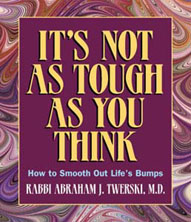
Purchasing this book
-- linked in 3rd paragraph --
helps fund JWR
life's bumps, Jewishly
Marry a Loser?
It may seem inevitable that two people living in close contact will have some disagreements. Sometimes these disagreements lead to arguments. While some quarreling between husband and wife may not be serious, at other times some unkind words are said in the heat of the dispute, and these may inflict emotional pain. It is not always easy to maintain full control of one's words, and either
intentionally or unintentionally one may say something that is derogatory or that strikes a raw nerve. It would be best if reasonable disagreements could be discussed without their degenerating into arguments.
As both a rabbi and an M.D., the author’s inspiration springs from numerous sources. “Rabbi” Twerski dips liberally into the Talmud for wisdom, and into Jewish culture for spice. The Talmud on Type-A personalities (a wise person doesn’t interrupt); the Talmud on peacemaking (tell each party that the other wants to make up: you won’t be lying, because deep down they do).

Shelley Frier List is a freelance writer in Baltimore. Send your comment by clicking here.

