 |
|
|
Benyamin Cohen
http://www.jewishworldreview.com --
DAVID LISS realizes that, on the surface, a work of historical fiction may find more readers in tweed jackets than roller-blades. "I started out with the problem of a novel about 18th-century finance," Liss humbly explains during a phone interview. "You could take everybody in the world who would be excited by that idea and fit them in my hotel room -- with room to spare."
Liss, who received a master's degree in English from Georgia State University, doesn't let all the media hype surrounding his novel get to his head. "When exciting things happen to other people," he candidly explains, "it seems really crazy and interesting. And then when it happens to you, it's just your life."
HISTORY 101
In comparison, the real business of 'Change Alley took place in a few tiny and seemingly insignificant streets that one might circumnavigate in but a few minutes. On the south side of Cornhill, just across the street from the Royal Exchange, one entered Exchange Alley, and proceeded south past Jonathan's and then Garraway's, while the alley would east to Birchin Lane, and a traveler passed the old Sword Blade Bank and a few other coffeehouses in which one might do business with lotteries or insurance or projects or trade abroad. Birchin Lane took one north, back to Cornhill, thus completing the simple tour of the most confusing, powerful, and mysterious streets in the world.
JUDAISM 101
"I have been becoming more religious in my adult life," reveals the 35-year-old. "One of the first things I did after selling the book was I started studying biblical Hebrew. I always felt alienated in the synagogue before because I didn't know the language. That's something that personally I wanted to remedy and never had the time."
Paper Trail
Purchasing this book -- by clicking
on link below -- helps fund JWR
Apparently, the publishing world was not as worried when it read Liss' manuscript. The book, a murder mystery set amidst the backdrop of the first stock market crash in the English-speaking world, set off a frenzy every freshman novelist dreams about. After an intense four-day auction, Random House purchased the novel for a staggering $725,000, and, as if icing was needed on this cake, Miramax has optioned the book for a movie. Currently, he finds himself crisscrossing the country on a media blitz promoting the new book.
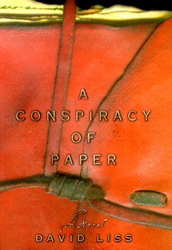
The highly lauded novel, "A Conspiracy of Paper," is ostensibly a period piece housing a murder mystery.

While working on his dissertation, Liss decided he want to write a novel. "Then I had to figure out what I wanted to write about," Liss explains. "I became interested by the idea of trying to turn my academic research into a story."
Inspiration came in the form of the autobiography of Daniel Mendoza, a Jewish boxer born in 1764, a book Liss came across while working on a chapter for his dissertation on the representation of Jews in 18th-century literature as embodiments of finance.
Liss took certain aspects of Mendoza's life and created Benjamin Weaver, a Jewish thug who tracks down debtors and thieves. In the story, Weaver is found investigating the mysterious death of his estranged father, a notorious "stock-jobber" -- known today as a stockbroker. To solve the mystery, Weaver must contend with a garrulous prostitute who knows too much about his past, relatives who remind him of his alienation from the Jewish faith, and a cabal of powerful men in the underworld of British finance. Along the way, readers get a history lesson in the beginnings of the stock market.An Excerpt
Many years ago, stock-jobbers like my father did their business in the Royal Exchange, and Jews had their own "walk" or place of business in the courtyard, along with clothiers and grocers and all manner of men engaged in foreign trade. But then Parliament passed a law forbidding stock-jobbing within the Royal Exchange, so jobbers had moved to nearby Exchange Alley, taking up residences in coffeehouses such as Jonathan's and Garraway's. Much to the anger of those who had fought against stock-jobbing, the greater share of London's commerce moved along with them, and while the Royal Exchange stood as a monument to Britain's financial soundness, it was but a hollow monument.
Liss first became interested in the subject matter when he took a course at Georgia State University in 18th-century fiction. "I thought it would be a good idea to have a plot that was interesting and have characters that were engaging, rather than to be pedantic and heavy-handed with it. That's what I tried to do with it."
His attempts to make the story palatable have apparently paid off. Random House has printed 100,000 copies of the book, a giant vote of confidence for any author.
In the story, Weaver uses his brawn to contend with his problems, something that Liss didn't write from personal experience. "There is certainly a fantasy element here," offers a meek Liss. "I think a lot of us would like to be able to deal with our problems by beating up the people who irritate us. I certainly don't deal with my problems that way."
However, Liss can relate to Weaver's insecurities about his religion. "I think Benjamin Weaver is somebody who is learning what it's like to be Jewish in a non-Jewish world with no model to follow," notes Liss. "I grew up in the small town of Plantation, Fla., an area where there was a lot of anti-Semitism. I suppose that in that way there is some overlap between me and Benjamin."
Liss is not having that problem now. Living in the Jewish capital of America, New York City, he is finding it easier to practice his Judaism.
Despite starting work on a second novel (this one about the Jewish community in 17th-century Amsterdam), Liss now has the opportunity and time to consider his spirituality. "I think having a religious Jewish identity is becoming a bigger part of my sense of self," says Liss. "I'm going to synagogue more, keeping kosher, learning Hebrew, and making Jewishness a part of my life.
"I was raised with this idea that I was Jewish and it was important, but I was never really told why or what it was. That's something I don't want to repeat with my

JWR contributor Benyamin Cohen is a staff writer for the Atlanta Jewish Times and editor of Torah from Dixie. Send your comment by clicking here.

