 |
|
|
Jewish World Review Sept. 21, 1999/ 11 Tishrei, 5760
Robert Leiter
But last year when his curiosity was aroused by the descriptions of the
Star Trek conventions he decided to discuss his long-held ambivalence with
his wife's cousin John Rosove, who is also the couple's rabbi at Temple
Israel in Hollywood.
Nimoy said he thought it could only be a small number.
5/26/99: America's new anti-Semites
Spock's spectacular voyage
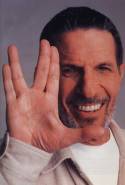
The actor, famous for his role as Spock on the classic TV show "Star Trek,"
began being invited to Star Trek conventions in Germany repeatedly in the
mid-1990s - and just as repeatedly had refused to go. In a personal essay
published in the current issue of Reform Judaism, he tells of how he had
been "intentionally rude," throwing the invitations in the trash and not
looking back.
But then he began hearing from Star Trek colleagues about the crowds that
appeared at these gatherings, and how animated they were. His curiosity was
peaked. But that didn't yet completely dispel the ambivalence he felt about
going to the homeland of the Nazis.
This personal struggle with things German didn't just crop up in Nimoy's
life. Nor had he avoided going to Germany altogether. He took a business
trip there in 1985 when he was asked by his studio to help promote one of
the Star Trek films, his first effort as a director.
Nimoy's appearances in Germany clearly helped the film, he says in the
article, but his emotional baggage stayed fairly intact. During a break
from work one day, he and his wife took a tour of Munich conducted by a
young woman conversant with the history of the area.
"Here you can see," she said pointing up to the architecture, "where some
of the buildings have been reconstructed on top -- such a shame. So much
damage from the war -- a shame for these beautiful buildings."
Notes Nimoy: "I took this away with me as a testament, a proof that my
feelings were valid. Her sadness for the bricks and mortar made me ill. I
bit my tongue."

Rosove asked if Nimoy thought that young German fans knew he was Jewish and
that he had introduced the Vulcan hand salute from watching the kohanim
(the priestly descendants of Aaron) at synagogue services.
"If you were to go and tell the story and identify as a Jew, it might have
a profound effect," the rabbi said. "It might be a transforming experience
for some of those young people to discover that this person whom they
admire is Jewish."
Nimoy almost immediately made arrangements to attend a convention in Bonn
set for May of last year. The actor had his whole presentation carefully
planned before he left, but several technical glitches meant that the
question-and-answer period came sooner than expected. Someone eventually
asked about the origins of the Vulcan salute, and though Nimoy didn't want
to get ahead of himself he couldn't avoid telling the tale. When he
finished, the applause was deafening.
Nimoy writes: "How could I have so miscalculated? How could my expectations
have been so far afield from the reality I encountered? Could this indeed
be a new Germany? After all, this audience ranged from teenage to mid-50s,
essentially a post-World War II generation. Could I have prejudged them on
a false assumption? In any case, it was I who felt transformed."

No one would deny the genuineness of Nimoy's experience, but perhaps his
ambivalence shouldn't have deserted him so quickly. What is appealing about
his article is that it is not writerly in any way; it represents an
individual conveying his experience in an honest manner, unmediated by the
technique of art. But what might be nice to see is a follow-up, perhaps a
few months down the road, when the roar of the applause has faded a bit
more from Nimoy's ears.
Not that change doesn't happen, even in Germany;
but lets just say that dealing with make-believe Jews and symbolism is a
lot easier than dealing with real live ones, day in and day

Robert Leiter is Literary Editor of the Philadelphia Jewish Exponent.

5/06/99: New York (Times) Jews
4/29/99: To tell the truth
3/17/99: Beauty is indeed in the eye of the beholder
