
|
|
|
Michael Feldberg
Staying Jewish on the Arizona Frontier
http://www.jewishworldreview.com --
IN 1852, a boat landed in New York carrying, among its
many passengers, members of two Polish-Jewish families
who were destined to change the history of Arizona. One
family's name is well known: the Goldwaters. The other
family, the Drachmans, is less well known, but in the
early years of Arizona Jewish history, no less important.
When he was only 10 years old and living in a Pietrokov
near Lodz, Poland, Philip Drachman's parents decided that
he and his younger brother Samuel would someday flee
to America rather than, at age 13, be drafted into the
Czar's army. According to a family memoir, the boys'
parents removed floorboards from a room in their home
and started digging a cellar in which Philip and then
Samuel were hidden. "At night," the account goes, "they
would carry the soil out of the house and spread it over
the ground so it would not be noticed. This went on for
months and months."
When Russian army officials came to find Philip, they
were told that he had run away. Actually, he was in the
cellar, where he lived for several months while his
parents made arrangements to secret the two brothers
to America. The memoir concludes, "Philip had health
problems most of his adult life, and he felt they stemmed
from the months he had spent in the damp hole
underneath his home. It was said that he first came to
Arizona for the warm, dry climate. Thus he may have
been Tucson's first health seeker!"
At age 16, Philip Drachman and his brother Samuel, age
13, arrived in New York after living for a time in England.
Samuel moved to Charleston, SC. Philip chose to pioneer
the virtually undeveloped Arizona Territory. Philip became
a naturalized American in 1860 and by 1864 a successful
landowner, cattle rancher and retail merchant. In 1867,
he persuaded his brother Samuel to abandon the civility
of Charleston for the desert starkness and economic
opportunity of Tucson.
As Arizona had few marriageable Jewish women, Philip
made the arduous journey to New York to find a Jewish
bride. He won the heart of Rosa Katzenstein, who agreed
to marry him and move to Tucson. After a New York
wedding, the couple traveled to California by taking a
boat to Panama, wagons across the Isthmus and another
boat to San Francisco. From there, they traveled to Los
Angeles and San Bernardino, California, for a visit with
Philip' s sister before setting out for Tucson. Years later,
Rosa Katzenstein Drachman wrote a memoir of her
journey:
Philip and Rosa had 10 children. Unfortunately, in 1889,
when the youngest was only a year old, Philip died of
pneumonia at the age of 56, leaving Rosa to raise the
children alone. Philip Drachman had been a respected and
popular man, having been elected to the Territorial
Legislature and having founded the B'nai B'rith Lodge of
Tucson. Another successful Arizona Jewish pioneer,
William Zeckendorf, conducted his graveside funeral, the
largest in Tucson to that time.
Philip's brother Samuel Drachman carried on the family
tradition of mercantile success and Jewish observance.
To find a Jewish wife, Sam traveled to San Bernardino,
where his sister had identified a prospective bride.
According to historians Abe and Mildred Chanin, Sam
Drachman "did more in Arizona's territorial days than
anyone to keep Judaism alive in the desert Southwest."
He was one of first 17 contributors to form Tucson's
Jewish Cemetery Association and, in 1910, he helped
build Arizona's first synagogue, Temple Emanu-el of
Tucson. Sam served as the congregation's first
president. Most impressively, Sam traveled throughout
the Arizona Territory and even into Texas to preside at
Jewish weddings.
Ironically, despite their Jewish commitment, the
Drachman's have left few descendants still practicing
their Judaism. However, thousands of recent Jewish
settlers in Arizona, a state with a rapidly increasing
Jewish population, have benefited from Jewish community
institutions planted by the first generation of
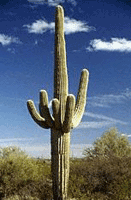

We started for Tucson on October 21, 1868.
We traveled in a four-horse ambulance,
which was a relic of the Civil War. We had
provisions and camped out . . . the first night
we camped out I could not sleep on account
of the howling of the coyotes. . . .Our
bedding was spread on the ground and that
is the way we slept. . . . We traveled at the
rate of twenty-five miles per day and
camped near stagecoach stations where I
saw the roughest and worst class of men. As
we traveled we passed many graves of poor
people who had been murdered by the
Indians or the desperate characters.. We
were detained by many mishaps to our team.
. . There was nothing but cactus, sand and
brush and occasionally an immense freight
team. . . We reached Tucson on November
15, 1868 after a long and tiresome journey.

Michael Feldberg is the director of the American Jewish Historical Society. Comment on this article by clicking here.


Don Solomono, Jewish Indian Chief
Mordecai Manuel Noah: How Buffalo almost became the gateway to the Promised Land
Alfred Huger Moses, industrial visionary
Alfred Mordecai, Military Scientist
Moses Michael Hays: "A Most Valuable Citizen"
"I am a Jew, I am a Republican and I am poor"
The temptations of marrying 'out' ... in Colonial New York
Vindication of an American Jewish patriot
Old in wisdom, tender in years
Mordecai Sheftall and the Wages of War
Haym Salomon: The rest of the story
Francis Salvador: Martyr of the American Revolution
How Hebrew came to Yale
The Making of a Jewish Citizen