
|
|
|
http://www.jewishworldreview.com --
Jewish World Review Nov. 16, 1999 / 7 Kislev, 5760
My daughter’s more religious than I am
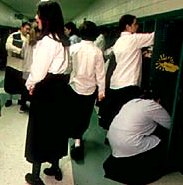
Lockers with pictures of rabbis, not rockers:
An Orthodox girl's high school
By Harriet Gold Cabelly
Tolerance, like charity, begins at home. I learned this from my oldest
daughter.
Sometimes we parents can learn the most and the best from our children if we
allow ourselves to open up to them. Parenting is not simply watching our
children grow, but growing along with them. This takes awareness,
flexibility and the ability to change. Our children certainly present us
with opportunities.
Raised in a modern Orthodox home and having attended a modern Orthodox
yeshiva, my daughter began her self-directed journey toward greater
religiosity when she was 12. It started with her decision to no longer go
mixed swimming. When our family, along with our friends, went on a camping
trip and she wouldn't go in the water, that was a tough one for me. I
thought it was ridiculous not to go swimming at age 12 just because boys
were there. My friend and I spoke about it and I recall her asking me how
I dealt with it. This was all new to me; I didn't know. What I did know,
however, was that I wasn't going to throw her in the pool, force her or have
an all-out power struggle.

I wanted to understand her reasons, her thoughts behind this first major
behavioral change. So began our dialogues. She began wearing only long
skirts-no more pants or shorts. Then came the long sleeves. And there were
numerous other examples along the way. Each new development brought with it
new discussions.
As she grew into teenagerhood, there were no parties or dating. Now some
parents might say, "This is great! I don't have to worry about my kid being
out until all hours of the night, doing G-d only knows what." I looked at
her self-imposed restrictions and said, "This is the time to have fun." Her
answer: That was not her kind of fun, not the kind of lifestyle she was
looking to lead.
This led us to talk about the whole area of dating. Her idea of dating was
for the sake of finding a husband. She had no concept of dating for the fun
of it or for the experience. It was for a specific goal. To me this was a
foreign way of thinking. I kept saying, "You're missing out on your teenage
years and what they're supposed to be about." And then I heard myself.
"Supposed to" according to whom? According to my perspective, or hers?
I kept trying to listen to her, to hear her ideas, thoughts and views on her
world. In the process of continuous talking and letting her try on all her
ideas for size, so to speak, it became easier for me to accept that she was
evolving into her own person with her own ideas about her life and how she
wanted to live it. After all, she wasn't hurting anyone. It was just
differe
nt from my way and what I thought her way would be.
Now I'm certainly aware of this type of lifestyle. I know people who live
it. I know the more "right-wing" Orthodox live this way. But again, it's
not my way. How did it become my child's?
Letting go and allowing for differentiation takes a lot of conscious work on
our part as parents. As we raise our children from birth, we have a
symbiotic relationship in which we as parents define their world. This has
to change as they grow. We need to allow our children to take small steps
toward defining their own worlds. We need to encourage and promote this.
Our job is to begin to see them as separate begins with distinct
personalities, with their own likes and dislikes, thoughts and feelings.
And separate can mean different.
Tolerance comes into play when there are differences. There is no need for
the idea of tolerance when everyone is in agreement. Religious differences
may appear quite small to an outsider, i.e., coming from an observant home
and moving further along the continuum toward a more observant level. But
the tolerance of the person whose reference point is being challenged - the
parent - is being put to the test. Power struggles occur and arguments
escalate; parents deliver the message, "Why can't you be like us? It's good
enough for us, we're comfortable with it."

But this is where respect and tolerance enter. My daughter took a change
upon herself and we have become closer through it. There is beauty in
reaching a high level of respect and acceptance, and doing so, in and of
itself, creates closeness. This closeness comes about through the support,
respect and tolerance of another's way.
We can start with small differences within our own family structure. Trying
to see the things from another's point of view without necessarily agreeing
or taking on that viewpoint is difficult. However, as long as no one is
imposing his or his views on another person, we can get to that point of
agreeing to disagree while maintaining respect and tolerance.
When this occurs within the microcosm of a home, it is more likely to extend
to the macrocosm of the outside world, where differences among people are so
common-cultures, religious, facets within religions, lifestyles, etc.
Sometimes it's easier to be tolerant of outsiders simply because we don't
have the same kind of emotional investment in them as in "our own." The key
here is to see that our children are not extensions of us, but rather
separate and unique individuals.
The most important message our children can receive and feel on a deep level
is that they are respected by is and loved unconditionally for who they are.
We are then sending them out into the world to do and be the best they can.
That feels good to

Harriet Gold Cabelly is a Certified Social Worker and writes on occasion
for the Long Island Jewish World, where this article first appeared. Contact the author by clicking here.

