
|
|
|
A survivor's face changed, his savior's did not. An article you'll never forget.
http://www.jewishworldreview.com --
BY 1965 I WAS a well-established suburbanite living in Springfield, New Jersey.
While I had slipped away from Orthodox observance many decades before, I did
retain a knowledge of Judaism and Jewish matters gained from my Chassidic
upbringing in Kolbuzowa, Poland. Many evenings over the years, our local Reform
rabbi, Israel Dresner, and I enjoyed one anther's company, as we discussed matters
of Jewish custom and observance.
One year, Rabbi Dresner had an inspired idea. He realized his Reform congregation
of westernized Jews had not the remotest acquaintanceship with the fervor with
which the Orthodox and Chassidim practice their shared religion. He organized a trip
to Brooklyn on the holiday of Simchas Torah that would bring interested members of
his congregation to observe the Festival of the Rejoicing of the Torah. The rabbi
asked if I would like to go along; I readily assented.
It had been many years since I had been with Chassidim on Simchas Torah.
The bus arrived in the Crown Heights section of Brooklyn -- which was then, along
with Williamsburg -- the main center of Chassidic life in America. Ultimately, we
found ourselves in the shul of the Bobover rebbe, Grand Rabbi Shlomo
Halberstam, who, now residing in Boro Park, Brooklyn, is in his 90s and still dances
publicly on Simchas Torah.
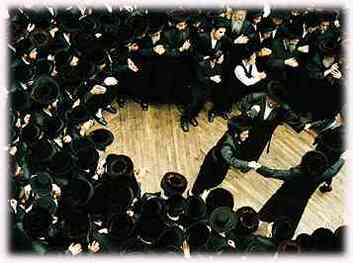
The Bobover Chassidim wore heavy beards, were silk-coated and were capped with
sable fur streimlach. While the Springfield Jews stood back in reserve, I
plunged into the crowd, elbows flying, and in a matter of moments they could see me
through the window.
Here the celebration was characterized by the rebbe, his head covered with his
tallis (prayer shawl), dancing with the Torah for hours on end. For this
purpose, he held a1 special miniature parchment scroll in his embrace and whirled
and whirled. I stood on a table, clapping my hands, singing and shouting alongside the
Chassidim.
Part of the holiday's many customs is hakafos, where honors are given to
deserving congregants who dance with the Torah and the rebbe. The first are
usually given to the kohanim (descendants of Aaron, the High Priest); and
then if there are more Torah scrolls than kohanim, the remainder are given to
important congregants.
Seven times during the evening, one has a chance to be so-honored, and as the
crowd cheered, a silk-coated Chassid, resplendent in fur hat and flowing red beard,
standing on a chair next to the ark, called the names of those to be so honored.
But then a man with a red beard held out a Torah and called "Zaleski, I give this
honor to Zaleski." When nobody in the room responded, once again he called
"Zaleski," and as I turned from facing the crowd to look at him, I realized the Torah
was being thrust to me.
Zaleski. I hadn't thought about using that name in 20 years! Zaleski was a
name I adopted while masquerading as a Polish Catholic in the army during the war
years. Tadeusz Zaleski. This Chassid with the red beard was honoring Tadeusz
Zaleski with the hakafah.
In bewilderment, I stepped down from the table and accepted the Torah scroll; and
as the group from Springfield peered through the window, I whirled around the
shul , Torah in my embrace, dancing with the Bobover rebbe, the last
Chassidic leader to transplant his decimated movement to America.
At length, I yielded up the scroll and tugged at the arm of the man who had called
my name.
"Why did you give me the scroll?" I asked in Yiddish. "How do you know me as
Zaleski?"
"I owe you a debt," he replied. "And I am glad to repay some small part of it by
giving you this honor."
"But I don't know you!" I protested.
"Oh, yes, yes you do," he said. "Do you remember back in Cracow, when you
rescued two boys who were being held in a coal bin in the police station ...?"
Two boys in a coal bin. My mind went back to before America, before
Germany, before the escape from Poland. Two boys in the coal bin --- yes, I did
remember.
IT WAS THE WINTER OF 1945. By that time I had advanced within the Polish
security forces to the position of head of the state security for the County of Cracow
and its neighboring communities. For a known Jew to hold such a position would
have been impossible. However, only a handful of people within the government
knew I was Jewish. To the rest, I was Tadeusz Zaleski.
I spoke perfect, unaccented Polish, had a characteristic Polish face and was clean
shaven; there was no reason to believe I was anything other than the Roman
Catholic officer I claimed to be.
After Russian forces liberated Poland, the few Jewish survivors gradually began to
drift back into the cities. Cracow was no exception, and as the number of Jews
grew, they organized themselves into Jewish committees to look after Jewish
interests.
Shortly after I arrived in Cracow, I made it a point to visit the Jewish leadership, a
lawyer named Stulbach and a woman named Marianska, to take them into my
confidence by revealing that I was a Jew and to let them know that I was available
to do whatever I could, unofficially, to ease their circumstances.
While I could do little within the formal structure, there was a great deal I might do
behind-the-scenes. The small Jewish community was extremely vulnerable to
governmental and personal abuse in Poland, and my offer was gratefully accepted.
At that time, Rabbi Moshe Steinberg, a rabbi who by some miracle had survived the
war, served as the spiritual leader of Krakow's threadbare Jewish community.
It was from Rabbi Steinberg that I learned one day of two Jewish boys from a small
town outside Cracow who had been arrested by police for black-marketeering had
disappeared. The police had caught them transporting a truckload of sugar, had
confiscated the vehicle and its cargo, and had taken the boys into custody.
From that point on, they had vanished with no satisfactory answer ever given to the
concerned inquiries made by the Jewish committee. The rumor was that the
authorities had kept the sugar for their own profit and turned the boys over to the
Cracow militia to be held somewhere in Cracow jail.
AS THE HEAD of the state security, I was indirectly superior to the local militia.
While we didn't report through the same chain of command, our political sponsorship
placed us in the dominant position. However, the political dominance could not
prevent simple lying.
It never has.
The next morning, I inquired of the chiefs of each of the precincts whether they
knew anything of the fate of these two brothers. Not surprisingly, none did. So I set
out on a precinct by precinct inspection of the jail facilities of Krakow's 12 precincts.
To all appearances, the inspection had nothing to do with the missing Jewish
brothers. It was simply an inventory of the city's jail cells undertaken for
bureaucratic
reasons.
One by one, I visited the dingy jails in the basements of precinct headquarters. One
by one, the cell doors were thrown open for my inspection. Some cells were
occupied, others vacant. Most contained the occupants called for by the records ---
criminals and political offenders of various stripes.
At length, I came to one building in the precinct called Wolnica; the inspection was
proceeding just as the others had, except at the end of the dark basement corridor,
there was one door still locked tight.
When I asked about it, the police chief assured me that it was just a bin used for
storage of coal. Nevertheless, I persisted in being allowed to look inside.
The keys are lost, I was told, whereupon I backed everyone away, took out my side
arm, and shot the padlock off the door. As the door swung open, I was able to
discern in the dim light of the bin two filthy figures --- the missing Jewish boys I was
seeking.
As the alarmed chief rambled on about lost records and confused paperwork, I
berated him for incompetence and worse. At length, I relented in my chastisement of
him.
"Just clean them up and get them to my headquarters. I will be taking care of this
matter myself!"
Relieved that his obvious impropriety had not led to anything worse, the militia chief
readily assented and by day's end, the prisoners were presented.
You can imagine the relief they felt -- after being beaten and then locked up for two
weeks -- when I told them I had been sent by Rabbi Steinberg, that I was Jewish
and that I was going to let them go, provided they left the Cracow territory and I
never saw either of them again.
And I never did --- until that Simchas Torah in Brooklyn.
"HOW IN THE WORLD do you recognize me?" I now asked of the Chassid. "I
don't know you at all."
"I could never forget your face, especially your eyebrows," he said. "I have
constantly thought about how we were delivered from that coal bin. The minute you
walked in, I knew it was you."
He observed that in Cracow I had been an adult, clean shaven then; and so I was
now. He, on the other hand, had been a youth who had matured, grown a beard, put
on a black coat, and was virtually a different person from the one I had set free.
Joseph, in Egypt, he reminded me, had not been recognized by his brothers because
he was a young boy, and he had changed just as much as this Chassid had.
And while the people from the Springfield suburbs in New Jersey stared through the
window of the shul in Brooklyn, their neighbor, who had danced with the
Bobover rebbe, now fell into the embrace of a red-bearded Chassid dressed in a
black silk coat and fur shtreimel, his face wet with long suppressed tears of
Jewish World Review Oct. 1 1999 / 21 Tishrei, 5760
 On Simchas Torah they called me Zaleski
By Norman Salsitz, as told to Stanley Kalish


With each name, an eager worshipper reached forward to take a Torah scroll and
join in the wild dance with the rebbe. While I am, in fact, a kohen, this was
unknown, and I was content to remain on the sidelines.


Normal Salsitz is the author of several books on Judaic themes. Stanley Kalish is a professor of economics at Rutgers University, Newark. He is collaborating on a book with Salsitz on his experiences and memories.
