 |
Jewish World Review / Oct. 20, 1999 /10 Mar-Cheshvan, 5760
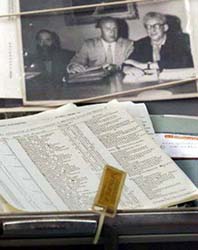 |
| Some contents from Schindler's suitcase |
a piece of the pie
By Toby Axelrod
http://www.jewishworldreview.com --
(JTA) THE 92-YEAR-OLD WIDOW of Oskar Schindler is
questioning the right of a German newspaper to the ownership of a suitcase
that her late husband left with friends before he died in 1974.
In an interview published yesterday in the German news magazine Stern, Emilie
Schindler said she was planning to fly to Germany soon to retrieve the suitcase
from the Stuttgart Zeitung.
The documents it contains, including letters and a copy of the famous list of
Jews whom Schindler rescued during the war, "belong to me, because I am
the widow and legal heir of Oskar Schindler," she said.
Emilie Schindler, who lives in a small town outside Buenos Aires, said she did
not know the couple with whom Schindler had left the suitcase and hadn't
even spoken to her husband since the late 1950s, when he left her and
returned to Germany.
She said she would have to see the documents before she could confirm their
authenticity. But Retures reported that the Stuttgarter Zeitung newspaper said the documents, including the sheaf of 1,200 names which gave its name to the Hollywood film, had expert advice that they were genuine.
Emilie Schindler, whose memoirs have been published in Germany under the
title, "In Schindler's Shadow," remains bitter over her relationship with Oskar
Schindler. She once told a Jewish group in New York that he had "run around
with women in lavish hotels and gave his money away.''

According to the Stuttgart Zeitung, the gray Samsonite suitcase with a tag that reads "O. Schindler" was given to the newspaper last year by a couple who found it while cleaning the home of their late parents. The family had been close friends of Schindler, whose story became world famous through Steven Spielberg's 1993 Oscar-winning movie,
"Schindler's List," based on a book by Thomas Keneally. The suitcase has been in the attic of his close friends since his death. After the friends passed away, their children, who live in Stuttgart, discovered the suitcase and entrusted it to the newspaper.
The papers include an exchange of letters from the 1940s through the 1960s, a
copy of the "list" and a speech given by Schindler at the end of the war, urging
the Jews from his factory not to take violent revenge. According to the wishes
of the family that had the material, it will be given entirely to the Yad Vashem
Holocaust Memorial in Israel.
"For the Germans today, Oskar Schindler is a very positive example," said
Stefan Braun, a reporter for the Stuttgarter Zeitung, which began publishing
some of the papers last weekend. "But after the war, people were not really
interested in knowing about his story. In one of his letters from 1948, he says,
'There is a neo-Nazism coming from the east. Nothing has changed and it is
worse.' If things are better today, I can't tell you," Braun said.
Reporters Braun and Claudia Keller managed to keep the existence of the
suitcase secret during the past year. Among the few who have seen its
contents is former Israeli Supreme Court Judge Moshe Bejski, who was
rescued by Schindler.
"Our first impression was that there were so many letters, pictures,
newspaper articles, and we did not know how to handle it," said Braun, 35.
"Nearly every evening we sat at home around the suitcase, just reading
letters. We were trying to find a way to publish this, but not too quickly."
The journalists decided against writing a biography based on the material, but
are considering publishing some of the letters, Braun said. Meanwhile, the
newspaper organized the papers to illustrate several points: Schindler's
relationship to his German fellow citizens, his problems with alcohol and
womanizing and his connections with Israel and with German Jews.
Publication of the series, called "Schindler's Suitcase," comes, coincidentally,
on the 25th anniversary of Schindler's death.

Though experts at Yad Vashem have said the list of names is probably not the
original, the letters clearly are and may provide important insights into the life
of a complicated man, Braun said.
"First, there is the man who wants to be who he was during the war -- the
boss of a big company," Braun said, "But it was not possible, it was too
difficult in postwar Germany.
"Secondly, [the letters show] how he learned that after the war Germany was
not interested in looking at what happened" during the Holocaust. "He was
very unhappy that Germans were not interested in the history, didn't want to
hear about it. And they were angry that he had made a good impression in
Israel."
In 1962, after Schindler was honored by Israel as a Righteous Gentile, his
business partner in Germany "canceled the partnership because he said, 'I am
a Nazi and now it is clear that you are a friend of Jews and I will not work
together with you any more,' " Braun said. Reportedly, during the so-called
denazification process in West Germany, when the Allies encouraged
Germans to clean house and earn a fresh start, Schindler was threatened for
revealing former Nazis.
Michel Friedman, whose parents were saved by Schindler, said the newfound
letters are important because they "confirm that his economic situation after
World War II was very bad, and the only ones who helped him were the
Jews, and not the German government, which paid pensions to old Nazis."
"Schindler was a guest of honor at my Bar Mitzvah and he was at our house"
for Sabbath dinners, said Friedman, a Frankfurt attorney and member of the
Central Council of Jews in Germany. He said he hadn't yet seen the contents
of the suitcase. "The suitcase is very old, it has a lot of trips behind it," Braun
said. "When you open it you see a lot of old papers, very old letters. No one
writes such letters any more today, and no one collects them, either. It was
completely disorganized."
Reading the contents gave him "the feeling of being intimate with someone I
never saw.
"He was a very open-minded and free-speaking person. He said what he was
thinking. He was balancing between a lot of hopes, a lot of disappointments."
Schindler immigrated to Argentina after the war, but later returned to
Germany. In his final years he received a pension from the German
government. He died in Frankfurt in 1974 at the age of 66 and was buried in
Israel as he had requested. In his last years, he had spent much time there.
Schindler's troubles with alcohol and womanizing are not unknown. For Braun,
it was fascinating to read about the failed Metro-Goldwyn-Mayer film project
based on Schindler's story. Though Schindler did get some advance money
from the project, it was canceled in 1966.
"Of course he was devastated," Braun said. "That was the end of the final
hope."
For Friedman, the hope represented by Schindler is not extinguished. "One
can use Schindler's story, in the good sense of the word, to motivate young
people to have civil courage, to prove to them that it makes sense to react,'' he


