
|

|
|
|
|
Jewish World Review Oct. 18, 1999 / 8 Mar-Cheshvan, 5760
Toby Axelrod
German Jewish life arises anew from dustbin of communism, Naziism
It is a long way from Russia's Ural Mountains, where Orlowski, 20, with
close-cropped blond curls and a ready smile, was born -- and a long way
from Israel, where she wants to be.
Across town, Inna Slavskaja, 44, a Yiddish singer from Birobidzhan,
smokes another cigarette. Her husband, Igor, died three years ago and she
is raising their son, Genja, now 11, alone.
"I see myself as Jewish," says Slavskaja, a small, dark-haired woman with
sad eyes. But Genja, though born in Ukraine, feels like a German.
In the evening, Lyonia, an engineer from Lithuania, sits in a grocery store and
watches his wife, Marina, a slightly plump woman with dyed-blond hair,
count the pfennigs of another drunkard making a small purchase. Lyonia, 53,
a short man with glasses and a receding hairline, had wanted to emigrate to
America. For now, the two, who requested that their last names not be
published, live in Germany.
In the last decade of the century, their arrival has dramatically changed the
Jewish landscape of Germany, more than doubling Germany's Jewish
population and making Germany the only country in Europe whose Jewish
population is significantly growing.
In fact, since 1990, Germany's official Jewish population has risen from
35,000 to 75,000, nearly a fifth of its prewar level.
With Germany settling its immigrants on a per-state quota basis, new Jewish
communities are being established virtually overnight in towns and cities
where no Jews have lived since World War II. In some cities, like Munich,
Berlin and Frankfurt, the Jewish population has soared.
"I believe in the year 2004 we will have 100,000 Jews in Germany, making
one of the largest Jewish communities in Europe," said Michel Friedman, a
Frankfurt attorney and member of the board of the Central Council of Jews
in Germany. He is a possible contender to replace the late Ignatz Bubis as
council president.
There are now nearly 12,000 Jews in Berlin alone, a tiny minority in this city
of 3.8 million inhabitants -- but Berlin now has a Jewish community larger
than that of Milan, Italy, and many other major European cities.
"The immigrants brought back life into a community that was in danger of
being very overaged, to put it lightly," said Nicola Galliner, director of Jewish
adult education programming in Berlin. "We have two Jewish junior high
schools and one high school in Berlin, and none of these schools would have
been possible without these immigrants."
The immigrants are old and young, resigned and hopeful.
Pushed to leave the former Soviet Union because of economic hardship,
anti-Semitism or fears for the future in chaotic new conditions, all have
personal reasons for choosing Germany over Israel, where hundreds of
thousands of other ex-Soviet Jews have immigrated since 1990. These
reasons include Germany's liberal policy in accepting ex-Soviet Jews, not to
mention a desire by many to live in a country which is both a solid
democracy and a firm member of the European Union.
"It's very difficult to get to America, you can't get into England," said a
Berlin Jewish activist who asked to remain anonymous. "Germany has the
highest standard of living in Europe. It's Germany or Israel, and if you are
desperate you will go anywhere."
The Slavskajas, for example, left Ukraine in 1991, after learning that their
son's playground had radioactive sand in it, probably from Chernobyl.
"I knew Germany took Jewish families," said Inna Slavskaja, who had
cousins in Berlin. "We came with two suitcases."
Germany's open door for Jews is no accident. It is connected with
responsibility for the Holocaust. After the fall of the Soviet Union in 1991,
Germany established a liberal immigration policy for Jews. They are eligible
for housing, financial aid, language instruction and help in finding work.
They may also become German citizens more quickly than usual, a right
usually extended only to immigrants from ethnic German families. Under
European Union regulations, citizens of one member country have the right
to live and work anywhere in the E.U.
The influx has presented major challenges as well as rewards.
To be sure, Germany's Jewish newcomers often have little connection to the
Holy Land, and little more than a piece of paper certifying their Jewishness.
Raised in the Communist atheist tradition, they usually have more cultural
than religious bonds to Judaism. But the Hebrew stamp on one's passport --
once associated with discrimination -- is now virtually a ticket out of a world
whose poverty and growing xenophobia outweigh the advantages of free
speech and free enterprise.
With enough rubles, one can buy proof of a Jewish maternal grandmother on
the black market.
"It's true that a lot of people would like to be Jewish because they have a
better chance to get out," says Michael Liokumowitsch, the official
trouble-shooter on integration issues for Berlin's Jewish community.
Liokumowitsch, 40, is a dental surgeon whose family emigrated from Russia
in 1974.
In some cases, he said, the community does something to check, such as
asking people who are visiting Russia to see if a certain person is known in a
Jewish community or not.
But Jewish leaders say fakers pose less of a challenge than does the task of
integration.
Newcomers need to learn German, and find homes and jobs. Jewish leaders
would like them to show an interest in religion, and not just to use Judaism as
a ticket for social help.
For some, the process has produced resounding success.
"In Frankfurt we have had an unbelievable infusion of oxygen into Jewish
life with these former Soviet Jews," Friedman said. "They are creative, a lot
of them are artists, and the younger generation is very quickly integrated."
But many who work with new immigrants express frustration and even
cynicism.
"After 10 years, people here still make their Passover seders in Russian,"
said Judith Kessler, who has been handling immigration issues for the Jewish
community in Berlin since 1990, coordinating language classes, vocational
training, social clubs, and publishing a German-Russian Jewish magazine.
"We have done something wrong," said Kessler, who herself came to
Germany from Poland in 1972. "We took them by the hand and served
them in their own language."
And Andy Steiman, who until recently was acting rabbi for the former East
German state of Mecklenberg, dismissed the idea of a real "Jewish revival."
It's just numbers, he said.
He told of a young couple who met because of a Passover seder, which they
attended because it means a free meal. "When they got married," he said,
"they didn't want to have a chupah because they think it is antiquated. And
when they had a baby boy, they didn't want to have him circumcised
because they claimed it is a human right not to be harmed bodily."
Ironically, some of the new immigrants who most want to be involved
Jewishly are, as children of Jewish fathers and gentile Mothers, not
considered Jewish according to Halachah, or Jewish law, and thus, according
to community regulations, cannot take part in all official communal activities.
"It's a big problem," said Kessler. "They say, rightly, 'In Russia we were
Jews, and here we are Russian. Why will no one have us?' "
But some, she said, are getting "closer to Judaism" in a variety of ways.
Some, for example, are taking conversion classes, with some men even
being circumcised. Others are immersing themselves in a cultural rather than
religious Jewish orientation.
Inna Slavskaja's Yiddish cabaret performances attract good-sized crowds
around Germany, mostly non-Jewish. Her identity is more cultural than
religious. But her son is talking about a Bar Mitzvah.
"I have nothing against it," she said. "It will take a lot of practice, but I am
happy."
And Inna Orlowski, a member of the first graduating class of Berlin's new
Jewish high school, is part of a back-to-Judaism movement among young
people.
"My grandparents had decided against Jewish life and for Communist
ideals," she said. "Now, we can begin again to rebuild the relationship to
Judaism. If I don t do it, then for my children it would not be possible."
Throughout the postwar period, the prevalent view of world Jewry was that
no Jews should live in Germany.
Until the influx of immigration over the past decade, the Jewish community
consisted mainly of Eastern European Jewish survivors who ended up in
Displaced Persons camps after the war, and their descendants. Many openly
said that they lived "with packed suitcases" at the ready -- just in case.
"For the Jew, it is always a difficult decision to come to Germany,"
Liokumowitsch said. "The generation who suffered directly [from the
Holocaust] is still alive. On the other hand, Germany has changed, and we
have to ask ourselves, 'What is the alternative?' "
Still, whether Jews should live in post-Holocaust Germany is eternally
debatable. Sometimes, ironically, immigrants encounter more overt
discrimination in Germany than they faced at home. Two years ago, citizens
of the economically depressed eastern German town of Gollwitz
demonstrated against plans to place 50 Russian Jewish immigrants in their
midst.
German xenophobia is most often directed against the millions of Turks and
other foreigners living in the country, but a series of recent anti-Semitic
episodes, including the desecration of the biggest Jewish cemetery in Berlin,
has put the community on guard.
The fact is, however, that, 10 years after the fall of communism and more
than half a century after the Holocaust, Jews are in Germany, building new
lives.
"It's certainly good that Jews want to live in Germany and are no longer
afraid," said Orlowski, the student from the Urals.
"I don't believe that the young German born yesterday should carry guilt on
his shoulders," said Slavskaja, the Yiddish singer from Birobidzhan.
"We must be sure that never happens again."
"Maybe in 15, 20 years, when the young extremists come to their senses, it
will be better here," said Lyonia, the engineer from Lithuania. "Whoever
doesn't take a risk, gets
(JTA) -- BERLIN --- Inna Orlowski sits at an outdoor cafe near the
Jewish high school here, sipping a cappuccino. Bicyclists pass, sending long
shadows across the cobblestone street.
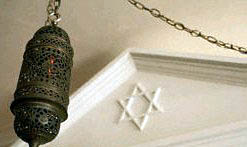
The Ner Tamid, eternal light

These people are among the tens of thousands of Jews who, instead of going
to Israel, caught the wave of freedom that swept the former Soviet Union
after the fall of communism and rode it into the land they always associated
with Hitler and death camps.

How does the established Jewish community integrate a largely non-religious
population? And how does Germany justify its liberal policy toward Jewish
immigration when more than 4 million Germans are unemployed and when
Israel wants these Jewish immigrants for itself?


