 |
|
|
Jewish World Review Oct. 20, 2000 / 21 Tishrei, 5761
http://www.jewishworldreview.com --
THE THREE PILGRIMAGE FESTIVALS are in the merit of the three Patriarchs: Passover in the merit of Abraham, Shavous in the merit of Issac, and Succos in the merit of Jacob. In whose merit is Shemini Atzeres/Simchas Torah? This fourth festival is in the merit of the Jewish people as a whole, and it represents Israel's inseparable unit with G--d and the Torah, as the Zohar states, "The Torah, the Holy One, Blessed is He, and Israel are all one.
This is the deeper significance of Hillel's famous teaching that the primary commandment of the Torah is "Love your fellow as yourself"--- the rest is commentary; go and study! (Talmud, Shabbos 32a). Hillel meant to say that the Torah and its commandments are the means to bring together Jews as one, and when there is the proper kind of unity among Jews, then the Torah can achieve its purpose of bringing about unity between Israel and G-d. So it was that the Torah could be given at Sinai only when Israel had banished strife from itself and gathered at Sinai,"Like one person with one heart" (Rashi, Exodus 19:2).
Unity among people has a tremendous spiritual force --- when it is exercised for good, and even when it is eimployed for evil. So it was that when mankind, shortly after the Flood of Noah's time, had the audacity to build a tower with the delusion that they could storm Heaven; as it were, their extraordinary unit of purpose would have had such cosmic repercussions that G-d intervened and caused them to turn against one another (see Rashi's commentary to Genesis 11). As several of the great Torah leaders in the period between the two world wars commented, when asked why the enemies of Torah life enjoyed such success, "It is true they are fighting for an evil cause, but they are doing so with conviction and unity!"
Shemini Atzeres represents this national perfection achieved through a united effort. The cycle of the Three Pilgrimage Festivals had given Jews, each in his own way, the opportunity to perfect themselves --- and as a result they had earned the Heavenly gift of a new, independent festival. Shemini Atzeres also comes as the climax of the three festivals of Tishrei, Rosh Hashonah, Yom Kippur, and Succos, the month and the occasions when the Jewish people face G-d's judgment and elevate themselves through repentance and joy. There is an allusion to this in the previously noted verse from which the Sages derive the commandment to be joyous on Shemini Atzeres: "You shall only be joyous" (Deuteronomy 16:15). See above for an explanation of the Sages' exegesis.
The word Ach has the numerical value of twenty-one, alluding to Tishrei's twenty-one days up to Shemini Atzeres, as if to suggest that those days and the performance of their commandments prepare the nation for the explosion of joy that takes place on Shemini Atzeres.
MOSES' ROLE
It is noteworthy that as soon as we conclude the Torah by praising Moses' accomplishments, we begin once again to read the Torah, reciting the words "In the beginning of G-d's creation ..." As Rashi explains on the first verse of Genesis, the word Bereishis, "beginning," refers to the Torah itself, for it is the beginning, the source of everything. Thus by connecting the final words of the Torah with its first words, we declare, in effect, that whatever Moses did was accomplished only through the power of the Torah.
SEPARATE, YET ONE
Abraham, Isaac, and Jacob are called the "fathers" of the nation because all our spiritual characteristics derive from them. There are infinite blends of their attributes -- one individual may stress Abraham's attribute of kindness, another may emphasize Isaac's attribute of service, and a third may concentrate on Jacob's attribute of Torah study -- but in whatever blends of these attributes various people choose, the Patriarchs are the source of all the essential ingredients of Jewish existence.
This explains the anomaly of Shemini Atzeres/Simchas Torah: It is a separate festival, yet it is not a fourth festival. Rather, it is the natural outgrowth of the Three Pilgrimage Festivals, just as only Abraham, Isaac, and Jacob are Patriarchs, while Moses, for all his greatness, is their successor, not their equal. Thus Shemini Atzeres/Simchas Torah is the amalgam of them all, rather than a fourth and unrelated one. (Sfas Emes).
ANCHORED IN THE TANGIBLE
Since celebration has a powerful appeal to the body and such a time can easily cause people to forget their fear of G-d, He commanded us that at that time we should take something tangible in our hands, something that will remind us that all the joy in our hearts should be for His sake and for His glory.
The Chinuch's point is very simple. People can easily be carried away by joy, as our everyday experience shows very clearly. Celebrations of family and national victories often turn ugly. Few things frighten police forces as much as the crowds careening through the streets to celebrate the home team's win in a championship final. On the other hand, joy can be a valuable tool to bring one closer to G-d. As the Sages teach, prophecy rests only on a joyous person, and during the years when Jacob grieved for his missing son Joseph, G-d did not reveal himself to him. But hzppiness can be dangerous. All too often the Evil Inclination seizes upon it to remove all inhibitions and unleash people's most animalistic passions. Therefore the Torah channeled the joy of the harvest into the commandments of Succos, the Four Species and the commandment to surround oneself with G--d's Presence by dwelling in a succah.
What of Shemini Atzeres? The Chinuch continues:
"And if you ask: Since Shemini Atzeres contains great joy for Israel, why are the Four Species not taken on it? The answer is that Shemini Atzeres in its entirety is devoted to G-d. As the Sages say, it is like a king who made a huge feast [for all his subjects, and, then, when the mass festivities were over, said to his children],"Stay behind with me for one more day, for it is hard for me to part from you." Therefore it is called Atzeres [staying behind], and consequently it does not need any [tangible] remembrance.
So unlike Succos, the joy of Shemini Atzeres/Sinchas Torah does not need a tangible mitzvah-performance to channel it away from harmful influences. What is the key to this?
The difference is simply in the nature of the event that causes one to celebrate. For example, if someone experiences a great victory in a business competition, it is natural that he will celebrate it with his colleagues; if the cause of joy was a family event -- a birth, a marriage, the completion of a tractate of the Talmud -- one will celebrate with the family and close friends. It is inevitable, as well, that the nature of the celebration will depend on the likes and dislikes of the people involved. For example, when an Orthodox Jew feels uncomfortable about the antics in an office party, it speaks well of him, but it is not necessarily a
reflection on his gentile colleagues; he is reflecting his upbringing and beliefs and they are reflecting theirs. Since Succos is a festival that revolves around the happy harvest season -- a material event -- there would be an understandable tendency to descend to a carnival atmosphere. But what of the G-d Who gave the rain and held the plant blight at bay? What of the One Who blesses commerce and gives the health without which prosperity cannot be enjoyed? When the Jew enters his succah and nestles in the shelter of faith, when he holds his lulav and esrog, his hadassim and aravos, and waves them in all directions to show that G--d is the Master of the winds and rain, and of everything above and below, there comes upon him a recognition that the festival is not a "Mardi gras," but a sublime reminder that "Hashem. He is G--d, it is He Who made us and we are His, His people and the sheep of His pasture" (Psalms 100:3).
THE JOY OF BEING TOGETHER
For seven days he has expressed his gratitude for G-d's nateruak blessings and -- whether through the actual offerings in the Temple or the recitation of the offerings as part of the daily Mussaf prayer -- he has beseeched G-d to spread His blessings upon the nations of the world. Now, there is a day that belongs only to him and G-d.
After retelling the parable of the king inviting his children for an intimate feast, the Zohar gives the "menu" for the feast, the "program" that will bring out the joy of their intimacy: "Israel makes a celebration called Simchas Torah,and beautifies the Torah scroll with its crown." The primacy delicacy of Israel's feast with its Father, the King is the joy of having been given his Torah and enjoying the exciting privilege of studying and absorbing His wisdom, the joy of declaring His wisdom, the joy of declaring that, in the words of the daily Maariv service, "With an eternal love have You loved the House of Israel, Your nation. Torah and commandments, decrees and ordinances have You taught us....for they are our life and the length of our days...may You not remove Your love from us forever.
As noted above, there is an intrinsic unity between the Torah, Israel, and G-d. The Torah is the means, the glue,as it were, that binds the other two. The Torah is the soul, the life-giving force of Israel, the basis of our undying attachment to G-d. It is the conduit through which G-d's spiritual bounty flows to Israel.
That is why the celebration of Shemini Atzeres became Sinchas Torah, because there is no better expression of the intimate love between the King and Israel than the Torah.
Sfas Emes comments homiletically that Simchas Torah can be translated as the Torah's celebration; i.e., the Torah itself rejoices in its relationship with Israel. One might suggest that, during the Hoshana ritual of Succos, the Torah scroll was held at the bimah-table of the synagogue and the Jews circled it, on Simchas Torah the scrolls themselves join in the circuits. It is as if the Torah scrolls were symbolizing that they are part of the celebration, that they are glad to join the people holding them in the happy ceremony of the festival.
EXHILARATION AND CONSTANCY
On Simchas Torah, we need both. On the one hand, there is the exultant joy that is the highlight of the Hakafos, the dancing with the Torah. On the other hand, it is a day of Atzeres, a day that urges us to retain the lessons of the festival and carry them with us into the fall and winter, when there will be no festival, but which need the legacy of the month of Tishrei and its Shemini Atzeres/Simchas Torah climax.
When joys customarily wish one another "a healthy winter" at the end of Simchas Torah, they mean spiritual, as well as physical health. They mean that the exhiliration of Simchas Torah should be carried into the rest of the year, that the oneness of Torah, G-d, and Israel remain healthy and enduring always.
May we all merit this blessing,
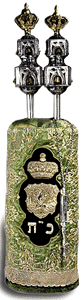
A Holy Day's uniqueness
By Rabbi Nosson Scherman

The one who brought about this unity was Moses, who was G-d's agent to present the Torah to Israel. Midrash Tanchuma expounds on the Torah's description of Moses as the "man of G-d" (Deuteronomy 33:1) --- Moses was part man and part angel [i.e., a G-dly creature], for he was the one who bridged heaven and earth, among other things, by bringing G-d's Torah from the province of the angels and presenting it to human beings. Whatever Moses did, however, he did for the sake of Israel, as implied by the very last words of the Torah, that all his miraculous deeds were performed before the eyes of the people. 
It is axiomatic in Jewish thought that, although each of the Patriarchs had his own unique form of combined service, each built on the teachings and spiritual legacy he had inherited. Thus, Isaac absorbed
Abraham's heritage of kindness, and to it he added his own strength and introspection. Jacob absorbed the teachings of Abraham and Isaac, and to them he added his attribute of truth and Torah. Because Jacob combied all three attributes, he represented a level of spiritual refinement that surpassed those of his predecessors. That is why he is referred to as the possessor of the attribute of "splendor," and why the Sages refer to him as "the select of the Patriarchs (Bereishis Rabbah 76:1).
In a sense, Shemini Atzeres surpasses all the festivals. Sefer HaChinuch explains why Succos has several commandments associated with it, while Shemini Atzeres has none. Since the days of the Succos festival are a time of great rejoicing for Israel -- for it is the time when the crops are harvested and fruits are brought into the house, and then people rejoice with great gladness, and therefore Succos is called the harvest festival -- that is why G--d commanded His people Israel to declare a religious festival before Him at that time, in order that the primary celebration be dedicated to Him [i.e., G-d decreed that the harvest days be sanctified through the observance of Succos, so that the nation would realize that their prosperity resulted from His blessing and should be dedicated to His service.
There is another sort of joy, one that derives entirely from closeness to G-d. The Jew who exalts in the elevation of prayer, the performance of a mitzvah, the thrill of Torah study will celebrate by drawing closer to his Maker. Like the king and his children when the madding crowd is gone and they can hasten to enjoy one another's company, the Jew on Shemini Atzeres/Sinchas Torah has only one primary thought --- to rejoice with G-d.
One of the popular refrains in the Simchas Torah liturgy is "Rejoice and be glad on Simchas Torah." What is the difference between these two expressions of joy? Malbim explains that "rejoice" refers to a sudden outpouring of joy, an emotional surge; "gladness" refers to a constant feeling of happy contentment, one that is consistent and unchanging.

JWR contributor JWR contributor Rabbi Nosson Scherman, one of Jewry's foremost Jewish educators and thinkers, heads Brooklyn-based Mesorah Publications, Ltd. Comment by clicking here.

