
|
|
|
Jewish World Review Oct. 11, 2000 / 10 Tishrei, 5761
 |
http://www.jewishworldreview.com --
WHY NOW the campaign of violence against Israel?
The Israeli explanation, espoused by Prime Minister Ehud Barak and other
officials, blames Yasir Arafat; he turned it on and he can turn it off. Why
did he start the violence now? Shlomo Ben-Ami, the acting foreign minister,
says he wanted to distract attention from American "bridging proposals"
intended to break the deadlock in his negotiations with Israel.
But this fails to account for all the violence outside Arafat's control.
Hizbullah, the Lebanese Islamist organization, captured three Israeli
soldiers and shelled Israeli positions. Israeli Arabs resorted to
unprecedented violence. Hundreds of thousands of Egyptians and Moroccans
took to the streets shouting anti-Israel slogans. Saddam Husayn promised to
"put an end to Zionism."
Focusing on the role of the Palestinian Authority, in other words,
misses the larger point, which is that the violence of the past two weeks
results from a growing mood of exuberance in the Palestinian and
Arabic-speaking "street." That mood has deep roots.
When the State of Israel was declared in May 1948, Arabs widely assumed they
could quickly snuff out the nascent Jewish country. This confidence eroded
as the Arabs lost one war after another: 1948-49 and 1967 marked the worst
defeats; 1970 and 1982 were also bad; and 1956 and 1973, though portrayed as
political victories, were widely recognized as military disasters.
For Arabs, the lowest point came in 1991 with the defeat of Iraq and the
dissolution of the Soviet Union. Victory over Israel appeared very remote
indeed.
Then, at its moment of greatest power, instead of destroying the
Palestine Liberation Organization, Israel in 1993 magnanimously extended a
hand in friendship toward it. In what became known as the Oslo process, the
Israeli government recognized Arafat as a "partner for peace." It took this
step assuming that Palestinians and their supporters had learned from their
forty-five years of failure to destroy Israel; and that, sobered by this
experience, they would now accept the permanent existence of a sovereign
Jewish state in the Middle East.
But, as every survey (plus much other evidence) shows, most Palestinians
as well as their Arab and Muslim allies did not give up on the hope to
destroy Israel. Instead, they put this ambition in the freezer, to be thawed
out at a future date when again opportune.
That thaw began surprisingly quickly. Acting from a sense of strength,
Israeli leaders, Labor and Likud alike, encouraged a friendly Palestinian
disposition by handing over land, granting political autonomy, helping with
economic development, and generously conceding on contentious issues (such as
the control of holy places). They also did not hold the Palestinians to the
letter, or even the spirit, of signed agreements.
This Israeli high-mindedness prompted not reciprocal feelings of
constructive intent but a boisterous sense of Palestinian strength. What
began as cautious winks and tentative statements soon turned into open
defiance and explicit hatred. By the time of the Camp David II summit three
months ago, the Palestinian mood had reached such a state of enthusiasm that
the "street" prevailed on Arafat to turn down even Barak's shockingly
generous concessions. These they found too little, too late.
With this rejection, Palestinians signaled that they had no more need to
truck with the Zionist enemy; from now on, they implied, the Hizbullah method
of victory through force would be their model. But Israel's leadership,
myopically projecting on to the Palestinians its own hopes for a harmonious
resolution, ignored the reality that they were preparing for a violent
offensive.
In late September, in a spirit of exhilaration and even millenarian
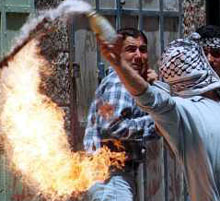
expectation, the Palestinians finally initiated a new round of violence.
More than any other single act, the desecration of Joseph's Tomb, a Jewish
holy site, symbolized their triumphalist spirit. The more modest of them
spoke of liberating the Temple Mount or Jerusalem; the more ambitious saw
their actions as a first step towards the destruction of Israel itself.
Looked at historically, the Palestinian and Arab mood vis-à-vis Israel is
today more resolute and optimistic than at any time since before the Six-Day
War of 1967 - or possibly since Israel's declaration of independence in 1948.
The enemies of Israel again feel they are on the road to eliminating the
"Zionist entity." Listen closely; hardly a word of caution or skepticism
emerges from them; they agree their moment has arrived.
Re-establishing the acceptance of 1991-93 won't be easy for Israel. It
will require great exertions and probably substantial sacrifices. But, with
enough will, it can be
By Daniel Pipes


JWR contributor Daniel Pipes is director of the Middle East Forum and the author of several books, most recently Conspiracy: How the Paranoid Style Flourishes and Where It Comes from. Let him know what you think by clicking here.

