 |
Jewish World Review / Sept. 30, 1999 /20 Tishrei, 5760
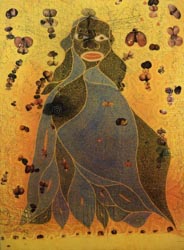 |
| Picture of a black Virgin Mary covered in dung. It was created by an African artist. |
Art as religious bigotry
By Matthew Brooks and Seth Leibsohn
http://www.jewishworldreview.com --
SOME 135 YEARS AGO Abraham Lincoln said "The world has never had a good
definition of the word liberty, and the American people, just now, are in
much need of one." When it comes to religious bigotry, the First Amendment,
and the arts community, Lincoln couldn't have been more prescient. Does an
artist have the liberty to depict religious symbols and characters in a
denigrating light? Yes. Does a city or state, with taxpayer money, have the
obligation to stand athwart such bigotry and say "No!"? Absolutely. Mayor
Rudy Giuliani should be thanked for taking this courageous stand for
religious tolerance and civic standards.
Two weeks ago an art exhibit, titled "Sensation," which includes a depiction
of the Virgin Mary stained with elephant dung, was planning to open in New
York's Brooklyn Museum of Art. The exhibit would be closed to people under
age 18 but Mayor Rudy Giuliani, realizing the Brooklyn Museum was funded to
the tune of over 7 million dollars a year by NY taxpayers, saw things
differently and the battle lines were drawn.
There are few religious symbols held as sacrosanct by the Christian community
as the Virgin Mary, the mother of the Christian messiah. Denigrating this
figure, in the most obscene forms, is nothing short of bigotry. If the
Brooklyn Museum had an employee that openly denigrated Christian co-workers
for their beliefs, or if that co-worker hung such a picture at his desk, or
if that co-worker hung a picture of a nude woman from the pages of Playboy at
his desk, there would be no question that the offending employee would lose
his job. Employment and anti-discrimination laws have taught us that. What
to do then about an exhibit, funded from the same purse and open to the
entire world, that discriminated in just the same way? Mayor Giuliani knew
what to do; he threatened to withhold funding. The arts community is now
suing the Mayor for the money it believes it has a right to receive.
We've been here before, some years ago the NEA's funding was threatened over
an exhibit that had a depiction of the Christian savior submerged in a bottle of
urine. The NEA and the arts community won. But do Jews not have an
obligation to stand with Mayor Giuliani and say that the four most important
words about the First Amendment are "up to a point"?
We say "up to a point" when we talk about free speech in the context of
work-place discrimination and religious bigotry. By submerging the Christian
messiah in urine, when splattering the Virgin Mary with animal feces, have we
not reached that point? For the avant-garde among us, we ask a simple
question: How would Jews feel if the Brooklyn Museum hosted an exhibit with
the Star of David submerged in urine, or with the Western Wall covered in pig
dung, or with the Torah splattered with blood?
The Virgin Mary today, the Torah tomorrow.
By raising the claim that art should not be subject to personal taste and
that it should be covered by the First Amendment, the arts community shows
its true arrogance: "Fund us," they say, "but don't judge us; we have an
absolute right to your money." In passing, we note that some of the best art
of the ages, from van Gogh to O'Keeffe, received no public funding when it
was painted. But we also recognize that there is a good case to make for
subsidizing art. Good art does, after all, improve society and the way it
sees and educates itself.
Some years ago, Professor Irving Kristol made the point "that no society can
be utterly indifferent to the ways its citizens publicly entertain
themselves." Kristol further argued that the corollary to the premise that
good art is of benefit to a society is that bad art can corrupt society: "If
you believe that no one was ever corrupted by a [work of art], you also have
to believe that no one was ever improved by a [work of art]. You have to
believe that all art is morally trivial and that, consequently, all education
is morally irrelevant. No one, not even a university professor, believes
that."
The artists who depict religious symbols with utter contempt and disdain
don't believe that art is morally neutral. They are making a point, with
their depictions, about how they feel and think about religion. The first
duty of the government, however, is to make morally relevant decisions and
refusing to pay for religious bigotry with public funds is a decision that
should not be hard to make.
Government, Louis Brandeis
said, is the best teacher. Mayor Giuliani is providing a good lesson for us
all and deserves our support in his decision as we try to regain a proper
understanding of true

With a near-unanimous voice
we would call it what it is: religious bigotry and we'd be right. We should
be no less intolerant when it comes to our Christian brothers and sisters.

Mayor Giuliani made the right decision here. During the litigation to ensue,
we will hear people asking "Who has the right to determine socially redeeming
value?" We all have that right and we enforce it when we elect public
officials. The Mayor discharged his duty nobly and we support his concern
for religious tolerance. Kristol may have put it best: "If we believe in
self-government, we should have selves worthy of governing." Supporting the
public funding of religious bigotry would say far more about ourselves and
our worth than any of us should hope to want. 
Matthew Brooks is the Executive Director of the Jewish Policy Center, a think tank based in Washington. Seth Leibsohn is the Center's Director of Policy.

