
|
 |
|
|
|
Jewish World Review / Aug. 9, 1999 / 27 Av, 5759
Josh Pollack
IT'S BEEN SAID that history repeats itself, first as tragedy, then as farce.
Perhaps with this thought in mind, Dick: The Unmaking of a President
has been released to theaters in time for today, the 25th anniversary of
Richard M. Nixon's final, disgraced departure from the White House.
In Dick, a pair of squealy, ditzy Washington, D.C. high-school girls,
Betsy Jobs (Kirsten Dunst) and Arlene Lorenzo (Michelle Williams)
collectively turn out to be "Deep Throat," the mysterious source who
supplied hints about the momentous scandal known as Watergate to Washington
Post reporters Bob Woodward (Will Ferrell) and Carl Bernstein (Bruce
McCulloch). One can easily imagine director Andrew Fleming and co-writer
Sheryl Longin pitching the script to the studio as All The President's
Men meets Clueless.
The film is not without its flaws. Its humor is at times juvenile,
particularly in the Woodward and Bernstein scenes, which rapidly bring to
mind a tiresome Saturday Night Live skit that just won't stop. (Will
Ferrell is an SNL regular, and recently appeared in the
SNL-inspired A Night at the Roxbury, while Bruce McCulloch is
a veteran of Kids in the Hall, SNL's Canadian analogue.)
Fortunately, the camera mainly sticks with our 15-year-old heroines, ably
played by 17-year-old Dunst, best remembered for her uncanny performance as
Claudia, the child vampire in Interview With The Vampire, and
18-year-old Williams of Dawson's Creek fame. Their innocence renders
them more palatable than a certain troubled, nonfictional 22-year-old, and
their age excuses their vapidity. The fact that there are two of them
generates dialogue in which Arlene can confess her teenage crush on the big
creep (the big CREEP?) to Betsy, without resort to a Linda Tripp figure.
Much of the charm of the movie lies in the writers' use of existing
material. Many scenes and details lifted directly from All The
President's Men surely will go over the head of younger audience
members, but anyone who has seen the earlier film should recognize Bruce
McCullogh's flamboyant hairstyle, for instance, as a lampoon of Dustin
Hoffman's, ca. 1976.
Humorous treatment of such historical artifacts as the Vietnam peace treaty
and detente will also tend to benefit the older more than the younger. The
same can be said of the telling portrayals of Nixon (Dan Hedaya), Rose Mary
Woods (Ana Gasteyer of SNL), G. Gordon Liddy (Harry Shearer of
Spinal Tap and The Simpsons), and above all Henry Kissinger
(Saul Rubinek), which remind us that little if any exaggeration is needed to
caricature those who are caricatures of themselves to begin with.
In a day and age when 76% of Americans polled think Watergate was no worse
than other, more recent scandals, Dick does a nice job of putting the
essentials into perspective without dwelling on the details. Today we are
sour, mistrustful, and jaded. Apparently we are mostly unaware of it, but
Dick, paranoid, tormented and vicious, is the reason
Innocence lost
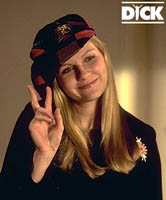
Kirsten Dunst as Betsy Jobs,
half a Monica
 In a significant sense, however, the story is as much about Slick Willie as
Tricky Dick. Its clever, unstated and necessarily somewhat vulgar premise is
this: what if "Deep Throat" was, in fact, a bubbleheaded Jewish girl who got
access to the White House and repeatedly got into the Oval Office by
bringing the President something to eat? Thus the title of the movie, and a
deft plot line that is doubly a case of art imitating life.
In a significant sense, however, the story is as much about Slick Willie as
Tricky Dick. Its clever, unstated and necessarily somewhat vulgar premise is
this: what if "Deep Throat" was, in fact, a bubbleheaded Jewish girl who got
access to the White House and repeatedly got into the Oval Office by
bringing the President something to eat? Thus the title of the movie, and a
deft plot line that is doubly a case of art imitating life.
 Just about everything in Dick is slightly different, and more
innocent. Rather than seducing the President, Arlene and Betsy secretly walk
his dog. In this fashion, sordid elements of the Clinton scandal are
sanitized, transformed and transported to a roller rink-era, strangely
whitebread Washington, replete with period soundtrack. (The Dick
version of intern-bearing-pizza is one of the funnier recurring devices.)
Just about everything in Dick is slightly different, and more
innocent. Rather than seducing the President, Arlene and Betsy secretly walk
his dog. In this fashion, sordid elements of the Clinton scandal are
sanitized, transformed and transported to a roller rink-era, strangely
whitebread Washington, replete with period soundtrack. (The Dick
version of intern-bearing-pizza is one of the funnier recurring devices.)

The movie's serious moment comes when Arlene and Betsy discover the other
Dick Nixon, the one on audiotape, plotting break-ins and the obstruction of
justice, abusing his dog, and ranting against the Jews. Betsy, who is Jewish
in a nominal, Lewinskyesque way, is shocked. Arlene is heartbroken and
utterly disillusioned. When the girls confront Dick, he pulls out their FBI
dossiers; he's had them investigated. The audience is suddenly reminded of
the differences between one episode involving "Deep Throat" and the other.

Josh Pollack is a sometime moviegoer and JWR contributor.
