
|
|
|
Jewish World Review August 28, 2000 / 27 Menachem-Av, 5760
Steve Lipman
http://www.jewishworldreview.com --
FOR AMERICAN JEWRY, the summer of 2000 is the Golden Age — as in Harry Golden.
The nomination of Sen. Joseph Lieberman, a [sometimes -- editor's addition] Orthodox Jew, as the Democratic Party’s nominee for
vice president, brought reminders of the late humor writer’s quip, upon Barry Goldwater’s nomination for
the presidency by the GOP in 1964, that “I always knew the first Jewish American president would be
Episcopalian.” With a Jewish-sounding name, Goldwater, a conservative senator from Arizona who lost
the general election to incumbent President Lyndon Johnson, had Jewish roots on his father’s side —
though considered Jewish by some voters, he was raised and identified as a Christian.
Golden, an iconoclastic social critic, put into words what many American Jews felt in their hearts — that
America wasn’t ready for a really Jewish candidate on a major party ticket in 1964.
What a difference a generation makes.
Everyone knows that Lieberman is a Sabbath-observant Jew, that his wife Hadassah is the daughter of
Holocaust survivors, her father a rabbi.
Lieberman, in the opening words of his acceptance speech in Los Angeles last week, invoked Golden
again. “Only in America,” the Connecticut senator declared in an apparently impromptu addition to his
prepared text, repeating those proud words throughout.
“Is America a great country or what,” he asked rhetorically.
“Only in America,” a phrase that has become a cliché in melting pot America, was the title of Golden’s
best-selling book of essays and observations.
A prolific author and journalist — “For Two Cents Plain” is probably his most widely known book —
Golden captured the pulse of Jewish assimilation and black civil rights and other social issues from World
War II until his death at 79 in1981.
His life was as reflective of life in the first half of the 20th century as Lieberman’s is of the changes in the
second.
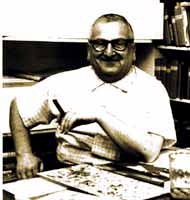
Born in Galicia and raised in New York City, Golden was a stockbroker, jailed for mail fraud during the
Depression, before moving to Charlotte, N.C., and beginning a career as a publisher. He called his
newspaper the Carolina Israelite. Its scope not limited to Carolina, it had a readership that transcended
geographic and religious boundaries.
He was a portly, liberal curmudgeon who often infuriated Southerners with his presciently liberal views.
“The civil rights movement is not for the Negro, it’s for America,” he wrote in 1966.
And this comment, quoted by Eli Evans in a book about life as a Jew in the South: “I got away with my
ideas in the South because no southerner takes me — a Jew, a Yankee, and a radical — seriously. They
mostly think of a Jew as a substitute Negro, anyway.”
“Golden was extremely popular in his time. He is pretty largely forgotten” in America today, Norman
Podhoretz, author of the recently published "My Love
Affair With America: The Cautionary Tale of a Cheerful Conservative," tells The New York Jewish Week.
Podhoretz, incidentally, used the “Only in America” line in his own book.
“The phrase, which I don’t think he invented, has lasting resonance,” he says.
What about the “Episcopalian” line?
“Lieberman definitely is not Episcopalian,” Podhoretz says, calling the selection of an Orthodox Jew
predictable. “All religions are much more accepted” in contemporary American society “than even in the
recent past. It doesn’t surprise me that the first Jew on a national ticket is an observant
Golden Moments


Steve Lipman is a staff writer with the
New York Jewish Week. Comment on this article by clicking here.

