
|
|
|
Jewish World Review August 14, 2000/13 Menachem-Av 5760
http://www.jewishworldreview.com --
THE X-MEN, for a
film that begins in a concentration camp and ends on
Ellis Island, is not big on Jewish values, although
there's an odd comparison struck between Jews and
another hunted, persecuted minority, super-powered
mutants.
Based on the Marvel comic book of the same name, “The
X-Men” addresses the problems of a specific group of
Super-Heroes who, by accident of birth, have gained extraordinary powers in
what we are told is “the next step in human evolution.”
The notion that a series of first-generation mutants would spontaneously
develop such varied abilities as walking through walls, weather control and
magnetism strains credibility. Still, it makes for a richness and variety that makes
oddly flattering the heavy-handed analogy between Jews and mutants.
That comparison would seem to be the primary motivation of “Magneto,”
(pronounced Mag-neat-oh) a super-powered mutant who has some rough plans
for the rest of us. As a child, he survived in a concentration camp while
his family and community died.
Based on this trauma, whose victims’ only crime was being
born different, his life experience has developed into a siege
mentality. This is brought to a head when a senator demands
that the United States government begin registering mutants,
whose strange ways and talents - it seems - could make them a
danger to the rest of us.
Patrick Stewart, most famous as the suspiciously Shakespearean captain
Jean-Luc Picard on television’s “Star Trek, the Next Generation,” portrays
Dr. Xavier, a mind-reading mutant who, unlike his magnetically empowered
counterpart, chooses a series of more positive pursuits.
Notably, he runs a school for gifted children. Their giftedness runs much
deeper than verbal, mathematical and creative talents and runs more in the
"laser-vision," “walking-through-walls” or “moving objects without touching” area.
Despite Magneto’s concentration camp number tattoo, the audience never quite
buys into his updated paranoia, in large part because the modern mutants he
worries about are a far cry from defenseless European Jews. One might
question the wisdom of having the only clearly defined Jewish character a
murderer (and arguably a madman), but there seems to have been a feeble
attempt at sensitivity in demonstrating Magneto’s commitment to keep history
from repeating itself.
There is another Jewish X-Men character, but in this film she only has a
walk-on . . . or rather, walk-through role. At Dr. Xavier’s school we catch
a glimpse of a young lady walking through a doorway without bothering to
open the door. This character will become Shadowcat, a walk-though-walls
heroine who - as they say - “happens to be Jewish.”
But there is a new Super-Hero team a bit more on-target with the Jewish
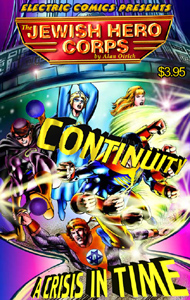
Values and positive Jewish Role modeling. The long-awaited first issue of the
Jewish Hero Corps Comic Book will be published this Fall.
Three years ago the Jewish Hero Corps came out as the first ever Jewish
Super-Hero Comic Book on CD-Rom. Now, Electric Comics is producing a real
printed paper standard comic book with a brand new story drawn by some of
the world’s top comic book artists.
The essential concept is to have a diverse group of Jewish heroes whose
common enemies are assimilation (“Jewish Amnesia”) and the unraveling of our
collective Jewish past.
This is the case in the upcoming full-length comic, which will be out before
Chanukah. “Continuity - A Crisis in Time” features the villainous Fobots,
who, in the CD-Comic, inverted computer memory chips to create “Forget-me-Chips”
whose function was to erase Jewish memories. This time out they’ve partnered
with the mysterious Apathons to use a time device called “The Zmonitor” to
try to unravel history by going back in time and “nudging” out of existence the
origins of Jewish Super-Heroes. In the process, the reader gets a look at some
until-now secret origins of members of the Jewish Hero Corps. This comic is built
around the origins, with epic tales that take the reader from Medieval Japan to the
brink of Space, from a small Jewish shop on Manhattan’s Lower East side to a top
secret laboratory.
The Heroes include Menorah Man, who can abruptly find himself with eight
flamethrowing arms. The just as aptly named “Dreidel Maidel.” Her powers,
which come from the alignment of electron orbits, allow the “Emerald
Hurricane” to spin around at speeds so tremendous that no one can see her perform her good deeds.
Yarmulkah Youth, (The Capped Crusader) inadvertently gets a name change to
“Kipa Kid” in this comic, the result of some tampering with time using the
unraveling device also known as the Time
Loom.
The story opens with the origin of the centuries-old shield carried by the
Sephardic superhero who calls himself “Magen David (Shield of David) in
honor of a mysterious heirloom forged by a distant ancestor, a shieldmaker to
kings.
Also appearing in the story is Shabbas Queen whose electromagnetic wand
incapacitates villainous electrical and mechanical devices . . . giving them
a “rest.”
Her wand, we learn, needs to be recharged for one day in seven, just as we
do.
Only Minyan Man -- who can multiply into ten when necessary – has an origin
that will remain secret for now.
The Title: “Continuity, A Crisis In Time” addresses Jewish communal issues
while referring to the standard comic book concern of retaining story threads and
logic in cause and effect, influencing both the past and future of characters. The
Comic is being published in cooperation with Leviathan Press, a company with
a great reputation for producing innovative materials that combat assimilation with Jewish
education for a cross-the-board Jewish audience.
In the spirit of keeping entertaining and educational Jewish available at
reasonable cost, the comic book is expected to be priced at $3.95. For
further information on the Jewish Hero Corps, click
 Move over X-Men,
here
come the Jewish Super Heroes
By Alan E. Oirich


Alan E. Oirich, a syndicated film columnist, covers Jewish pop-cultcha for JWR. Comment by clicking here.

