 |
|
|
Jewish World Review Oct. 14, 1998 / 24 Tishrei, 5759
OY, Bubba-leh! If only prez would have heeded Halacha (Jewish Law)
He quoted from a Reform prayer book in an effort to get the country to forgive him and claims to "know" the Bible in the biblical sense. Too bad Bubba ignored some of Judaism's most basic rules.
AN APPRECIATION OF a Jewish law could have saved President Clinton
from alot of his current troubles.
Ken Starr's recently released report contains eleven items that he lists may
constitute grounds for impeachment. Item IX in this list is the
accusation that President Clinton attempted to obstruct Justice by
influencing the testimony of his personal secretary, Betty Currie.
This alleged offense occurred when Clinton tried to plant in Betty Currie's
mind something we now know to be false --- that he was never alone with
Monica Lewinsky and that she, Betty Currie, could always see and hear
Clinton and Lewinsky when they were together. If one is going to engage
in obstruction of justice and witness tampering, this might seem like a
strange and feeble factoid to plant in Ms. Currie's head.
But it was at that moment that President Clinton achieved an understanding of the
value of the Jewish prohibition of yichud, and his argument to Ms.
Currie was indeed very cogent.
In the Jewish legal code such isolated male/female pairing with no
"chaperon" present is known as yichud, and with few exceptions is
prohibited. The laws of yichud are aimed at preventing situations in
which immoral behavior is likely to occur.
Not surprisingly some of the
exceptions include a husband and wife, a woman with her grandfather,
father, son, grandson, or brother, and a man with his grandmother,
mother, daughter, granddaughter, or sister. The prohibition does include
aunts, uncles, cousins, and in-laws. Many commentators categorize this
prohibition as biblically based.
Yichud situations can arise unexpectedly, for example when a homemaker
finds herself alone with a repairman or a female secretary with her male
boss. When there is a door open to a public thoroughfare there is no
prohibition. Similarly, if the woman's husband is in the same city and
knows his wife's whereabouts or if there is a halachikally recognized
"chaperon" there is no prohibition. This prohibition also applies if the
member of the opposite sex is non-Jewish.
Yichud is the term used not only for such proscribed activities but
also to denote a key component of a Jewish wedding. Since permissible
yichud epitomizes the spousal relationship it plays a central role in
the marriage ceremony. Following the legal proceedings that include
kiddushin, usually effectuated by the husband giving the wife a ring,
and the signing and giving over of the kesuba, the newly wed couple
retires to a private room "guarded" by two witnesses. It is this
yichud, that symbolizes that the couple has entered into a new
intimate relationship, that concludes the formal wedding ceremony.
A leading Reform rabbi, Eugene Borowitz, in a different context, has noted
that often the wisdom of our sages is not perceived until after one
learns through personal experience and hardship the lesson they were
trying to impart through liturgy and legislation. The lesson of yichud
is that due to the frailties inherent in being human, there are certain
drives to which, given the opportunity people will succumb. The Talmud
and Maimonides explicitly stated what may seem obvious, that the sexual
drive is one of the strongest and therefore requires the greatest
safeguarding. The Torah portion selected by the sages to be read on Yom
Kippur afternoon details the forbidden sexual relations. Reading this
section on the holiest day of the year stresses their significance.
By adhering to the sometimes onerous restrictions of yichud one will be
less likely to fall prey to those temptations. It is for this reason,
especially given the modern social climate, that the yichud laws are
still very much applicable and practiced today. I am aware of at least
two books devoted solely to clarifying the conditions under which the
prohibition of yichud applies.
Unfortunately for President Clinton, he learned this lesson not through
Jewish legislation but after it smacked him in the face following his
deposition in the Paula Jones case. For the rest of this country's
citizens, Clinton's troubles once again drive home the sense behind the
rules governing ambulance technicians, doctor's offices, and the laws of
yichud. It is also a reminder that we should trust that our tradition is
based on millennia of experience and wisdom and it pays to look for the
moral behind the liturgy and legislation through study and practice
before we learn it the painful way, as Rabbi Borowitz and President
Clinton each
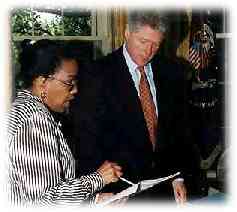
Bubba and Betty
By Ari Zivotofsky

Ari Zivotofsky, a suburban D.C. writer, is a researcher at the National Institute of Health in Bethesda, Maryland.

