 |
Jewish World Review / Oct. 14,1998 / 24 Tishrei, 5759
Remembering Nixon --- the 'anti-Semitic' prez who saved Israel during the Yom Kippur War
A FEW YEARS AGO I got a phone call from Marvin Kalb. He had just completed a
book about Richard Nixon, The Nixon Memo. The epilogue, Kalb told me, offered
forensic proof of Nixon’s anti-Semitism.
Kalb’s daughter, Debbie, who had
worked for the Jewish Telegraphic Agency -- the "Jewish Associated Press" -- during the years I had spent in
Washington, DC, told her dad I was just the man for the job. Would I do it,
Kalb wanted to know. Would I write about his book and its proof of Nixon’s
Jew-hatred?
Problem was, the chapter in question did not provide the knock-out punch
Kalb had promised.
You couldn’t read Kalb’s description of the harassment he had
faced by various federal agencies acting on Nixon’s orders without thinking
ill of Nixon. But nowhere did Kalb supply an anti-Semitic motive for the
harassment. Instead, Nixon perceived Kalb to be an enemy, as he did many
others in the media and elsewhere, because of the newsman’s politics.
According to Kalb, Nixon used the Internal Revenue Service to harass Kalb
and had Kalb’s phone “bugged”; Kalb’s CBS office at the State Department was
twice ransacked by men apparently looking for any information Kalb might have that
would be considered “classified material.”
Kalb believes his “first offense” against Nixon came in 1969 when he had
helped break the story of the administration’s “top secret” decision to
begin bombing Cambodia.
Kalb also ran afoul of vice president Spiro Agnew, who believed the
journalist had “…twice contradicted the president’s statement about the exchange of
correspondence with Ho Chi Minh” during a CBS news analysis of Nixon’s
speech on his meeting with Ho Chi Minh.
Nixon may have been anti-Semitic — later tapes from his archives show him in
a rather unfavorable light — but one would not be able to tell from Kalb’s
epilogue.
The only shred of evidence, and it is a shred, comes when Kalb cites Agnew’s
famous attack on the chattering classes as liberal think tanks, filled with
“nattering nabobs of negativism,” “elites,” “effete intellectuals” from the
Northeast engaged in “querulous criticism.” Kalb insists there was “an
undercurrent of anti-Semitism.…” in Agnew’s words — written, if I recall, by
William Safire, a bona fide Jew.
After reviewing the chapter, I phoned Leonard Garment, the Washington lawyer
who had played a key role in the Nixon administrations and who has defended
the late president against charges of Jew-hatred. Garment denied that the
administration sicced the IRS on Kalb; but even if it had, he insisted, it
was no sign of anti-Semitism. Kalb was a liberal journalist, Garment said, and
that was enough to make Nixon suspicious of him.
Was Nixon a Jew hater? The evidence piling up certainly suggests so. But the
question lingers because of his role in helping — many would say, saving —
Israel in the dark days of the Yom Kippur War, 25 years ago this week.
Israel had run dangerously low on ammunition until Nixon okayed sending
planeload after planeload to resupply the depleted Israeli military stocks.
In Israel, Nixon is recalled with great fondness as a true friend. This is true
particularly in the Israeli Labor Party, some of whose members were in the
Golda Meir government or in senior army positions during the ’73 war.
While estimates vary slightly, Col. Trevor N. Dupuy, U.S. Army (ret.),
writes in Elusive Victory — The Arab Israeli Wars 1947-1974 that the American
resupply included 815 total sorties bringing Israel 56 combat aircraft and
27,900 tons of munitions and supplies. Taken together with the Soviet
resupply to Arab countries fighting Israel, “military analysts” told Time magazine
that it was “the largest airlift in the history of both countries.”
The question lingers because of the steady rise in the number of politicians
who are vigorously pro-Israel and simultaneously at odds with the still
center-liberal agenda of the American Jewish organizational world and (to
judge by how they vote) the rank-and-file mainstream.
And it lingers because of the contradictory testimony offered last year by
two books, Garment’s engaging memoir, Crazy Rhythms, and Abuse of Power: The New
Nixon Tapes, edited by Stanley I. Kutler.
The Kutler book is based on more than 200 hours of Nixon presidential tapes,
whose release the scholar won in a 1997 suit. Newsweek and the San Francisco
Chronicle also reported on newly released Nixon tapes.
Garment was a colleague and friend of Nixon’s, who served in various
capacities in the White House, including counsel to the president. (He also
served briefly at the United Nations with Pat Moynihan.)
Naturally, he does
not think Nixon was an anti-Semite. Nixon was friendly to Garment, a
Brooklyn,
NY-born and reared former jazz musician and Democrat, and, he writes, there
were too many Jews high up in the administration. Moreover, Garment writes
that Nixon sided with the more pro-Israel elements in his administration,
dispatching Garment to New York to give then prime minister Meir a green
light
to attack the Middle East peace plan just released by Nixon’s state
secretary,
William Rogers.
Nixon wasn’t only sweet on Israel, a small anti-communist country that was,
wonder of wonders, a democracy to boot. Israel had “moxie” — an in-your-face
readiness to face up to dangerous enemies. Nixon was the first president to
recognize, for purposes other than pro-Israel lobbying, that there was an
American Jewish community system. The Conference of Presidents of Major
American Jewish Organizations greatly expanded its role under Nixon, in
large
part because of close ties between the president and Max Fisher of Detroit
and
Jacob Stein of Long Island, New York. J.J. Goldberg, in his book Jewish
Power,
goes so far as to say, “Under the Nixon administration, the Presidents
Conference became what it had always aspired to be: the official voice of
American Jewry.”
The same thing happened with Soviet Jewry. Nixon and Kissinger may have
opposed the community’s support for the Jackson-Vanick amendment linking
trade
tariffs to emigration, but they went along with it when they had to. Fisher,
a
lifelong Republican, now says (in Goldberg’s book) that Nixon may have been
right, after all.
“History has proven I was probably right when I opposed Jackson-Vanik,” says
Fisher. “Nixon was trying to work it out by personal diplomacy,” Fisher told
Goldberg. “Kissinger thought he could get out 30 or 40,000 a year if they’d
worked that angle. When you think of it over 20 years, you could have gotten
out quite a number of Jews.”
“It remained for Richard Nixon,” Goldberg writes, “to create the now
familiar
U.S.-Israel alliance… It was Nixon who made Israel the largest single
recipient of U.S. foreign aid; Nixon who initiated the policy of virtually
limitless U.S. weapons sales to Israel. The notion of Israel as a strategic
asset to the United States, not just a moral commitment, was Nixon’s
innovation.
“Yet Nixon was widely reviled in the Jewish community…. And the dislike was
mutual.”
The evidence of that dislike continues to pile up. In 1997, the San
Francisco
Chronicle reported that White House tapes show that in September 1971 Nixon
urged IRS investigations of wealthy Jews who contributed to 1968 Democratic
presidential candidate Hubert Humphrey and former Maine senator Edmund
Muskie.
“Bob,” Nixon told adviser Bob Haldeman, “please get me the names of the
Jews,
you know, the big Jewish contributors of the Democrats.”
Nixon also said that the IRS was going “after [Billy] Graham,” because the
agency “is full of Jews, Bob…. That’s about what I think. I think that’s the
reason they’re after Graham, is the rich Jews.”
After reviewing the newer tape transcripts, Abraham Foxman, national
director
of the Anti-Defamation League, said they confirmed that Nixon was “an anti-
Semite,” having “absorbed every ugly stereotype.”
But Garment, writing in the Forward following the San Francisco Chronicle’s
report of the new tapes, said some of the passages quoted were simply not
there in the tapes.
Garment also insisted, as he had when I called him about the Kalb book, that
“there is, however, a more important question: Do remarks like these, even
if actually made and accurately reported, mean that Nixon was an anti-Semite?
The
familiar fact is that Nixon appointed a number of Jews to the highest
positions in his administration — men like Henry Kissinger, Arthur Burns,
Herbert Stein, William Safire, Larry Silberman, Arnold Weber, Richard
Nathan,
me and many others. He characterized Jews (and other ‘groups’) in hostile
terms when he was blowing off steam in angry private staff meetings, but the
object of these remarks were people he saw as political enemies.
“He was the opposite of an operational anti-Semite in his public
appointments,
speech and behavior and, most importantly, his presidential decisions.
Consistently so: Yitzhak Rabin held him in the highest regard, according to
Rabin’s close friend, Yerach Tal, the American editor of Ha’aretz. Golda
Meir
describes Nixon in her autobiography as the best friend Israel ever had in
the
presidency and does so in life and death terms.”
One example supporting Garment’s read comes in the tapes when Nixon and
Haldeman discuss several political foes. “The Times reporter,” Haldeman
says,
“I can’t remember his name, but it wasn’t what struck me as a Jewish name.”
“You can’t tell that way,” Nixon responds. “But what the hell. And
incidentally, suppose they’re both Jews and that has nothing to do with it,
but it at least gives you the feeling of the possible motivation deep down
of
the liberal leftists.”
Personally, I had always distrusted Nixon on the Jewish question. I grew up
in
a neighborhood that was way off, to the left, of Nixon’s political charts.
People I knew were still sore at him for being nasty to Helen Gahagan
Douglas,
his opponent when he first ran for Congress. In the late 1970s, Al Barkan,
the
late director of the AFL-CIO’s political committee, told me how during the
1960 presidential election he had managed to find the contract for Nixon’s
Virginia home. Nixon had signed a restrictive covenant — the home could not
be
resold to Jews or blacks. Barkan’s committee duplicated the contract and
distributed it widely.
One day, an FBI agent visited Barkan, saying the Nixon campaign folks were
pretty upset about it. “Is there anything illegal here?” Barkan asked. “No,”
the agent, obviously sent over to intimidate, sheepishly admitted. “And by
the
way,” he said on his way out, flashing a JFK pin under his coat lapel, “keep
it up, you’re killing them.”
People recall Nixon as either an unscrupulous, paranoid, bigoted and
vindictive demagogue or as a great statesman, Israel’s best friend. American
Jews will remember him as both.
By David Twersky
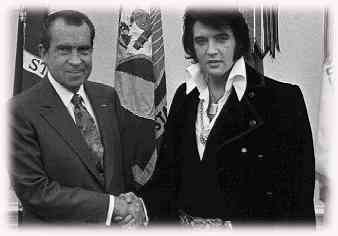
Could a president who agreed to Elvis' request
to meet him have been all that bad?

JWR contributor David Twersky is Editor in Chief of the New Jersey Jewish News.


8/11/98: Does a 35 year-old song hold the secret to the world's future?
8/05/98: The strange case of 'Brother Daniel'