
|
|
|
Jewish World Review / Sept. 25, 1998 / 5 Tishrei, 5759
 |
|
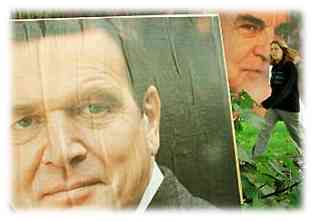
A woman passes posters of Germany's two candidates for chancellorship, Kohl, in back, Schroder, in front. |
A vote for memory?
BERLIN --- An empty field near the border of the
pre- and post-Communist capital of Germany is
dividing the country again.
A German Holocaust memorial, the first one with
a national scope, is to rise on a 17-acre building
site near the towering Brandenburg Gate that
formerly separated East and West Berlin.
The subject of a national debate, as well as an issue in the election for
chancellor coming up Sunday, its future now is in doubt.
The planned memorial — once supported by Germany’s politicians,
intellectuals and general public — again is forcing the German people to
come to grips with the horrors of their 20th century past. While the idea of
a memorial to the Holocaust has wide support, the size and cost of this one
has drawn wide opposition.
Incumbent Chancellor Helmut Kohl, trailing in most polls, is in favor of the
memorial, although he postponed final approval until after the election,
pending the subsequent approval of the Berlin city council and a citizens’
initiative.
Kohl’s likely successor, Gerhard Schroeder of the Social Democrat Party, is
against the memorial, as are leading German left-wing intellects and,
according to a recent survey, most Berliners.
Schroeder’s likely choice as culture minister, former book publisher
Michael Naumann, opposes the memorial on the grounds that it would set
the wrong tone for a “self-assured” land. Naumann said the memorial was
reminiscent of the work of chief Nazi architect Albert Speer, an explosive
analogy that drew rebukes but also applause from the numerous critics.
New questions were raised about the project this summer, when American
artist Richard Serra, partner in the design favored by Kohl, withdrew for
what he called personal and professional reasons. Serra’s former
teammate, New York architect Peter Eisenman, indicated he would carry
on alone.
Serra’s resignation was the latest dramatic installment in the memorial
series, a 10-year-old brainchild of Hamburg television personality Lea Rosh
and Stuttgart history professor Eberhard Jaeckel. It is slated to cost more
than $10 million and open in 2000.
The Serra-Eisenman design consists of 4,000 stone pillars on a stark plaza
of more than 180,000 square feet. The overall effect is said to be that of a
graveyard-like labyrinth which can be entered from any of its four sides.
After years of public debate and two design competitions, a group of
German writers earlier this year published an open letter to Kohl saying no
artwork could symbolize the Holocaust, and that the money should be
spent on research and protecting memorials at several former
concentration camps and death camps around the country. And Berlin
Mayor Eberhard Diepgen, a member of Kohl’s Christian Democrats who
has long maintained close relations with the Jewish community, led an
increasingly populist campaign against it. He called the memorial grandiose
and said the center of Berlin had no historical connections to the
Holocaust.
The grassroots debate continues.
Some critics ask why the memorial should be dedicated to Jewish victims
only. (A separate memorial has been planned for the Gypsy victims, and
advocates for homosexual victims are fighting for one, too.) Others want to
know why Berlin’s scattered memorials — marking deportation sites, for
example — aren’t enough. Still others ask when they can stop talking
about the Holocaust, once and for all.
More than 56 years after the “Final Solution to the Jewish Question” was
mapped out at a villa in Berlin’s Wannsee suburb, the Holocaust is not
about to go away as a topic of discussion here.
“The years of debate are itself like a monument,” says Jens Jessen, culture
editor at the Berliner Zeitung newspaper. “It is not only a debate about the
memorial but about how Germans work with Holocaust history. It is one of
the most intelligent discussions we have ever had.”
Oft invoked is the word Schlussstrich, or bottom line, after which the
Holocaust need not be discussed. “There is a saturation point being
reached in the public,” says Die Ziet’s Berlin correspondent, Klaus Hartung.
“But I am convinced there will never be a Schlussstrich.”
Hartung observes evolution of the discussion in his own family. “My
daughter knows what Auschwitz was, but she does not see herself as a
member of a nation of criminals.”
German Jews have chimed in, almost all in favor of a memorial. But there
is general agreement that it should be planned by and for all Germans, and
not by and for German Jews (there are about 70,000 here now, nearly
doubled in the last several years through emigration from the former Soviet
Union).
“We as Jewish people don’t need a memorial to remember,” says Norma
Drimmer, vice president of the 10,700-member Berlin Jewish Community.
“When I say a memorial should be built, I say this as a member of this
generation of Germans, as a citizen of this city,” says Drimmer, whose
family lost more than 300 members in the Holocaust.
“Mayor Diepgen is the man who caused this shambles,” says Michel
Friedman, board member of the Central Council of Jews in Germany.
“Diepgen doesn’t want Berlin to be a city of repentance. So he delayed it,
chopped it down and pulled it into the campaign. It’s a scandal. We can
live with a decision not to build. But we can’t live with a hypocritical
decision not to decide.”
Bruce Ramer, president of the American Jewish Committee, last week
urged erection of the memorial, calling it “an absolute necessity.”
“Embracing the memory of the Holocaust is for Jews a sacred matter,”
Ramer said. “It should be no less important for Germans. In the
half-century that has passed since those dark years, Germany has
shouldered its responsibilities in unprecedented ways. The building and
establishing of an appropriate Holocaust memorial seems a fitting symbol
of that responsibility.”
The debate reveals the many-layered relationship Germans today have
with this chapter of their history. In a nation where millions of citizens have
little firsthand experience with democracy; where joblessness often is
blamed on so-called foreigners; where a radical right-wing party recently
reaped a stunning 12.9 per cent in a state election; and where neo-Nazi
crimes (from bomb-making to physical attacks) have surged in the last year,
Berlin’s Holocaust memorial is another sensitive topic.
Its planned site, bigger than a football field, is surrounded by a high
wooden fence posted with signs that warn, “Verboten,” [entrance]
forbidden.
On one recent afternoon, double-decker buses pass between the columns
of the Brandenburg Gate, casually crossing where East German soldiers
once stood watch with orders to shoot.
A 46-year-old engineer passing by the site pronounces plans for the
memorial too big. But, he says, “It is sensible to have a special memorial for
the Jewish people because they suffered the most, and right here in Berlin,
too.”
“There are still Nazis in Germany,” says Alexander Jordan, 26, of Hamburg.
“It is important to remember what happened. It can happen again because
there are too many jobless.”
“It should be not only for the Jews but for all the victims, the Poles, the Sinti
and Roma,” says a 26-year-old man, using the formal terms for the major
Gypsy groups.
Lars Mueller, a 28-year-old student, says he prefers a rejected proposal for
the memorial — a bus station offering educational trips to Auschwitz. Says
his friend, 37-year-old Joerg von Stein, “The discussion about the whole
thing [is] absolutely unbearable. They have been discussing for 10 years,
and nothing has happened.”
Fears that a memorial would attract vandalism are not unfounded. Three
times since last December, vandals have defaced a stone that marks a
deportation site on Grosse Hambuger Strasse, most recently with swastikas
and the word Schweinkopf, pighead.
A temporary volunteer-watch program was established there, together with
a police guard. It’s a good listening post for opinions on the controversial
memorial, says Friedhelm-Leonhard Lennartz, who served as a volunteer.
“Every night we hear passers-by say things like, ‘That sh—-y memorial, it
costs too much, and look at what the Jews are doing to the Palestinians.”
“It is my opinion that people with such opinions are mostly drunk,”
Lennartz says. “But there’s a German saying, ‘In wine is the
As Germans go to the polls on Sunday for their elections, a planned National Holocaust Museum is emerging as a symbolic -- and divisive -- issue
By Toby Axelrod

Toby Axelrod is a Berlin-based journalist.

