|
|
|
Jewish World Review July 3, 2001 / 12 Tamuz, 5761
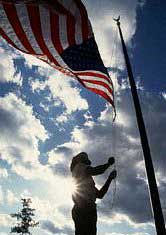
"Take off your hat," my father said.
The man didn't respond. "Hey you," my father said, louder, "take off
your hat."
The man grunted an unintelligible, though clearly dismissive remark.
"You unpatriotic SOB," growled my father; he didn't abbreviate, either.
"Dad!" I whispered, mortified and afraid, but also faintly confused. My
father had never before demonstrated any dramatic displays of patriotism.
The national anthem ended, the game began, and I guess I forgot about the incident
because I never discussed it with my father, never asked him to explain an indignation that
seemed entirely out of character.
But now I'm a father myself, and I don't find my father's action thirty years ago
perplexing at all.
Why should we take off our hats for the national anthem? Why should we stand up for
the flag? Why should we address strangers as "Sir" or "Madam," wear coats and ties to religious services, and give up our seats to the elderly?
It's a matter of respect. Respect for people. Respect for institutions. Respect for
wisdom and values and human dignity.
Unfortunately, respect has been going out of fashion for a long time. Sex scandals and
no-fault divorce have eroded respect for marriage and commitment. Partisan politics has eroded
respect for leadership. Inflated grades and deflated standards have eroded respect for
teaching. Abortion-on-demand and doctor-assisted suicide have eroded respect for life.
"Reality television" has eroded respect for ourselves.
Which was our first step onto this slippery slope? Maybe it was the noble ideal of
social equality, set spinning so wildly out of control that we began to equate respect with
elitism. Maybe the information glut convinced us that we know as much about medicine as our
doctors, as much about cars as our mechanics, and as much about education as our children's
teachers. Maybe our relentless pursuit of leisure time has made us too selfish to value age
and experience, too lazy to act civilly toward our neighbors.
When respect is not earned, it disintegrates; when respect is exploited, it implodes.
Indeed, after his desperate quest for legacy, our recently departed Bill Clinton may end up
best remembered as the American president who made his underwear preferences a matter of public
policy, who pilfered the White House china, and for whom a large percentage of
once-self-respecting Americans so casually excused perjury in federal court.
But we should never rely on respect to percolate down from the top; it is our
responsibility to grow it up from the grass roots. It is the job of parents to teach their
children to say "please" and "thank you," to not interrupt and not talk with their mouths full,
to speak civilly and give up their seats to the elderly, to pick up their own litter and maybe
even someone else's. By doing so, parents instill in their children an intuitive sense of
respect for others, even if their children may not understand why all these social minutiae are
indispensable.
But too many parents have abdicated that job, either because they're not around enough
or because they never learned to be respectful themselves.
The Talmud says that where there are no leaders, strive to be a leader yourself. In
today's increasingly fatherless society, teachers, scout leaders, and little league coaches
have a greater obligation than ever to teach respect by showing respect for others -- and so do
we all every time we walk down the street or through the supermarket aisle.
A journey of a thousand miles begins with a single step. And a journey through life
begins with a step in the right direction. Help a child take that step and, many steps later,
his success will speak his thanks louder than words.
And, by the way: Thanks,
 Respect matters
By Rabbi Yonason Goldson

JWR contributor Rabbi Yonason Goldson teaches at Block Yeshiva High
School and Aish HaTorah in St. Louis, and writes a regular column for the St.
Louis Post-Dispatch. Send your comments by clicking here.

