
|
|
|
FOR JEWISH BASEBALL FANS in Detroit it’s been a long wait.
In 1946,
Hall of Fame first baseman Hank Greenberg played his last game at Tiger
Stadium. Now, nearly 53 years later, another Jewish player is beginning to
make his mark in Motown, and at this point there may be no telling just how
far he may go.
At 23, Tiger center fielder Gabe Kapler has the look of a future star. The
Southern California native is already a legend for what he accomplished last
year in the minors. Last year the 6-2, 208 lb. Kapler was the baseball minor
league player of the year. His offensive numbers were huge — a .322 batting
average, 28 home runs, 319 total bases, 47 doubles and a minor league leading
144 RBIs. After a strong spring training this year, the Detroit front office
thought so highly of Kapler that they traded their speedy outfielder Brian
Hunter away so Kapler could play every day. Since becoming a regular Kapler
has already hit 8 home runs and knocked in 21 RBIs — not phenomenal stats,
but respectable for 135 at bats.
Hollywood born, Kapler is an avid bodybuilder who has already earned a
national television contract endorsing the KSwiss athletic line. Unusual for
a rookie, especially for a player with less than half a season’s experience
in the majors. In fact, five years ago Kapler was still playing high school
baseball and only dreamed of getting drafted. After attending Cal-State
Fullerton and Moorpark Jr. College, Kapler was a late-round draft pick by the
Tigers. But his work ethic surprised the Detroit front office, and he put
together three outstanding years in the minors. After last year’s monster
season, the center field job was his to lose.
Kapler is proud of his family, his background and “Jewish blood,”
In the small fraternity of Jewish major league baseball players, Kapler
already stands out. He’s spoken with Shawn Green, another Jewish kid from
California, who is on his way to superstar status in Toronto.
Superstar is not a word they’re using yet to describe Kapler in Detroit. He
won’t duplicate his Southern league season this year, but look for his
numbers to increase steadily over the next few years. Kapler sets high goals
for himself and would be happy if he was able to hit 20 home runs and get 450
at bats. His manager, Larry Parrish, is a believer. “He’s got his own style,”
Parrish said before a Tiger-Red Sox game. “The one thing you really like
about him is his makeup. His ability to grind, and his mental capacity is
really tough.”
Tiger first baseman Tony Clark, one of the most feared power hitters in the
American League is also dutifully impressed. Said Clark, “Kapler is in the
big leagues for one simple reason, and that is because of his work ethic.”
Kapler, an articulate, polite player is not quite like the “Bull Durham”
rookie who “takes every game one day at a time.”
“It’s an overall feeling of being successful. That’s why I play this game.
It’s an incredible rush.”
And hitting home runs?
“You could get real descriptive about it but it’s just an adrenaline rush.
It’s also a feeling of release, like you just exhaled — you’re holding your
breathe and G-d, you just want success so bad and you want to help your team
and you do it. It’s a relief.”
Up in Detroit, no one is anointing Kapler as the next Greenberg. They’ll be
satisfied if he begins to approach his potential. Throughout America though,
Jewish fans are sitting back and waiting, reading the box scores and looking
at the numbers next to Kapler’s name.
Folk hero, star or platoon player,
Kapler already is a
Jewish World Review June 16, 1999 / 2 Tamuz, 5759
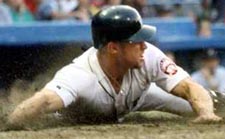 In the shadow of Hank Greenberg, a slugger emerges
By Steven Rosenberg
 Kapler comes from a family of educators. His mother is the director of a
Jewish preschool, Adat Ariel, in North Hollywood. His father teaches and
produces children’s music. Sitting in the visitors dugout at Fenway Park,
Kapler reflected upon his Jewish upbringing: “Up until the time I was eight
we celebrated Christmas. Both my parents are Jewish but neither one of them
really celebrated their heritage. And then all of a sudden things turned
around. My mom decided she really wanted to celebrate her heritage. I had a
bar mitzvah when I was 13.”
Kapler comes from a family of educators. His mother is the director of a
Jewish preschool, Adat Ariel, in North Hollywood. His father teaches and
produces children’s music. Sitting in the visitors dugout at Fenway Park,
Kapler reflected upon his Jewish upbringing: “Up until the time I was eight
we celebrated Christmas. Both my parents are Jewish but neither one of them
really celebrated their heritage. And then all of a sudden things turned
around. My mom decided she really wanted to celebrate her heritage. I had a
bar mitzvah when I was 13.”
 What’s the best part of playing baseball?

Steven Rosenberg is editor of Boston's
Jewish Advocate. Send your comments to him by clicking here.
