
|
|
|
Jewish World Review June 29, 1999 / 15 Tamuz, 5759
AS THE LEADER of his youth group, Jason Moore fights the same
battles as any kid in his position, trying to get others to become more
active. If they resist, he listens to their reasons, but he doesn't hear them;
Jason is hearing-impaired. His youth group is Our Way, a group for Jewish
deaf.
A Los Angeles native, Moore was in Chicago in this month for the Our
Way shabbaton, a four-day convention. He joined 120
hearing-impaired Jews of all ages and backgrounds, who came to share a
Jewish experience with other Jewish deaf.
And Lederfiend knows. His two children are deaf, and so are his
parents. Accordingly, Our Way provides programming for Jewish deaf of all
ages. "We want everyone to be Jewishly involved," he says.
The shabbaton, which received funding from the Jewish United Fund
of Metropolitan Chicago, promotes Jewish involvement, with three Shabbat
meals and kiddush and Hamotzi being perfomed in Hebrew sign language, for
example. Before Shabbat, the group, which in previous years has met almost
exclusively on the East Coast, toured the Sears Tower, Navy Pier, and the
Shedd Aquarium.
While open to all Jews, Our Way, which has chapters across the
country, aligns itself with Orthodoxy movement and is run under the
auspices of the National Jewish Council for the Disabled and the National
Conference of Synagogue Youth, a division of the Orthodox Union.
"Many [Jewish deaf] are estranged because they don't go to day
school, and because of community issues it's difficult [for them] to be
involved. This [shabbaton] is a chance for them to experience Shabbat, to
meet other deaf Jews," said Libby Chernoff, convention coordinator, whose son, Daniel, 15, is deaf.
But the convention, held at Congregation K.I.N.S. in West Rogers
Park, wasn't just about the deaf; it was for the hearing as well. The musaf
service in the main sanctuary, for example, was interpreted into sign
language.
"Many people have never met a deaf person, let alone a Jewish deaf
person," said Chernoff. "By meeting the people they can discover what
their needs are." She hopes that more interaction with deaf people may lead
congregations to provide sign language interpreters at more prayer services
and lectures.
JFCS works in the Chicago community to help deaf children gain access to
Jewish community centers, day schools, and religious institutions, Meyers
explained. In smaller cities, where the Jewish and deaf populations are low, it
can be a real struggle.
"How do you hold a minyan if there are only three [Jewish] deaf
people in the town?" she said.
INTEGRATION OR SELF-CONTAINMENT
The manual has been sent out to many Orthodox
day schools, and Jacob plans to send it to all Solomon Schechter Schools
shortly. Any school or teacher may obtain a copy of the handbook, which
includes specific examples of what to do in a classroom.
Jacob explained that within the Jewish deaf community there are two
schools of thought: those who want to be fully self-contained, and those
who want full integration. "But even the self-contained want to know that
the education their children are getting is fully equal," she said.
DEVELOPING LEADERS
"It gives us a chance to socialize, to meet new people, see old faces,
and have neat experiences," he said.
But the shabbaton presents an inherent conflict for Jewish deaf, who
often get turned off from the hearing community, said Lederfiend.
"Judaism for deaf kids is different. They get inspired at this
convention" then where do they go? At their shul they don't understand
the rabbi. They don't know what page [the congregation] is on." Our Way
does what it can, trying to get schools and synagogues to be more
accommodating.
Still, the convention is a place where kids can be themselves, said
Lederfiend.
"Even if they're successful [in school or their synagogue], they're
only following everyone else, trying to figure out what's going on; they
can't be a leader. Here, they can be a
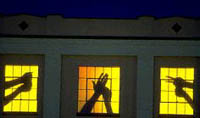 Hearing it their way: Convention brings together Jewish deaf from around the country
By Sid Singer
 "For many of these kids, it's their first opportunity to meet other
Jewish deaf," explained Rabbi Eliezer Lederfiend, Our Way founder and
executive director. Aware of how few resources were available to Jewish
deaf, Lederfiend started the group back in 1969; but things haven't changed
all that much. "Even today, the vast majority of Jewish deaf groups are
either senior citizens or adults," he said.
"For many of these kids, it's their first opportunity to meet other
Jewish deaf," explained Rabbi Eliezer Lederfiend, Our Way founder and
executive director. Aware of how few resources were available to Jewish
deaf, Lederfiend started the group back in 1969; but things haven't changed
all that much. "Even today, the vast majority of Jewish deaf groups are
either senior citizens or adults," he said.
 "For these kids this is their only real peer group," said Linda Meyers
of Jewish Family and Community Service (JFCS), which provided
consultation for the conference. "In most of their Jewish schools they'll be
the only deaf kids, and in their deaf groups they'll be the only Jewish kids."
"For these kids this is their only real peer group," said Linda Meyers
of Jewish Family and Community Service (JFCS), which provided
consultation for the conference. "In most of their Jewish schools they'll be
the only deaf kids, and in their deaf groups they'll be the only Jewish kids."
Aside from providing classes for adults and social events for kids,
Our Way has helped integrate more than 150 kids into yeshivas and day
schools throughout the country, Lederfiend explained. Batya Jacob, a New
Jersey teacher, wrote a handbook for teachers on mainstreaming
hearing-impaired children into Judaic classrooms. The issues that arise for
students include reading lips in a foreign language (the interpreter often must
first translate into English); looking at a Jewish text and an interpreter
simultaneously; and alternatives when students can't see the teacher's lips
(e.g., if he has a beard).
Moore, 16, has been involved with Our Way for five years, and now
serves as the national president. He encourages his peers to get more
involved.

Sid Singer is a staff writer of the
JUF News, a monthly published by the Jewish Federation of Metropolitan Chicago. Contact the author or the magazine by either clicking here, or calling (312) 444-2853.

