
|
|
|
Jewish World Review June 2, 2000 / 28 Iyar, 5760
Louis Jacobson
http://www.jewishworldreview.com --
KALVESTA, Kansas -- More than a century ago, in this flat, desolate corner
of Kansas, a few dozen Jews tried to squeeze out a living. Now, 42 miles
from Garden City, the nearest town of any size, I'm looking for the remains
of their fleeting society.
"Don't step on the rocks--there might be rattlesnakes under them!" Randy
Thies calls out to me. Randy is a Kansas state archaeologist, so he's used
to snakes. He also knows how to maneuver a 4x4 through 3-foot-high weeds,
which is good, because if it weren't for him, I wouldn't be anywhere near
Beersheba, the first Jewish agricultural settlement in Kansas.
Beersheba was established in 1882 by 60 newly arrived Jewish immigrants
from Russia. Each family homesteaded 160 acres, living in houses made of
sod--the thick ribbons of prairie earth that settlers stacked into
buildings. Beersheba settlers also turned sod into a synagogue and a school;
they used cow chips for fuel.
In winter, the colony endured major blizzards; during the summer,
droughts were common. A popular lament of the time was, "In G-d we trusted.
In Kansas we busted."
Pat Smith, a researcher who joined Randy and me for the visit to
Beersheba, tries to put it in context. "As you stand here sweating"--it was
100 degrees the day we visited--"think of what it was like 117 years ago.
The wind was the only cooling they had."
As Pat says this, we gaze out toward the ruins of the Ravanna
schoolhouse, which was built in 1887. Ravanna was a town located four miles
from Beersheba; at its peak, Ravanna was home to 700 people, of which about
10 to 15 were Jewish. Historians think that most of the Jews in Ravanna
opened businesses there after deciding that the economics of family farming
in dusty southwestern Kansas were too grim.
Ravanna survived into the 1890s, as residents erected an expensive stone
courthouse that became known as "The Great White Elephant." But the town
eventually became embroiled in a bizarre war with its
neighbor--Eminence--over which would become the seat of Garfield County. So
costly was the war that the state stepped in, merging Garfield County into
Finney County. That was the final blow. Within a few years, just about
everyone had left.
Today, the Ravanna schoolhouse--which once stood at the center of a
bustling little town--is nothing more than a jumble of limestone fragments
in the midst of a vast, windy prairie. All around are small cacti and clumps
of tickle grass, a distant relative of wheat.
We head across the dirt-and-gravel road to the former site of the Great
White Elephant. It's now a cow pasture, ringed by an electrified shock
fence. Randy and I go inside (with the advance permission of the landowner,
as is the practice out here) and make our way toward the ruins. Prairie
weather can be bad, but even a century's worth isn't going to reduce
limestone to mere remnants; instead, these stones were cannibalized by
humans, in the 1940s, when a football field had to be built in Dighton, a
town to the north.
Randy, who hasn't walked up to the ruins since his youth, suggests that
we not get too close or stay too long--those darn rattlers again. So we
scramble back to the 4x4s. On the way out, the electric fence brushes
against my lower back and gives me a mild shock. I shake it off.
Don Cramer, a freelance researcher who has joined us for the outing,
stares into the distance. "On a day like this 100 years ago, it must have
looked like pretty bleak country," he says. "They must have had a lot more
confidence than I would have. A lot of people said this land would never be
settled. Seeing this, you understand what they mean."
EGO KILLS A SETTLEMENT
Donald Douglas, a retired historian at Wichita State University, has
studied Kansas' seven Jewish agricultural settlements--Touro, Leeser,
Beersheba, Lasker, Gilead, Montefiore and Hebron. All were located in the
state's largely empty southwest corner; their impulses ranged from utopian
socialist to individualistic. (Other Jewish farming settlements were
established in the Dakotas, Colorado, Utah, Oregon, Arkansas, Louisiana,
Michigan, New York and New Jersey.)
Beersheba, the first of the Kansas settlements, was probably the most
unusual. It was the brainchild of Isaac Meyer Wise, the founding father of
Reform Judiasm in America. Like many assimilated American Jews of the late
1800s, Wise feared that large numbers of black-garbed, Yiddish-speaking Jews
emigrating from eastern Europe threatened the hard-won social status of
German and Sephardic Jews, who had been in America for decades.
So Wise and his allies proposed steering the new immigrants toward the
hinterlands, where they would be far from the "labor troubles, socialism and
anarchism" of the cities, as Wise's American Israelite put it in 1887. To
be sure, Wise's impulse was partly high-minded--he wanted to accustom the
newcomers to America and aid them economically--but many observers today
view his general approach as embarrassing.
In early 1882, Wise helped launch the Cincinnati-based Hebrew Union
Agricultural Society. Agents for the society chose a tract of land in
southwest Kansas, and by late July--after an unruly, harrowing trek that
included evictions from train cars and (nearly) from a hotel in Kansas
City--two dozen Russian Jewish families moved in.
The colonists seem to have faced little if any anti-Semitism from the
local farmers; indeed, the farmers were eager to welcome "the Russians"
because they provided additional bodies to defend against incursions by
cattle herders, who were eager to occupy any land with grazable grass.
It was this cattle-vs.-farmer battle that ultimately hastened Beersheba's
demise. In the spring of 1884, some of the settlers leased their lands to a
cattle syndicate. The colonists' chaperone, Charles K. Davis, applauded the
move, saying it gave the colony the badly needed capital that Wise was not
supplying. But Wise reviled the decision and retaliated swiftly,
ordering the repossession of the settlers' farm implements.
While legal, the decision strikes many historians as wildly
disproportionate. The decision all but put the kibosh on Beersheba. By 1885,
the settlement was completely abandoned, with settlers scattering first to
Ravanna, and then to Kansas City, St. Louis and smaller towns and cities in
the Plains. A few descendants who married into non-Jewish families remain as
farmers today.
Historian Douglas points to several causes of Beersheba's failure. "The
timing was abominable," he says over lunch in Wichita. "They came to Kansas
at a time when Kansas was really showing its best face--a seven- or
eight-year period when there was abundant rainfall and when things looked
great. But from the time they began, a dry spell hit, and in the winters
they faced severe blizzards."
Douglas also cites poor land ("the good land was gone by 1880," he says),
bad location (far from a railroad line), low commodity prices and--not
least--the Jewish colonists' total lack of farming experience.
Still, historians say, everyone in southwestern Kansas then--Jewish or
not--had similar experiences. "They all faced the same troubles together,"
says archaeologist Thies.
RECLAIMING ROOTS
Bart, an attorney and bank president, and Mary, a retired college
administrator, have spent years trekking across the state, researching
Jewish history in Kansas. They've braved rusty-nail injuries and muddy side
roads to meet with descendants of Jewish settlers.
A few years ago, the Cohens proposed placing a historical marker near the
settlement site. The state agreed, and on a frigid day in November 1998, the
Cohens helped unveil the marker at a highway rest stop near Kalvesta.
To the Cohens, Beersheba and the other Kansas settlements were not
failures at all. Sure, they acknowledge, sending non-farmers to the
inhospitable West seems like the ultimate folly. But they contend that
Beersheba and the other settlements provided many Jewish immigrants with a
better start than they would have had in most cities.
By holding and using their land, Jewish homesteaders could rent, lease
or--if enough time had passed--take title to it from the government. Any of
those options provided crucial capital which they could then use to start
businesses in cities. Several Beersheba settler families became influential
business and political leaders in early 20th Century Kansas.
"At the time they sold, the value of the land was as high as it got for a
long while," Bart Cohen says.
*** Weary from the heat and the mileage, we drive on to our last stop of the
day, the small Jewish Cemetery north of Garden City. Blink and you'll miss
it: The cemetery is a small collection of graves cut out from the corner of
a soybean field. The cemetery includes some Beersheba settlers, though most
of them probably died long after the settlement itself had passed into
history.
Pebbles rest on some of the nameplates.
Don Cramer, the freelance researcher traveling with us, is not Jewish. He
says he became interested in Beersheba when he accidentally stumbled across
a reference to it while researching local history. Its existence was such a
shock that he found himself drawn in. "If someone had said there was an old
Jewish community around here," he says, "I wouldn't have believed it. So I
thought I'd find out what I could about
The Promised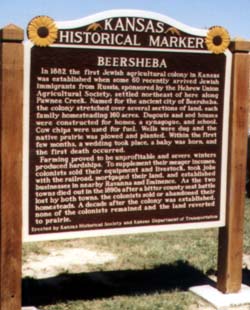
Land of Oz

Because the notion of Jewish farmers in southwest Kansas seems so odd,
Beersheba has attracted a small but notable following. To be sure, whenever
trains went west toward the frontier, Jews usually numbered among the
passengers. But most went to conduct business in towns and cities. Perhaps a
mere 20 percent came to farm.
It took Barton and Mary Davidson Cohen, a Jewish couple from the Kansas
City suburbs, to bring Beersheba back from obscurity.
JWR contributor Louis Jacobson writes for National Journal. Comment on this article by clicking here.

