
|
|
|
Jewish World Review June 13, 2000 / 10 Sivan, 5760
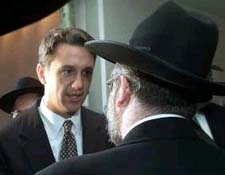 |
| New York senate hopeful Rick Lazio, at Orthodox grassroots group Agudath Israel's annual dinner |
http://www.jewishworldreview.com --
IN WASHINGTON, the election season has begun in earnest. Here, one can sense
it far in advance. Not much legislative business gets transacted. Members
of Congress are apprehensive about going home with a "record" that can be
used against them by their November opponents. It is funny - and telling -
that no one considers the possibility that the record might actually be one
of achievement.
This does not mean that Congress is not busy. Indeed, its legislative plate
is full. But which bills merit consideration during this short legislative
calendar depends little on substance or need. Nor does it deter anyone if
the legislation has no chance of passage or even if it faces certain veto.
Rather, bills that have the distinction of reaching the House or Senate floor
for a vote do so because of their "election value." The fundamental question
for both Democratic and Republican leadership is: how can this legislation be
used as a tool in the election?
What to some might seem an exercise in legislative futility, to others is
actually an exercise in election utility. It is a sad irony.
In presidential election years one also encounters the sudden and desperate
need to "connect." Candidate reaches out to community; community reaches out
to candidate. We in Orthodox circles have seen our share and done our share.
And that is fine. It is a mark of our "coming of age" politically and
demonstrates recognition on the candidate's part that we have something to
offer.
But what do we have to offer a candidate who comes courting? Like the larger
Jewish community, we are highly politicized, aware of the issues, and
prepared to express our support in tangible ways. And these assets are
important to any candidate.
Candidates have come to realize that the Orthodox vote offers something
unique. For decades, the Jewish vote has been one of the most predictable
phenomena in American politics. Voting patterns have remained constant,
showing little variance. It is this predictability that often causes the
Jewish vote to either be taken for granted or dismissed entirely (though
Jewish interest and involvement in a campaign are always welcome).
The wild card is the Orthodox vote. Its significance lies in the fact that,
unlike other segments of the Jewish population, it is a "swing" vote.
Traditional party allegiances and voting patterns are not as consistently
detected in the Orthodox community. We tend to concentrate more on the
candidate, not on the party. We also bring greater diversity to the scope of
views Jewish groups have on the issues of the day.
All this results in a greater possibility for variation in our voting
patterns and often puts our vote "up for grabs." It is not unusual for us to
cross and recross party lines or split tickets. Nor have we hesitated to join
nontraditional allies to advance positions popular in our community.
It is this lack of predictability -- better, this independence -- that makes
the Orthodox vote valuable to -- and sought out by -- a presidential candidate
and makes him or her realize that the few extra votes -- together with the
other traditional blocs -- might indeed make some difference.
And there is something else about the Orthodox vote.
Each year, as our political culture deepens, our Washington work grows. With
a legislative agenda spanning an extraordinarily wide range of domestic and
international issues, it is no wonder that our political activism is seen and
felt on many fronts. One of the greatest challenges we face as an
organization and as a community is how we, under the leadership of the
Council of Torah Sages, weigh the complex pros and cons of each issue, and
weigh one issue against the other, through the prism of Torah values.
This process -- indeed, the way we think as Orthodox Jews -- is reflected in
how we vote as well. Issues in which we are interested abound. Democrats
and Republicans have worked with us cooperatively and in friendship. They
come now "bearing gifts" and with support for legislation vital to us.
But, despite it all, the fundamental truth is this: the safety of world Jewry
overrides everything.
Where Jewish souls are at stake; where there is danger; where security and
wellbeing are threatened, no issue otherwise important to our community's
interests is strong enough to outweigh our concern for those in danger ---
whether they live in the Holy Land, Iran, the former Soviet Union or
elsewhere. To us, it is a matter of life and death, striking at the very
heart of our people and peoplehood. It is not "just another" issue to be
thrown into the electoral mix. It is not "politics as usual." It stands
alone.
I do not know if the same is true of the non-Orthodox vote --- though I would
rather think it is. And I have never seen any statistics as to whether
Americans of Irish, Italian, Serb or any other ancestry evaluate candidates
in the same manner. But I do know it is true of the Orthodox Jewish
community. Presidential candidates who seek us out would be wise to learn
this
By Abba Cohen


Abba Cohen heads Agudath Israel's Washington offices. Comment by clicking here.

