 |
|
|
Jewish World Review June 20, 2000 / 17 Sivan, 5760
http://www.jewishworldreview.com --
LIKE A LOT OF COMEDY, David Bader’s
popular 1999 humor book Haikus
for Jews, depends on familiar stereotypes to
deliver its punchlines.
In one poem, he plays on the notion of
Jewish men as coddled momma’s boys:
"Testing the warm milk on her wrist, she
beams --- nice, but her son is 40."
In another haiku, "SJF seeking eternal soul mate --- must be a
professional," he alludes to the view of Jewish women as
materialistic.
Though amusing to some, such jokes are troubling to others,
who say these stereotypes are a contributing factor in the rising
rate of intermarriage.
And while some would wish merely to laugh off the power of
stereotypes, a great deal of energy continues to be exerted to
track Jewish media images and, to a lesser extent, to measure
their impact on what single Jewish men and women think of each
other.
In the past few years, as she has traveled and lectured on the
subject of Jewish stereotypes, Janice L. Booker, author of
The Jewish American Princess and Other Myths: The Many
Faces of Self-Hatred, has spoken to many
young woman who have complained that their male friends insist
they will not marry Jewish women.
"They just accepted this stereotype without applying it in any
way individually," she says.
According to the author, people cling to stereotypes because "to
categorize is an easy way to go through life without any need to
question assumptions."
Making matters even worse, says Booker, is the fact that
stereotypes like the Jewish American Princess and the Jewish
geek are based on anti-Semitic constructs that were internalized
by Jews as they entered the larger society.
"If you can laugh along with what others believe," says Booker,
"it gives you entree, and makes you feel part of the general
community and more acceptable."
THE GENDER GAP
Looking for explanations, she says, one early theory for the gap
actually "blamed the victim" by tarring Jewish women with
negative stereotypes. An early study of Jewish men’s attitudes
toward Jewish women labeled it an incest problem, suggesting
that Jewish men did not want to "marry their mothers."
Geffen offered another explanation: "Somehow, we convinced
our daughters that there is nothing better than a Jewish man, but
we didn’t convince our sons that there is nothing better than a
Jewish woman."
The 1990 National Population Survey found that the gap had
decreased almost to the point of gender parity, according to
Geffen. By then, the American Jewish Committee had already
commissioned a number of surveys touching on the feelings
Jewish men and women had about each other, with some
analysis of how these opinions influenced dating and marriage
patterns.
Geffen worked on one 1984 study that polled 1,200 Jewish
college students on 14 campuses about their attitudes on
marriage and family. All the students were single; two-thirds
were undergraduate students; one-third were in graduate school.
Only 15 percent of the students said they would never date or
marry a non-Jew; about 10 percent to 15 percent said they
would never date or marry a Jew. This left the majority of
respondents in the more indecisive middle range.
"It turned out the issue of stereotypes wasn’t a deciding factor
facing the great majority. It was just a piece of the puzzle," says
Geffen.
Jews still want to get married --- it was simply less of an
assumption that the spouse and home would be Jewish, she
added.
Another way researchers chose to look at the impact of
stereotypes was to compare Jewish couples to their
counterparts in other ethnic communities. While the study
discovered significant levels of anger between men and women
in every community, "the Jews outdid them all," says Geffen.
And as the Gratz professor reported in another AJCommittee
study issued in the late 1980s, a study of 1,000 upwardly mobile
Jewish career women, the stereotypes were not merely flowing
in one direction.
Of the 330 single women interviewed, 99 percent said Jewish
men were intellectual, while only 56 percent used the same word
to describe non-Jewish men. Geffen quickly notes that
researchers virtually never get a 99-percent response to any
question.
On the flip side, only 29 percent described Jewish men as
"macho," while 78 used the word to describe non-Jewish men.
Overall, the sociologist says, the women described non-Jewish
men as more macho, sexy and less self-absorbed (i.e., the kind
of guy a woman might want to date), and Jewish men as good
fathers and successful professionals (i.e., the kind of guy a
woman might want to marry).
The only problem, adds Geffen, is that you tend to marry who
you date.
Oddly enough, the sociologist points out, the highest
intermarriage rates remain among the least successful --- those
with low incomes and, especially, without college educations.
This goes against earlier theories that Jews with an education
would take a more universal approach to dating.
Because the gender gap on intermarriage has decreased,
Geffen’s point of inquiry has changed slightly in recent years.
"My real question for the moment is: How does it happen that
we are raising our sons and daughters in the same households,
and trying to do it in the same manner, and they grow up not
liking each other?"
MATCHMAKER, MATCHMAKER ...
"I think 25 years ago, Jewish men and women who came to me
weren’t as open to the possibility of intermarriage as they are
today," says Joan Hoffman, head of Connections, a Philadelphia
matchmaking service.
Jewish singles today "are really looking to find a quality person,"
she explains. "If the person is a non-Jew, they don’t think their
mother will scream."
Hoffman says she hasn’t heard the word JAP in years.
"The women today have wonderful careers, they are doctors
and lawyers … guys aren’t going to call them JAPs, because
they know they work their tails off," she says.
Some Jewish communal workers, such as Hila Reichman, an
assistant director at the multicampus Hillel at Temple University,
noted that the word JAP has been replaced by other terms like
"high maintenance." For the most part, she says the young
Jewish students she works with are looking for a quality partner
who is intelligent, sensitive, caring and funny.
Richard Lee, who works with unaffiliated Jews through the
Collaborative, a local outreach program, says he has not heard
the word JAP in a decade.
"I think people desire to be more on the sophisticated side,"
says Lee. "I don’t think JAP is part of their vocabulary."
Talk of the Jewish geek, however, remains prevalent, he said.
"My experience has been that of the people who do attend
[Jewish singles events], a lot of the men tended to be on the
geeky side," says Jill Gladstein, a 32-year-old Center City
resident.
Still, she doesn’t believe that this is the general rule.
"I believe the non-geeks are somewhere," says Gladstein, who
remains committed to marrying a Jew.
Dan Goldman, a 30-year-old manager, also eschews the singles
programs. "You see the same people over and over," he says,
which is one reason he prefers to seek out dates at work or
through friends.
Goldman offers his own theory on why some Jewish men and
women resort to stereotypes to defend not dating other Jews.
Of the two people he knows who use that excuse, he says,
"both have low self-esteem and didn’t date a lot in general, and
used that as an excuse for why they weren’t dating."
However, Hoffman, the matchmaker, says that in general
today’s single Jews have a lot more self-esteem than in the past.
"They all have more self-esteem, they are well-educated,
well-groomed, they carry themselves well and believe they have
a lot to offer," she said.
So why are they not marrying Jews? Just like people from other
religious groups, she says, they are simply no longer as devout.
This thought is echoed by Liz Minkin, an associate director of
the University of Pennsylvania Hillel, who has worked with both
college students and young singles. The problem is not a lack of
numbers at Jewish singles events, she says, but a lack of
connection with the Jewish faith.
"Interfaith dating and marriage comes from a lack of identity,"
says Minkin. "We need to focus on the root of the problem, not
the symptom."
Otherwise, Bader may find himself writing more Jewish haikus
along these lines: "Filled with guilt about fly-fishing --- offspring
of an interfaith
marriage."
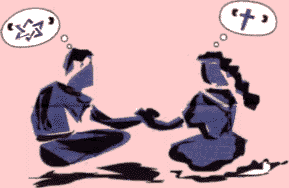 Are Jews causing their co-religionists to intermarry and abandon Judaism?
By Brian Mono

When the 1971 National Jewish Population Survey found that
men were far more likely than women to marry out, it spurred a
great deal of discussion about the gap. While a few critics of the
study say Jewish women who married out were simply not
called because they had non-Jewish last names, Rela Mintz
Geffen, a sociology professor at Gratz College, counters that
most analysts maintain that the statistics were more or less
accurate.
Many of the matchmakers and community organizers that work
with Jewish singles say the accusations and stereotypes have
died down in recent years, but so has the deep commitment to
marrying a Jew.

Brian Mono is a staff writer with the Philadelphia Jewish Exponent. Comment by clicking here.

