
|
|
|
Jewish World Review May 25, 2000 / 20 Iyar, 5760
David Twersky
http://www.jewishworldreview.com --
THERE’S A MOMENT in the otherwise forgettable 1999 Universal Studios remake
of its 1932 classic film The Mummy when Imhotep, the resurrected high priest
of Osiris, played by Arnold Vosloo, corners the professional thief Beni,
played by Kevin J. O’Connor.
Fearing for his life, Beni pulls out a crucifix and quickly mumbles a prayer,
to no avail. Increasingly frantic, he tries a number of other religious
symbols and traditions, but nothing works. Finally, Beni pulls out a star of
David and recites something in Hebrew.
That stops the Mummy in his tracks.
I was reminded of that line recently after I drove my father, Abraham, across
West Orange, New Jersey from Daughters of Israel geriatric center to the Solomon
Schechter lower school. My daughter Anna’s fifth-grade class had been
studying the life and work of Hayyim Nachman Bialik, the great poet of the
Hebrew renaissance. My father, now 96 years old, as a child had visited with
Bialik in Odessa. As if he were visiting a Jewish Santa Claus, my father sat
on Bialik’s lap and heard poetry and songs from the great man’s lips.
I told Anna, who told her Hebrew teacher, who sent a message back: Bring your
father to speak to the fifth grade.
My father was born in the Ukraine in 1904, when Bialik was 31 years old. The
poet was born in the village of Radi, near Zhitomir.
Following a stint at the famous Volozhin Yeshiva, Bialik moved to Odessa to
be near the literary and intellectual circles that formed around the
visionary cultural Zionist Ahad Ha-am (Asher Ginsberg). Shimon Shemuel Frug,
who wrote Jewish poems in Russian, was there, along with Moses Leib
Lilienblum and Yehoshua Hana Rawnitzki (who years later would form the Dvir
publishing house with Bialik and S. Levin). Within a few years, Mendele
Mokher Seforim, Simon Dubnow, Mordecai (Ben Ami) Rabinowicz, Hayyim
Tchernowitz, and Alter Druyanov all spent time in Odessa.
When his first volume of poems appeared in 1901, Joseph Klausner hailed
Bialik as “the poet of the national renaissance,” a virtual poet laureate of
Zionist renewal. That position was solidified when Bialik reacted to the
Kishinev pogrom with Al ha Shehitah (On the Slaughter) in 1903, followed by
the more famous Be-Ir ha-Haregah (In the City of Slaughter) in 1904.
Bialik lived in Odessa from 1900 to 1921, except for a one-year stay in
Warsaw in 1904, the year my father was born. In 1924 he moved to Israel,
where he lived until his death in 1934 in Vienna, where he had repaired for
medical treatment.
In 1927, fearing the rise of the radical right, and in any event the collapse
of the fragile Weimar democracy, my father and his family sailed to New York.
Twenty years later, Yochanan sailed again, for Israel, where he was an editor
at Dvir until his death in 1967.
All that was in the mists of time as my father sat at the front of a
classroom with a few score ten and 11-year-olds scattered in front of him and
his granddaughter at his side.
Among those fifth graders was Anna’s third cousin, Eden Lambert of
Livingston, whose grandmother had grown up with my father in the Ukraine,
first cousins separated during the Russian revolution. Just over 50 years
later, we received word that Shulamit Twersky and her husband, Akiva Grober,
had arrived in Israel. Two of their children were with them; the oldest,
Misha, was still in the Soviet Union, without the $1,000 he needed to pay the
"exit tax."
How we got the $1,000 is a story that involves another Jewish writer, Elie
Wiesel. Wiesel was my professor at City College, and when he heard my story,
he handed me a blank check from the account of a Holocaust survivor, Josef
Rosensaft, whose son Menny was Wiesel’s teaching assistant. Menny would later
make headlines as one of the group of activists, led by Rita Hauser, who met
Yasser Arafat in Stockholm in late 1988.
Misha got out (he lives in Brooklyn now), and Shulamit’s youngest child,
Sima, eventually moved to this country as well, landing in Livingston. Her
son, Eden, has shared a class with my Anna for the past six years.
What my father remembered hearing from Bialik was the Yiddish song Oyfn
Pripetshik (At the Fireplace), a Yiddish song about children learning Hebrew,
written by Mark M. Warshawsky.
Oyfn pripetshik brent a fayerl
A flame burns in the fireplace, the room warms up, as the teacher drills the
children in the alef-beyz. "Remember dear children, what you are learning
here. Repeat it again and again: komets alef is pronounced O. When you grow
older you will understand that this alphabet contains the tears and the
weeping of our people. When you grow weary and burdened with exile, you will
find comfort and strength within this Jewish alphabet."
This was the song my father sang to the children at the Jewish day school,
who learn the same alef-beyz, so that when they "grow weary and burdened with
exile, [they can] find comfort and strength within this Jewish alphabet."
In the language is our collective memory, the prayers of our ancestors and
their dreams and pain. Is it too much to hope that an American Jewish
renaissance would include the study of the alef-beyz? Until we know the
Hebrew language, we are like children beginning to learn by the rebbe’s
fireplace.
So what links the great poet Bialik with Imhotep’s "language of the slaves"?
Just this --- through Bialik, Hebrew went on its way to becoming not the
language of the ancient slaves, nor even the language of prayer, and not
merely a comfort from exile, but a living language of free women and
Mummies, Bialik, and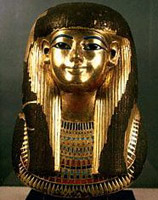
the language of slaves
 “Ah, the language of the slaves,” the Mummy says in what passes for ancient
Egyptian, translated into English as a subtitle at the bottom of the silver
screen. Imhotep spares Beni, making him his assistant. For the mummified
Imhotep, Beni’s broken Hebrew is a bridge to the ancient world he knew.
“Ah, the language of the slaves,” the Mummy says in what passes for ancient
Egyptian, translated into English as a subtitle at the bottom of the silver
screen. Imhotep spares Beni, making him his assistant. For the mummified
Imhotep, Beni’s broken Hebrew is a bridge to the ancient world he knew.
 In the early 1920s in Germany, my father, along with his mother and brother,
crossed paths with Bialik again. My father had fled to Germany during the
Russian civil war. My uncle Yochanan Twersky, a budding writer, formed a
close tie to Bialik, who had publishing interests in Frankfurt.
In the early 1920s in Germany, my father, along with his mother and brother,
crossed paths with Bialik again. My father had fled to Germany during the
Russian civil war. My uncle Yochanan Twersky, a budding writer, formed a
close tie to Bialik, who had publishing interests in Frankfurt.
Un in shtub iz heys
Un der rebe lernt kleyne kinderlekh
Dem alef-beyz.

JWR contributor David Twersky is managing editor of the New Jersey Jewish News. Comment on this article by clicking here.

