
|
|
|
Jewish World Review April 19, 2000/ 14 Nissan, 5760
http://www.jewishworldreview.com --
THE PASSOVER SEDER is a, well, a . . . Seder . “Seder ” in Hebrew means order. The unique
celebratory meal of Passover — the Seder — is an orderly sequence. It has two purposes: to re-live the Exodus, and to arouse the children’s curiosity. All of the prescriptions that
define the order of the Seder are designed to accomplish these two purposes. The adults need to
know; the children need to ask. The adults need to re-experience G-d’s mighty salvation; the
children need to be sufficiently thrown off guard to be drawn into the their own incipient
internalization of the original experience of — the Divine concern for — the Jewish people.
The Code of Jewish Law, commented on by Mishnah Berurah and Aruch ha-Shulchan, lays down many
details of the Seder .
Number one: Start on time
Not on Passover. This is because the Pascal lamb is compared to matzah. The Pascal lamb — the
idol god of Egypt that the Jews sacrificed to show that they accepted no idols — was offered
only when the ancient Holy Tabernacle and Temple stood. Then, the Pascal lamb, by Torah decree,
was eaten only at night. The Pascal lamb is not with us now, but that which is compared to it —
matzah — is. Therefore, matzah is eaten at night, not earlier; the Seder begins at night.
Number two: Keep certain things in mind. The Seder is mental work
“Blessed are You, G-d, King of the Universe, Who creates fruit of the vine” — this is the
blessing, but the intent is not only to drink a specific liquid. It is to fulfill a commandment
or mitzvah of drinking four cups of wine.
Therefore, at the recitation of the Kiddush or opening “sanctification” — when one drinks the
first cup of wine — one must have a double intention: to sanctify the festival day, drinking
the wine in association therewith; and to drink the first of four cups of wine in association
with the Passover Seder . One cup, two sanctities. One cup, two intents. The first intent is for
the festival sanctity in general, the second intent is for the sanctity of the Seder ’s four
cups in particular.
Seder 101: Three tips for a kosher Passover Seder
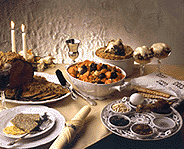
By Rabbi Hillel Goldberg
“A person’s table should be arranged while it is still daylight so that one may begin
immediately with nightfall.” The Seder is a unique opportunity. Do not dawdle, so that the
children end up going to sleep; do not squander the minutes: this is the message of the Code of
Jewish Law. At the same time, it is not permissible to begin early. This is normally allowed on a Sabbath
or other Jewish festival. Then, it is permissible “to add holiness to mundane time.” Sabbath
and festivals begin at sunset, but they may begin a bit early. Holiness can extend.
At the same time, it is not permissible to begin early. This is normally allowed on a Sabbath
or other Jewish festival. Then, it is permissible “to add holiness to mundane time.” Sabbath
and festivals begin at sunset, but they may begin a bit early. Holiness can extend.
The recitation of the Haggadah — the story of the Exodus — includes the recitation of many
blessings. Perhaps the most well known are the blessings over the four cups of red wine (or red
grape juice). Each blessing requires a double intent. 
Intent is not always associated with a blessing pre se.
Before the recitation of the Haggadah, one must have a specific intention in mind to fulfill the mitzvah of recounting the Exodus. The Seder is more than a storytelling or history session; it is the fulfillment of a mitzvah.
What, precisely, does the recitation include? Not, according to one authority, the famous “Mah Nishtanah” (why is this night different). This, of course, is the stage of the Haggadah at which virtually every Jewish child becomes the star of the evening.
In the middle of the Haggadah, there is a hole, so to speak. No adult fulfills any obligation by reciting the "Mah Nishtanah" (unless, alas, the adult is celebrating the Seder alone). The duty of the parent is to stimulate the child to ask questions about the formation of the Jewish people, in order to feel a part of it. The "Mah Nishtanah" is for the children. If an adult thinks that he fulfills part of his obligation to recite the Haggadah by reciting the "Mah Nishtanah," he might miss the whole point: his obligation is to give answers. An adult must know that the Haggadah is not merely a prepared script. While it must be recited in entirety, if the child is not instructed thereby, the adult must put the lessons into his own words — words that the children will understand.
Number three: bitter herbs or maror. What qualifies?
Some years ago, there was posted on the bulletin board of a synagogue I attend a reprint of
an article from a medical journal. It recounted the power and possible medicinal effects — and
damaging effects — of bitter herbs made straight from the root. Jewish law discourages this in
a few ways.
 First, there are five vegetables that qualify as maror. Third in line of preference is the
root. First is romaine lettuce.
First, there are five vegetables that qualify as maror. Third in line of preference is the
root. First is romaine lettuce.
Second, if one grounds the root by oneself, one should leave it uncovered so that its sharpness decreases. Some say it should be uncovered from the time it is ground, others from the beginning of the Seder. Either way, its sharpness is decreased, albeit in different degrees. Now, if a person with expert eyesight is not available to check romaine lettuce for the unkosher bugs frequently found in it, it is preferable to use the “root.”
All other things being equal, family custom should also be a determinant in the selection of
which of the five acceptable types of vegetables one uses for


