
|
|
|
http://www.jewishworldreview.com --
ON WEDNESDAY, FEBRUARY 9, just three days before he died, I met with
Charles Schulz to go over the manuscript of the fifth book of our
collaboration. It was a most memorable visit. Had I read his remarks
correctly, I would have known that he sensed the end was near.
When he got up to leave, he said,
“I’m going home to get some rest.” We
hugged and he said, “I’ve been honored to have you as a friend.”
Sparky (that’s what his friends called him) had suffered a minor stroke
several weeks earlier. He had a partial loss of vision, but what really
bothered him was that he could not find the words he wanted to say, and
this would make him cry.
“I know you were born Jewish,” he said, “and you were raised … (he was
looking for the word ‘Orthodox’) and Jeannie and I are … (he became teary
as he could not name his religion) something else. But why are we
different?”
“O.K.,” he said.
Then I said, “Sparky, where did you get the knowledge about addiction?
(Schulz’s demonstration about the nature of addiction via Linus’ addiction
to his blanket is nothing less than phenomenal).”
"Schulz told me that he never had any knowledge of anyone with addiction.
Then he said, “Abe, you keep on saying I’m wise. That’s just not true. I’m
not a philosopher or psychologist. I’m just a cartoonist.”
I told Sparky how Socrates had been told by the oracle that he was the
wisest of men, and he could not understand this because he knew he was not
wise. He then went around interviewing various people whom he had
considered wise, only to find that they were not wise. Socrates ultimately
concluded that he was not wise nor were they, but that because he knew that
he was not wise whereas they thought they were, this made him wiser than
them.
“That’s where you are, Sparky,” I said. “You’re wiser than many so called
wise people, and even wiser yet because you think you’re not wise.”
Sparky smiled, we hugged, and that’s when he told me he was going home to
rest. In retrospect, his expression when he said this should have made me
aware of what that comment really meant.
I told Sparky that although he might have some difficulty in finding the
words he wanted at the moment, his brain was still fully operative.
Although he was not going to write daily strips, I suggested that whenever
he had an idea for a cartoon, he should draw it. I had hoped that with the
chemotherapy he would still be with us for some time.
Schulz’s psychological creativity (in contrast to simple cartooning) came
in spurts. In the last few years he had some extraordinary insightful
strips. I felt he would still be able to be productive with his uncanny
intuition.
Our books have been translated into Japanese, Korean, Spanish, Italian,
Finnish, and Hebrew. Just last month they were picked up for a Chinese
translation.
No other cartoon has held such wide popularity for so long a time. I
believe this is because many people sensed, if only subconsciously, that
Charlie Brown, Snoopy, Linus, and Lucy were talking to them.
CHARLES SCHULZ, SLEEPWALKER
Jewish World Review March 3, 2000 / 26 Adar I, 5760
'Even wiser than most, because you didn't think you were wise': Remembering Charles Schultz
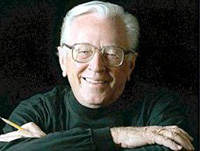
By Rabbi Abraham J. Twerski, M.D.
 I said, “Sparky, every human being is different. No two people have
identical fingerprints. Nations are different, ethnic groups are different.
Difference is not the problem. It is just that our differences should not
cause us to be separate.”
I said, “Sparky, every human being is different. No two people have
identical fingerprints. Nations are different, ethnic groups are different.
Difference is not the problem. It is just that our differences should not
cause us to be separate.”
Arthur Koestler applied the term
“sleepwalker” to several people who made
epochal discoveries, but had no concept of the magnitude of their
achievement. Among them Copernicus, a quiet unassuming canon who did not
realize that his proof that the earth revolved around the sun rather than
the reverse would revolutionize all science. Another was Kepler, who
formulated the gravitational theory that explained the heretofore
mysterious motions of the planets. These two people changed the world
forever, but had no inkling of it.

Reflect for a moment. Many popular characters have made a splash, then faded into virtual oblivion. For over fifty years, Snoopy and the Peanuts gang captured the hearts of millions of people across the globe. When Schulz recently announced his retirement, the headline “Good Grief! No more Peanuts!” expressed the sentiment of millions.
What is the magic charm of these cartoons that has captivated us? I suggest that it is because these delightful characters remind us of ourselves or of others we know. They show us a variety of human traits, some of which are our own, in a palatable vehicle.
Have some of us not felt at times, “Oh, what’s the use? There’s no point in trying. We’re going to fail anyway.” Yet something may spur us on to try again. We may be like Charlie Brown, who never won a baseball game in fifty years, nor as he ever, in fifty annual attempts, succeeded in kicking the football which Lucy holds for him and pulls away at the last moment. Charlie Brown says he is doomed to fail at everything, but does not give up trying. Some of us may identify with Charlie Brown’s resignation to failure. Yet some of us are able to persist in trying again.
We are rather familiar with the arrogance, grandiosity, and domineering attitude of Lucy. This is a trait which we can recognize more easily in others than in ourselves.
We may identify with Linus, who is browbeaten by his older sister. Linus is the prototype of an addict, unable to function without his security blanket (a Schulzian term). Seasoned addiction counselors cannot understand how someone who has not had direct contact with an addict can know so much about addictive behavior.
And the superstar. Snoopy expresses profound feelings of inferiority (“If I was a human being I wouldn’t even own a dog”), and escapes into the fantasy of being a fighter pilot who pursues the Red Baron. Alternately, Snoopy is a prominent lawyer of brain surgeon, or a leader of the Foreign Legion. But unlike his psychotic brother, Spike, who talks to the cactuses, Snoopy returns to the reality of being dependent on the round-headed kid for his supper. Which of us has not indulged the pleasure of a day-dream?
Some of Schulz’s psychological insights are uncanny. He describes the anxiety of magical thinking in the panic that strikes Linus when the rain stops after he has said “Rain, rain, go away.” Frightened by his power to control the world by his wishes, Linus pleads with his sister, “Hide me!”
 Don’t we know people who always blame others for their failures? Like
Peppermint Patty, who blames Charlie Brown for her failure to pass. “You
should have been a better influence on me.” Too lazy to study, Patty
explains her poor grades: “Teachers never give good grades to kids with big
noses.” No instructor of psychology could better in describing
projection and rationalization.
Don’t we know people who always blame others for their failures? Like
Peppermint Patty, who blames Charlie Brown for her failure to pass. “You
should have been a better influence on me.” Too lazy to study, Patty
explains her poor grades: “Teachers never give good grades to kids with big
noses.” No instructor of psychology could better in describing
projection and rationalization.
Schulz tackles some philosophical issues. Linus has laboriously built a sand castle, which is washed into the lake by a torrential rain. Looking at the ruins of his work, Linus says, “There must be a message in this, but I don’t know what it is.” Some heavy volumes on the problem of why bad things happen to good people ultimately come to this conclusion.
What does Schulz say about the psychological and philosophic content of his cartoons? “If I saw in my cartoons all that you see in them, I would be paralyzed. I wouldn’t be able to draw.” I responded, “O.K., Sparky. You draw and I’ll interpret.”
Many of Schulz’s cartoons are just amusing. However, there are enough to have comprised four books on self-improvement and spiritual themes, which we co-authored: When Do the Good Things Start ? , Waking Up Just in Time, I Didn’t Ask to Be in This Family, and That's Not a Fault...It's a Character Trait. A fifth book on relationships is in the making.
Schulz’s cartoons are being used in a very effective “cartoon therapy”, in which clients are given selected cartoons for interpretation. Whereas they may have resistance toward a therapist’s interpretation of their symptoms, they do not feel threatened by the lovable characters in the Peanuts strip. They are able to gain valuable insights into their own behavior.
Charles Schulz considered himself a cartoonist, nothing else. Perhaps he was indeed a “sleepwalker.
Charles Schulz’s biography is recorded in a book, Good Grief! The author postulates, quite correctly, that Schulz thought of himself as a loser. His life and work grew out of his feeling that losers can also be winners.
Schulz said to me, “Abe, I can’t understand it. I’ve had so many letters coming in. I had no idea that so many people cared.”
I said, “Good grief, Sparky. You’re Charlie Brown!”
He was. And a very pleasant Charlie Brown, at


